The robbery of the Crédit Agricole bank in Piazza Medaglie d’Oro, in the Arenella district of Naples (near Vomero), and the subsequent escape of the thieves through a hole leading to the sewer system raised numerous questions about the functioning of the branch’s security systems.
Four days after the attack, which occurred on the morning of 16 April with the seizure of 25 hostages and the breaking of around 40 safes, the head of Security at Crédit Agricole Italia, Luigi Altavilla, issued a series of clarifications: the note, also taken up by Corriere della Sera, it allowed us to shed light on which alarm systems are installed in the Naples headquarters, as well as on the physical protections of the vault and safety deposit boxes.
The protection systems of the vault of the bank robbed in Naples and the safety deposit boxes
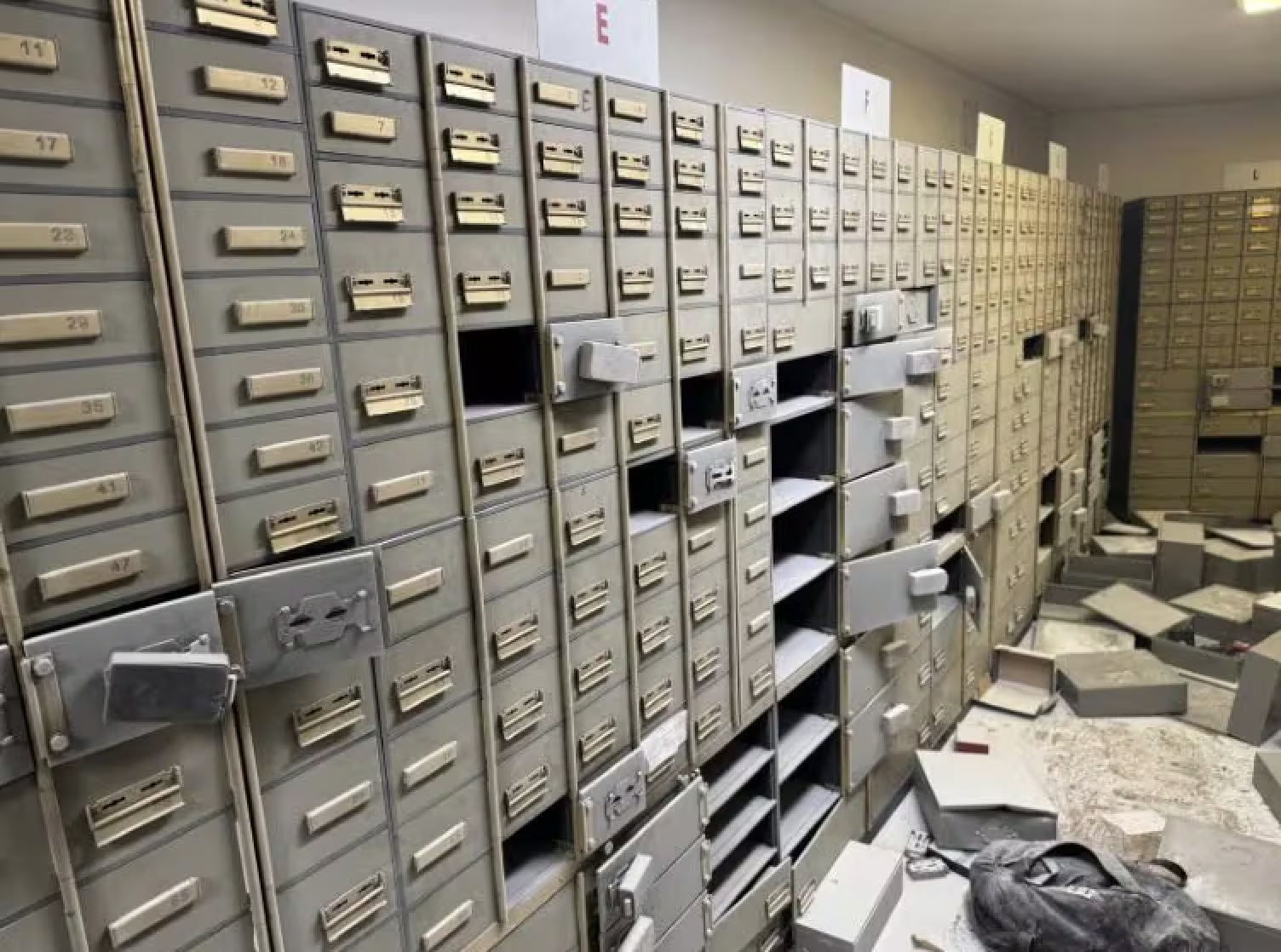
The safety of the boxes present inside the Neapolitan branch is not based on individual mechanical resistance, but on what Altavilla defined as “concentric levels of protection”. In practice, therefore, the bank had a series of physical and procedural barriers designed to make access to the stored assets more difficult, from the armored vault to avoid external attacks to the different procedures for accessing individual boxes.
More specifically, the first security ring is represented by the vault, which has “an armored perimeter, steel-reinforced concrete walls, certified armored door, anti-perforation, anti-cut systems and alarm systems in case there are attempted attacks of this type”. The armored door of the vault, among other things, is timed: the lock, therefore, is programmed to prevent any opening outside the bank’s operating hours.
The second level of protection concerns the individual boxes, with each compartment accessible exclusively through a double key mechanism: one in the possession of the customer and one in the possession of the bank. As Altavilla specified, this system serves to guarantee the certain identification of the owner at the time of access, but is not designed to offer mechanical resistance to a break-in.
In other words, if a criminal managed to get past the vault’s outer defenses, the boxes themselves would not pose a significant physical obstacle. In this case, Crédit Agricole stated that «protecting the boxes with additional armored cabinets inside the vault would be a redundant measure, which would not add security in cases like these since, even if there had been, the robbers would have forced the bank staff to open them at gunpoint».
The alarm systems of the Crédit Agricole branch
In addition to the protection systems for the vault and safes, the Naples branch affected by the robbery was also equipped with an electronic surveillance system based on several complementary technologies. The Altavilla security manager has in fact highlighted how the alarm system is not limited to traditional volumetric sensors (i.e. those that detect the presence of people in closed environments) but also includes seismic sensors and microphones.
Seismic sensors, for example, record anomalous vibrations transmitted through wall structures, immediately capturing the waves produced by attempts to perforate a wall or floor. The environmental microphones, on the other hand, intercept the noises produced by digging or cutting tools, activating the alarm the moment an attempt is made to violate the perimeter of the branch or vault.
According to the reconstruction provided by the bank, these devices actually worked on April 16: the alarm was in fact triggered automatically and instantly, with the police arriving on site approximately 10 minutes after the alarm was activated, allowing all the hostages to be secured and the number of boxes actually emptied to be limited.
The dynamics of the Arenella robbery
However, the fact that the alarms worked correctly did not prevent the robbers from carrying out the heist: the gang, made up of around 10 people according to investigators’ estimates, simply bypassed the external defenses of the vault without attempting to breach them. The robbery, however, was the result of long planning: for months the perpetrators of the attack dug a tunnel approximately 12 meters long through the sewer system beneath the bank, probably with the help of a generator found by the police, which would have been used to power the tools.
As reported in the 3D reconstruction by geologist Gianluca Minin, the tunnel, 12 meters long and between 70 and 90 centimeters wide, was completely devoid of supports or linings and was therefore particularly risky to travel through. The route is located approximately 4-4.5 meters deep: the tunnel emerged directly under the floor of the room that houses the safes, making the role of the armored door and armored walls completely irrelevant.
Precisely the fact that the thieves knew that the floor of the vault was not armored and that part of the safes were not deposited in safes also led the investigators to hypothesize the presence of a baseman, that is, a “mole” perhaps inside the branch of the credit institution who knew the latter closely.
According to the reconstruction of the dynamics provided by Altavilla, the action of the thieves on the surface and that underground took place in parallel: at 12.07 on 16 April, three masked men entered the main entrance of the bank armed with stage guns, kidnapping the 25 people present and locking them in a side office. A minute later, at 12:08, they gave the signal to the accomplices positioned in the tunnel, who went back into the vault and began to force the boxes. The opening of the hole on the lower floor triggered the alarm systems at 12.09pm, with the automatic call to the police, who arrived on site at 12.22pm to the astonishment of the robbers, according to what was reported by the testimonies of some hostages.
After about three hours, around 3:00 pm, the Fire Brigade freed all the hostages by breaking the armored glass window of the bank. At 4.45pm the Carabinieri of the GIS (Special Intervention Group) also intervened, arriving from Livorno by helicopter: at this point the police discovered a hole in the floor of the vault, approximately 50 centimeters wide, from which the robbers escaped by entering the sewer system after having stolen the contents of approximately 40 safes, the value of which is unknown to the bank.