Unlike other European countries, where production is concentrated in large and isolated industrial centres, the Italian system develops as a complex network of local entities, often small and medium sized, which work in synergy. It is precisely this “constellation” structure that represents one of the main strengths of Made in Italy, capable of combining artisan tradition, innovation and quality.
The numbers confirm this solidity: according to the analysis of the Research Department of Intesa Sanpaolo, in 2025 the furniture and design sector reached a turnover of 26.7 billion euros, placing Italy in first place in Europe ahead of Germany. An important result, especially at a time marked by challenges linked to energy costs, geopolitical balances and changes in trade routes.
Design and furniture between SMEs and artisanal know-how
The production sector of our country is represented by a widespread network of small and medium-sized enterprises that constitute the backbone of the national economic system. These companies, often family-run, are highly specialized and rooted in the territories and contribute significantly to the reputation of Made in Italy in the world.
Italian SMEs operate in integrated supply chains: each company carries out a specific and specialized function that is complementary to the others. This approach allows us to maintain high quality standards and, at the same time, enhance artisanal skills that have been handed down for generations. It is the combination of technical knowledge and design culture that makes Italian products recognizable and competitive at an international level.
Where design districts are located and how they work
The production districts represent the most concrete manifestation of this model. These are geographical areas, which extend across almost the entire peninsula, in which a group of companies specializing in the same sector is concentrated.
This creates real productive ecosystems. Most of these districts develop in Northern Italy, in particular between Lombardy and Veneto, but Central Italy also plays an important role, especially in the Tuscany-Umbria-Marche triptych.
In the design and furniture sector, Brianza is historically one of the most important hubs, while other areas such as Pesaro-Fossombrone and Poggibonsi-Sinalunga stand out for the production of furniture.
These districts are the driving force of the Salone del Mobile in Milan, a pilgrimage destination for all operators in the sector. Also thanks to the Fuorisalone events, today the Lombard capital is the capital of local design.
How the short Italian production chain works
The strength of the Italian production chain lies in these centers – and in others such as Prato for textiles, Biella for wool, Como for silk, Solomeo for cashmere, Murano for artistic glass and Carrara for marble.
Here the skills are organized in a sort of circular chain:
- planning is often developed within the district itself;
- the supply of raw materials takes place through local networks;
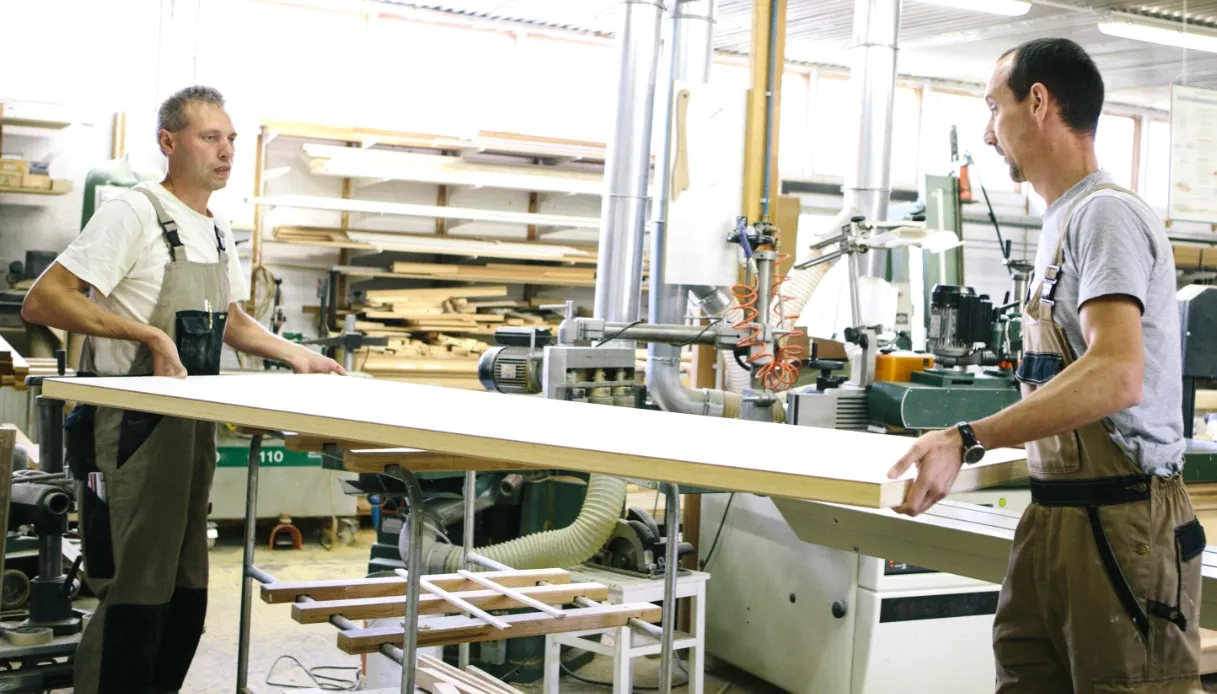
- the processing phases are entrusted to highly specialized artisan micro-enterprises, which deal with individual steps such as cutting or finishing;
- assembly and marketing are managed by leading companies or recognized brands, which bring the finished product to international markets.
This collaborative system allows not only to optimize time and resources, but also to maintain very high quality control throughout the entire production process.