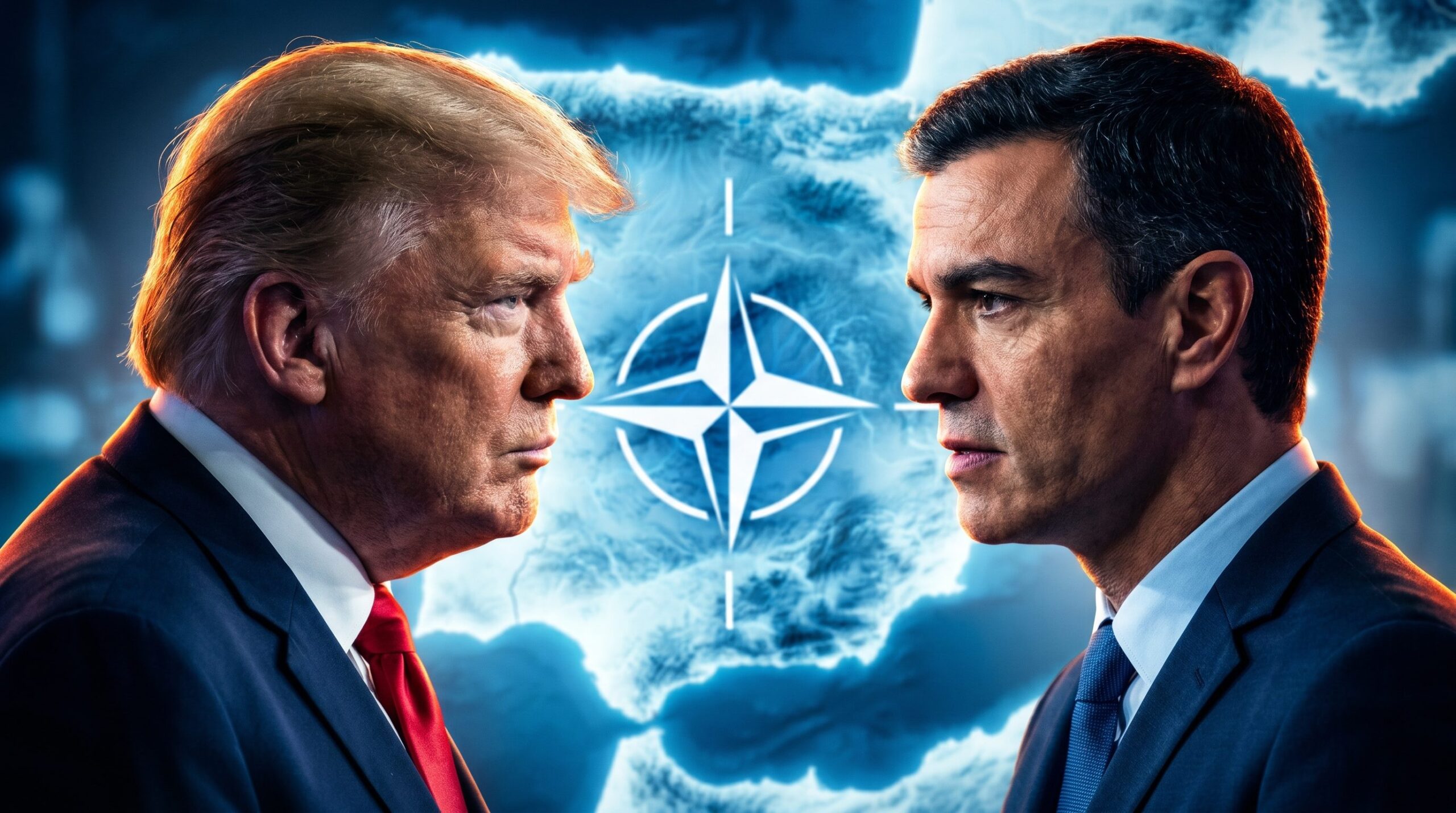
In the last few hours, the contents of an internal US Pentagon email have been leaked, outlining the options available to the United States to sanction NATO allies who did not support the war against Iran. The document, viewed exclusively by Reuterswould also include the hypothesis of Spain’s suspension from the Atlantic Alliance, after the government of Pedro Sánchez last March 30 had banned the use of the military bases of Rota and Morón for war operations against Iran, claiming that it did not want to be dragged into a unilateral conflict that does not respect the United Nations Charter.
President Donald Trump had already announced his intention to apply retaliation against Spain for its lack of support in the Middle East, an idea that had caused discussion due to the risk of creating a serious fracture within NATO: remember, among other things, that the Atlantic Alliance was created for purely defensive purposes – as provided for in Article 5 – and in no way contemplates the obligation for the Parties to intervene in a conflict caused by an ally and, above all, contrary to international law. Meanwhile, the Spanish Prime Minister responded by declaring that “the Spanish government’s position is clear: absolute cooperation with our allies, but always within the framework of international law.”
But is it really possible to suspend or expel a member country from NATO? The answer is very simple: no. The Atlantic Pact in no way contemplates the possibility of subjecting an ally to an infringement, suspension or even expulsion procedure. The only recognized possibility is that of voluntary withdrawal provided for in Article 13, which has never been used in history until now – except for the partial withdrawal of France from the military structure.
Furthermore, the topic had already been addressed due to the tensions between NATO and Turkey between 2019 and 2020: the episode, however, demonstrated that, even in the most serious crises, the Alliance has always preferred to contain tensions rather than break with an inconvenient ally.
Expulsion and suspension of a member state: the Atlantic Pact
Unlike the European Union, the founding treaty of NATO – the North Atlantic Treaty, signed in Washington on 4 April 1949 – does not provide for any infringement, suspension or expulsion procedures for member countries. This is a structural gap in the Atlantic Pact, most likely intentional, which effectively transforms the possibility of expulsion of an ally into a politically and legally impossible operation. Among other things, after 77 years of alliance, there are still no precedents for voluntary exit, other than France’s partial exit in the 1960s, however linked only to the military structure (and completely restored in 2009).
The only recognized option is that of the voluntary withdrawal of a State from the Atlantic Alliance, provided for in Article 13 of the Atlantic Pact. More specifically, this article recognizes the possibility of voluntary withdrawal of a State from NATO, establishing:
No Party, not even the United States, can decide independently to oust an ally from NATO: on the contrary, a country can decide independently to leave the Alliance one year after communicating it to the US government, which will inform the other states.
The only weapon in the hands of the USA, therefore, are possible bilateral retaliations against Spain, such as the reduction of military and economic cooperation, the withdrawal of assets or greater political pressure. To consider, however, there is the question of bases: Spain hosts 2 NATO military bases – that of Rota and that of Morón, used jointly by Spain and the United States – two strategic outposts for the Mediterranean especially for Washington, which can thus enjoy easy access to both the Middle East and Africa.
The precedent of Türkiye (never expelled from the Atlantic Alliance)
Although there is no precedent for the voluntary withdrawal or expulsion of a NATO member, this is not the first time that this issue has been discussed within the Alliance. The case of Türkiye, in fact, is the most significant historical precedent for understanding the practical limits of the NATO system.
Tensions with Ankara began in July 2019, when Turkey received the first batteries of the Russian S-400 missile system, breaking with one of the fundamental principles of the Alliance: the interoperability of defense systems. Washington had warned several times that the purchase of the S-400s was incompatible with Turkish participation in the F-35 program, the fifth generation US fighter-bombers, to the development of which Turkey itself had contributed.
The American response was therefore the formal exclusion of Ankara from the F-35 program and, in December 2020, the imposition of sanctions on the Turkish defense industry.
Added to these tensions were further frictions due to the Turkish military operations conducted against the Syrian Kurds (forces supported by the US) and the very harsh clash with Greece in the eastern Mediterranean during the summer of 2020 over energy exploration rights – an episode which had required direct NATO mediation.
Despite a direct crisis with the USA, geopolitical tensions with another NATO member and the purchase of Russian armaments deemed incompatible with collective security, Turkey has never been suspended or expelled from NATO: Ankara, among other things, has never contemplated the possibility of abandoning the Atlantic Alliance, which remains strategic for the country’s interests.