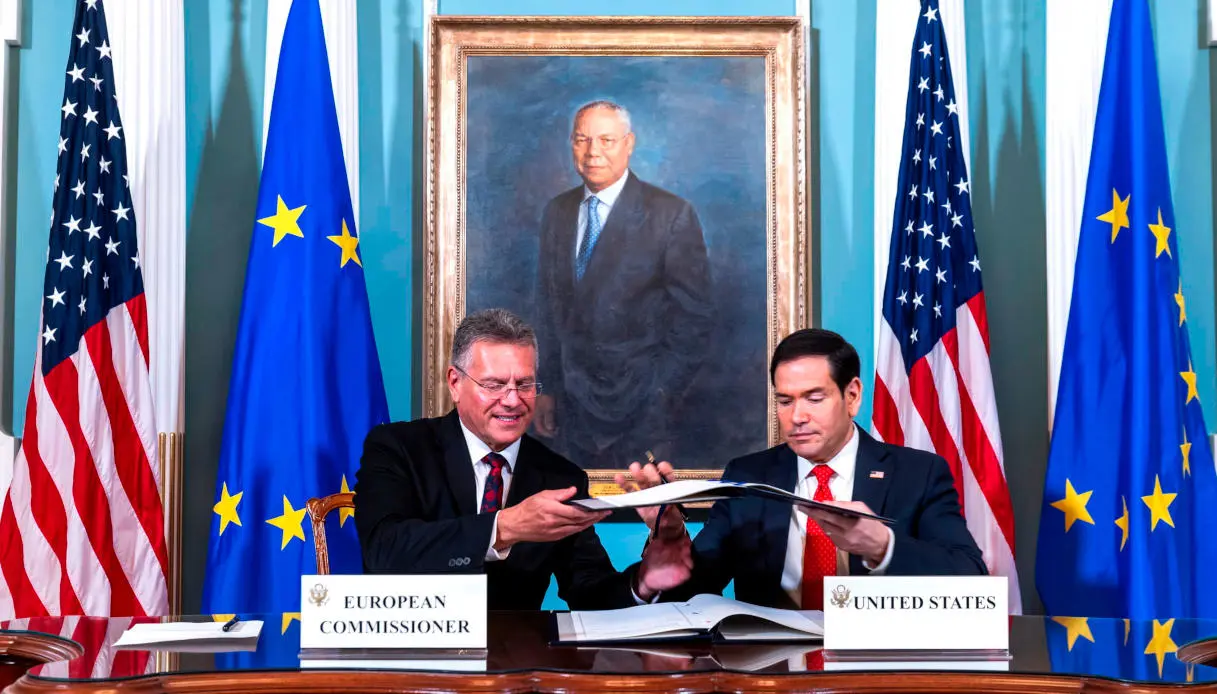
Despite the existing tensions, the US and the EU have found a meeting point on raw materials. In Washington, European Trade Commissioner Maros Šefčovič and Secretary of State Marco Rubio signed a memorandum of understanding that aims to coordinate the supply chains of critical minerals.
The objective is to make supplies safer and more sustainable, reducing the risks linked to the geographical concentration of resources and geopolitical tensions. In a nutshell: on critical minerals the US and EU intend to find common ground to resist the overwhelming competition from China.
Because critical minerals are fundamental today
When we talk about critical minerals we are referring to raw materials that are indispensable for key sectors: semiconductors, batteries for electric cars, advanced technologies and defense systems. Without these materials, the entire Western industrial architecture risks slowdowns or blockages.
In recent years, China’s growing influence in controlling these resources has raised concerns in both Brussels and Washington. Export restrictions introduced by Beijing have highlighted the vulnerability of global supply chains.
Rubio spoke explicitly of “unacceptable risk” linked to the concentration of resources in a few countries.
This is what Marco Rubio declared:
We need diversity in our supply chains. Diversity where it matters in the world.
Maros Šefčovič’s comment:
I believe that together we will be even more strategic. We will achieve our goals much faster than before. And, of course, together we will become stronger in this important area.
The content of the US-EU agreement
In addition to the generic political declaration on collaboration, the memorandum provides for an agreement on several fronts:
- mineral exploration and extraction;
- processing and recycling;
- definition of common standards;
- shared commercial tools;
- investment incentives;
- coordination on stocks and supplies.
An action plan was also presented which also includes possible initiatives with other international partners, opening up to a plurilateral dimension.
The central point of the agreement is diversification: the United States and the European Union want to reduce dependence on a few suppliers and build a broader and more distributed network.
This will push for greater coordination on subsidies and industrial policies, long-term purchasing agreements, development of recycling technologies and creation of strategic reserves. Šefčovič underlined that “the vision is there, now the challenge is to transform it into concrete projects”.
This opening towards Europe by the United States is seen as a signal of convergence on dossiers considered sensitive for security and economics. At the same time, the move is part of a broader Western strategy to balance China’s weight in global value chains.
Steel and trade are also on the table
During the meetings in Washington, other issues were also discussed, such as US tariffs on steel and aluminium. The EU seeks alignment with the United States vis-à-vis third countries, in particular to combat global overcapacity and low-cost exports.
We are also working on common mechanisms to protect Western industries, while technical negotiations continue.