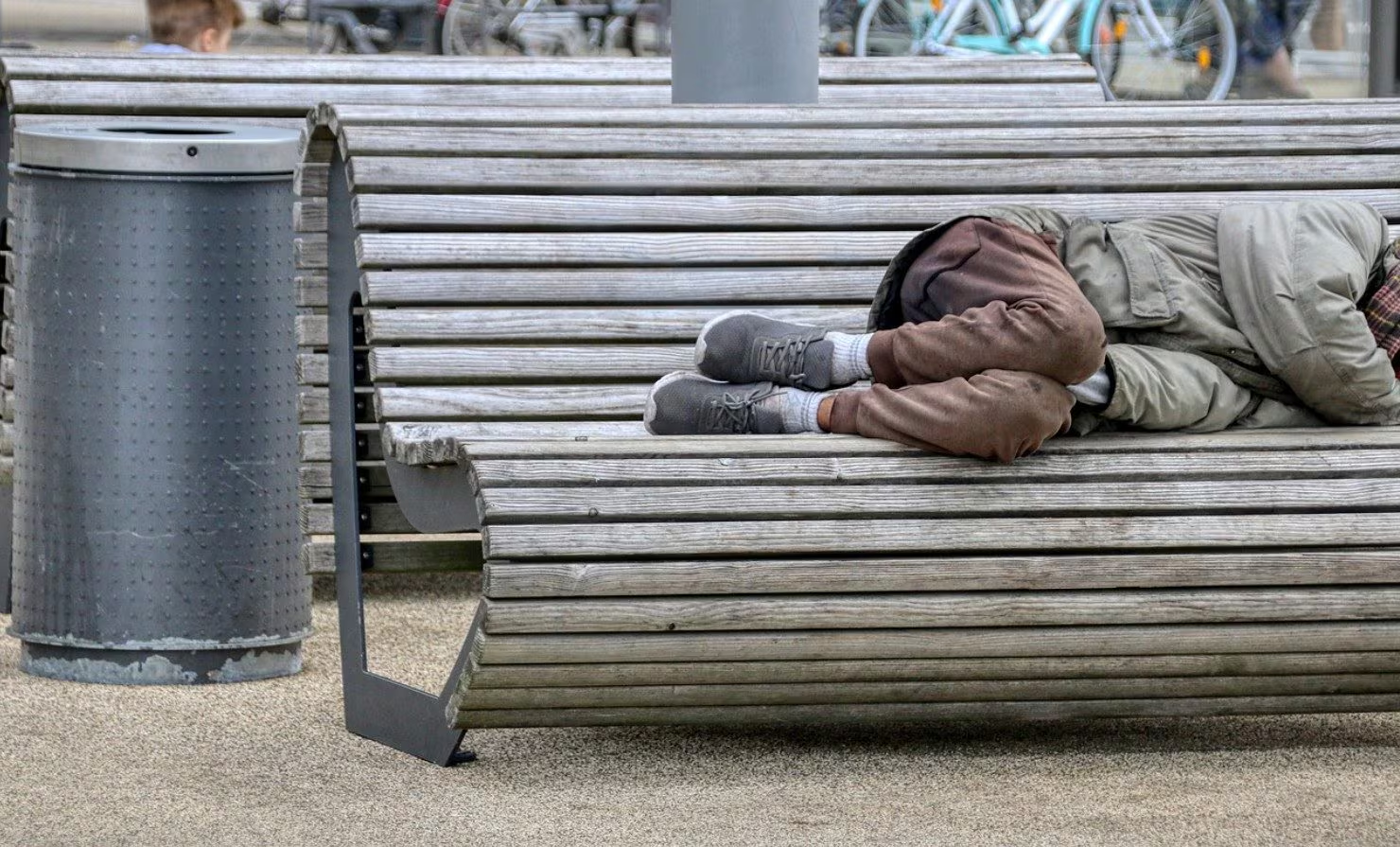
On the night of January 26, 2026, over 6000 volunteers and Istat surveyors walked the streets of the fourteen Italian metropolitan cities to count, one by one, those who had nowhere to sleep. The result is the first national census of homeless people conducted with a uniform method: 10,037 individuals over 18 years of age, including those who slept on the street and those who were hosted in a night shelter. It was promoted by Istat, in collaboration with fio.PSD-ETS, the Italian Federation of organizations for homeless people, with the logistical support of the municipal administrations.
How Point in Time counting works and why it matters
The method used is called Point in Time: a photograph taken on the same night in all cities, based on direct observation. The detectors covered the entire municipal territory divided into predefined areas, counting the people present in open spaces, porticoes, underpasses, stations, tents and cars. At the same time, the number of guests present was recorded in the night reception facilities. This is not a complete census of extreme poverty in Italy – those who live in organized settlements, in occupied buildings or in private homes are excluded – but it is the most systematic and territorially broad data ever produced in our country. Before this, information was fragmented, not comparable between cities and largely relied on the registers of third sector organisations.
Of the 10,037 individuals counted, just over half were hosted in night shelters, while the remainder were on the streets. Rome has the highest absolute value, followed by Milan, Turin and Naples.
The distribution is not uniform even in the proportion between those sleeping on the streets and those in structures: in Genoa the homeless on the streets reach 65.9% of the local total, in Florence 59%, while in Bari and Messina the share drops to around 20%. This gap reflects both the availability of beds and the climatic and urban characteristics of each city.
Young and homeless: who are the thousand under 30s on Italian streets
Among the most significant data in the report is the presence of young people: one in six of those who sleep in a public dormitory or in a first-level facility is under thirty years of age.
Cities in the South and on the islands have the highest concentrations of homeless young people in shelters. In Catania 39.3% of guests are between 18 and 30 years old, in Bari 31.2%, in Messina 25%. Milan and Turin are also above the national average. At the other extreme, in Genoa young people represent only 1.8% of guests, with a distribution that indicates that in that city youth homelessness manifests itself mainly outside institutional circuits. The picture on the street is equally relevant. Among the homeless counted outdoors for which it was possible to detect the age, young people under 30 represent 16.2% of the identified cases, with peaks in Cagliari and Messina.
These data suggest that the young age group is often the least reached by services: those under thirty tend to remain invisible for longer, to resort to informal solutions or to avoid structures. Homelessness at a young age is almost never the result of a long path of exclusion: it is often a rapid slide, linked to the loss of a job, the end of a relationship, or leaving a fragile family context. Arriving early means having greater margins for recovery, but also risking normalizing that condition.
Reception facilities and the third sector: who covers the void of the State
On the night of the count, 217 night reception facilities were operational, for a total of 6,678 beds, a number that covers just 66.5% of the total. Many of these facilities are small: only nine facilities exceed 100 places.
In some cities the gap is particularly evident. In Genoa the ratio between capacity and homeless people drops to 36.7%, in Venice to 46.5%, in Florence to 50.7%. The exceptions are Messina, where the declared capacity exceeds the number of people counted, and Bari, where the ratio is almost 96%.
Night reception services are provided both by third sector organizations and by Municipalities, and include dormitories, more structured reception facilities, micro-reception facilities spread across small apartments and, in some cases, mobile housing modules supported by operators. Next to the bed for the night, the organizations manage canteens, social secretariat offices, support for registered residence, job orientation, cultural mediation. The best practices implemented by the third sector in favor of homeless people are found in contexts in which there is a public system for planning interventions which, far from delegating public tasks, involves and enhances intermediate bodies as authentic partners. The problem is that this condition – a State that plans and a third sector that implements in an integrated way – is still the exception, not the norm. In most cases, the third sector is the substitute for a public system that does not exist or does not exist.
The Istat count itself was made possible thanks to fio.PSD-ETS, which recruited and coordinated the network of surveyors in the field. Without that associative structure, built over decades of territorial work, the operational capacity to photograph fourteen metropolitan cities in a single night would not have existed.
Foreign nationality and homelessness: the numbers of a profound divide
The nationality dimension is one of the most relevant elements of the report. In the night reception facilities there are 3,838 people of foreign nationality, equal to 69% of the total. Among those counted on the street, the share rises to 70.6% of cases for which it was possible to detect this information. This is a much higher proportion than that which the foreign component occupies in the general population of the cities considered, and reflects a structural overexposure to the risk of housing exclusion.
A homeless foreign person often faces a double obstacle: the material one of the lack of a roof and the bureaucratic one of access to services that require a residence, a regular residence permit, documents that those living on the street rarely manage to maintain. The fact that in many structures the only access condition required is actual homelessness – not documents, not nationality – is one of the elements that makes that informal and third sector reception network so decisive. And so difficult to replace with something more stable.