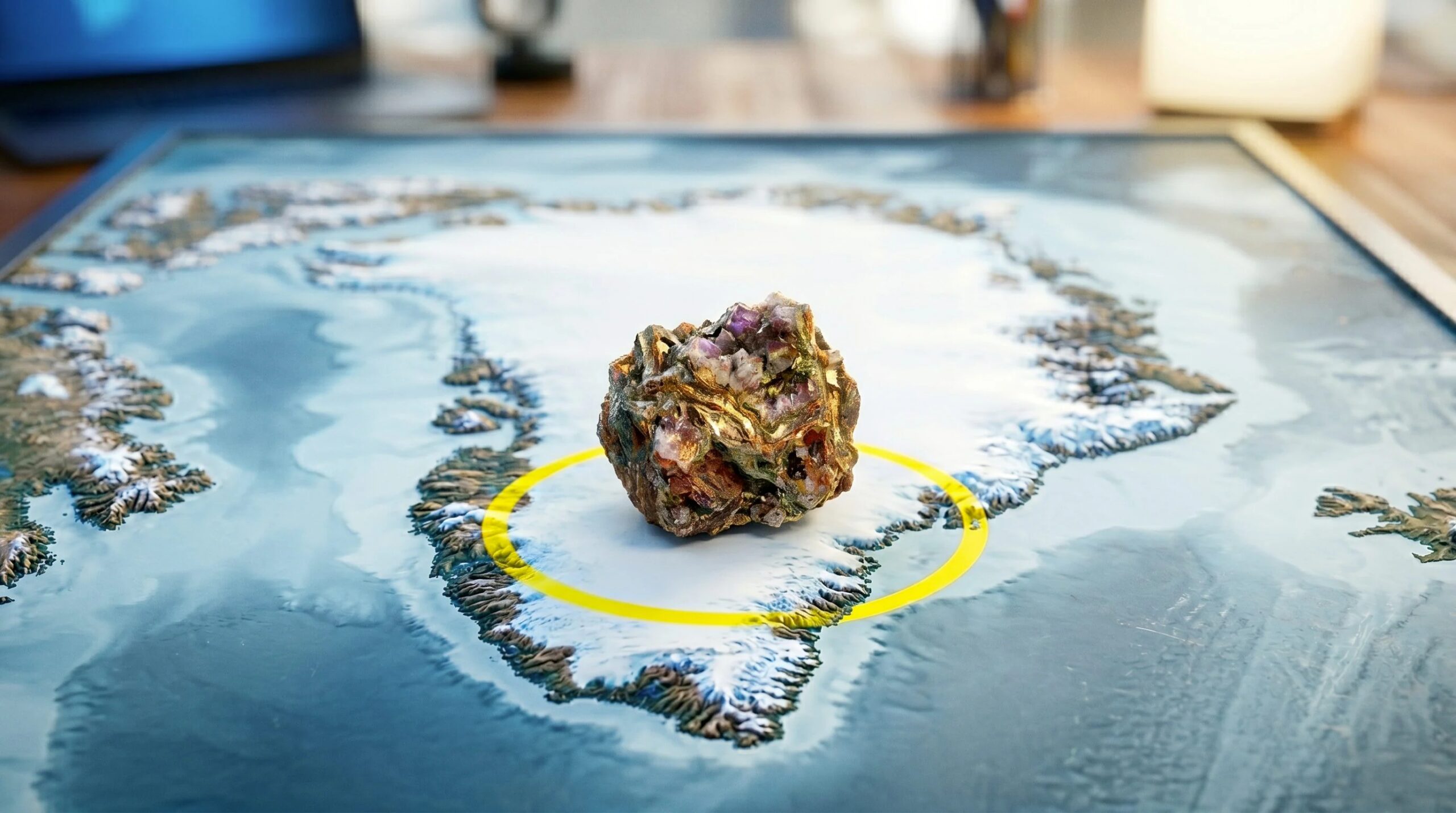
Donald Trump’s USA gets its hands on the rare earths of Greenland: the American mining company Critical Metals Corp, listed on Wall Street, has just obtained formal approval from the Government of Greenland for the acquisition of 70% of 60° North ApS (which provides logistics services to support mining operations), effectively taking control over the exploitation of the Tanbreez deposit, in the south of the island, considered one of the largest deposits of heavy rare earths in the world outside of China.
But what makes this deposit so strategic? It is not just a question of the quantity of resources, estimated at 4.7 billion tonnes, but above all of the type: Tanbreez, in fact, is a deposit rich in heavy rare earths (about 27% of the total), essential for the development of advanced technologies used in renewable energy infrastructures and in the defense industry.
In short, the objective remains to reduce American (and global) dependence on rare earths extracted from China, which currently still has a global monopoly, controlling approximately 85% of the total supply. The US expansionist aims on Greenland are therefore bearing fruit: although political control remains in the hands of the island’s government and Denmark, the US is gradually taking possession of the strategic resources of the Arctic, even without the use of military force (a hypothesis launched by President Donald Trump only a few months ago).
Why the Tanbreez deposit in Greenland is important: the presence of heavy rare earths
The Tanbreez field, which extends for 18km2is located in southern Greenland and is located near the town of Qaqortoq, about 35 km from Narsarsuaq international airport. The deposit is housed within the Ilímaussaq complex, which dates back approximately 1.16 billion years, and is made up primarily of a magmatic rock called kakortokite, a layered igneous rock rich in rare earths.
More specifically, an independent technical report, published in March 2025 by the consultancy firm Agricultural Mining Consultants, estimates that the Tanbreez deposit hosts approximately 4.7 billion tonnes of rare earth material.
But the fact that makes this deposit so strategic on a global level is another: approximately 27% of the rare earths contained in the deposit fall into the category of heavy rare earth elements (HREE). This is an exceptionally high concentration: to give you an idea, the American Mountain Pass deposit in California has a percentage of heavy rare earths of 0.49%. Bayan Obo, China’s largest field, reaches 1.13%. Tanbreez is at 27%.
And the point is that heavy rare earths (such as dysprosium, terbium and yttrium) are indispensable for high-tech applications and are in fact used, for example, in electric motors, wind turbines and even for some of the most advanced military systems. Furthermore, these heavy rare earths are also the most difficult to obtain outside of China, which makes this deposit a fundamental asset for the USA in its competition with Beijing.
A further advantage also concerns the very low uranium and thorium content: tests on the samples detected uranium levels between 10 and 20 ppm (parts per million) and thorium levels lower than 100 ppm. This is a determining factor because above all it reduces environmental risks: many other rare earth deposits, such as that of Kvanefjeld (also in Greenland), in fact have high levels of radioactive materials which particularly complicate the exploitation and approval of projects. Tanbreez, on the other hand, has already obtained a mining license valid until 2050, making it one of only 2 sites in Greenland to have received this approval out of over 140 active mining licenses on the island.
It is also expected that the field will have access to important transportation routes, as the area offers year-round direct maritime access through deep fjords leading directly to the North Atlantic Ocean.
The preliminary economic assessment released in March 2025 estimated the project’s value at approximately $3 billion. Commercial production, however, has not yet begun: Critical Metals expects an initial start-up of approximately 85,000 tonnes of rare earth oxides per year, with the ability to scale up to 425,000 tonnes after a modular expansion. The start of full operation is expected between 2027 and 2028.
Trump’s US scramble for Arctic resources
The acquisition of the Tanbreez deposit by Critical Metals is certainly not accidental: the project is part of the broader American strategy which aims to diversify the supply chains of rare earths, currently dominated overwhelmingly by China, which controls around 85% of global processing capacity and on which the United States depends for around 80% of imports. The same independent technical report specifies it clearly:
Moreover, Donald Trump’s expansionist aims on Greenland were not accidental either: in recent months, in fact, the US President had repeatedly declared his intention to acquire Greenland, including through the use of military force.
On an operational level, in early 2026 Critical Metals approved the construction of a storage facility, designed to withstand arctic climate conditions, which is expected to become operational by mid-year. Meanwhile, the company has also acquired a property in the area, intended to become an operational base, as well as a mobile geochemical analysis laboratory worth about one million dollars, with the aim of obtaining real-time data directly on the site.
The supply chain appears to be as follows: extraction of rare earths in Greenland, processing in the United States, final destination for the defense and advanced technology sectors. The game, however, is still long, given that the deposit has never been exploited on a commercial level, Greenland does not have developed mining infrastructures and the Arctic climate complicates every operational phase.
Yet, with near-total control now in the hands of a publicly traded American company, the Tanbreez field has already become the most concrete symbol of the American challenge to China’s monopoly on rare earths.