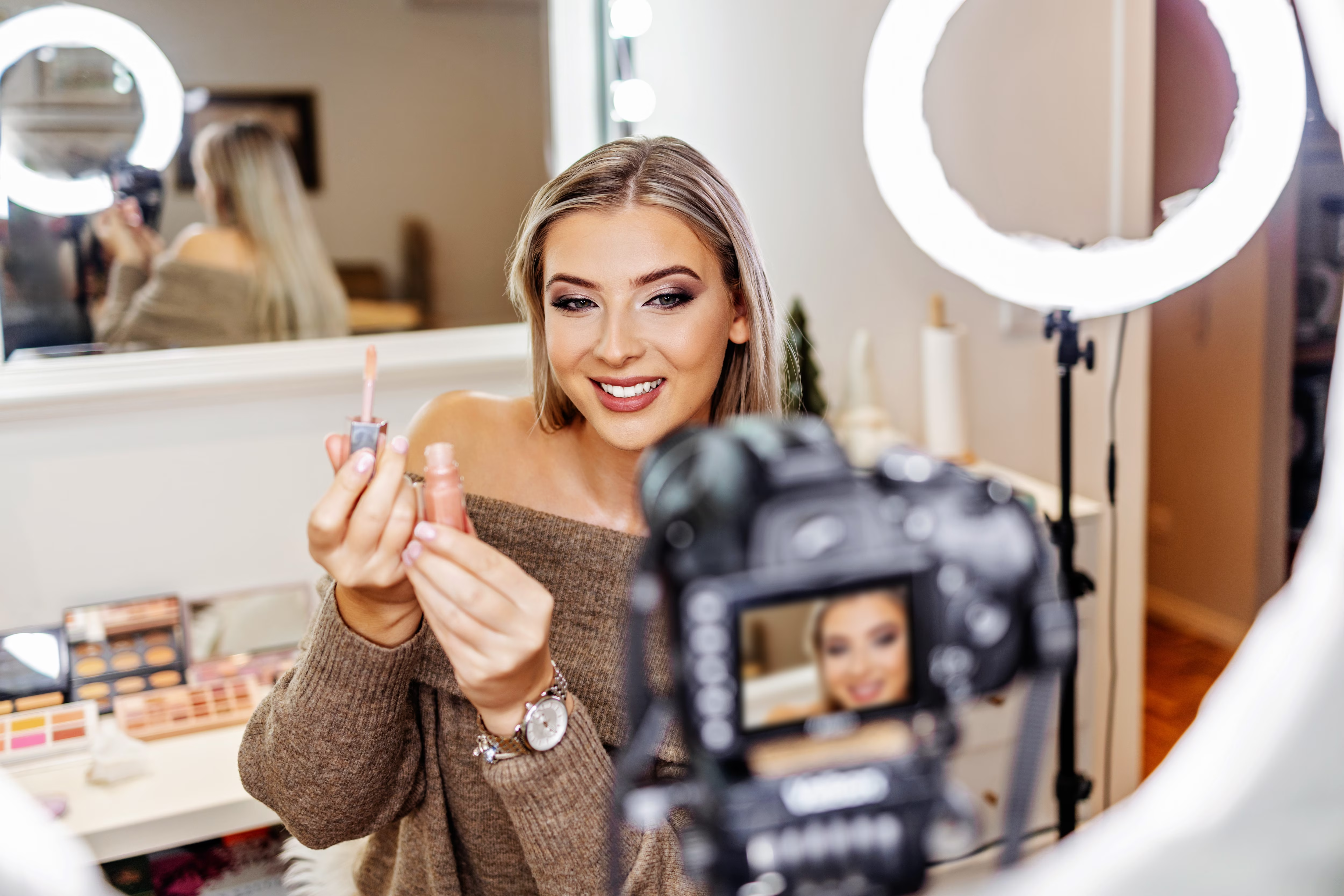
Scrolling through any social network, everyone has certainly come across an influencer generated by artificial intelligence. These digital personalities have millions of followers, collaborate with luxury brands and publish content every day. More and more companies are adopting them as a marketing tool, attracted by the possibility of having a testimonial who is always available, always controllable and immune to any scandal.
But do they really work? According to a study published by Da-Yeh University in Taiwan in April 2026, yes. By analyzing the results of 76 studies on over 64,000 people, the researchers highlighted that AI influencers are able to influence followers’ purchases as much as human influencers if they manage to generate empathy and appear realistic. The multiplication of AI influencers, however, could have very serious consequences on the well-being of social media users and could erode the trust we place in online content.
So let’s see what AI influencers are, what mechanisms they use to influence their followers and what the consequences of their presence on social media are.
What are AI influencers and the Italian case?
AI influencers are digital personalities created through artificial intelligence, designed to operate on social media exactly as a real influencer would: promote products, collaborate with brands, report news and build a public identity.
The best-known case is probably Lil Miquela, who appeared on Instagram in 2016 and became a digital fashion and music influencer in just a few years, with millions of followers and collaborations with brands such as Calvin Klein and Prada. But it is not an isolated case: in Italy we have Francesca Giubelli, the first Italian AI influencer to have obtained the “blue check” from Meta. We also have characters like @cittadino_zero and @margherita.civica, two blonde and young avatars who carry out propaganda respectively for the majority and opposition parties of the current government. The phenomenon is so widespread that OpenArt and ElevenLabs, two companies operating in the AI world, have established the “AI personality of the Year” award, to reward the most influential “personalities”.
In 2024, the AI influencer market was estimated to be around $6.33 billion and is rapidly expanding. Compared to traditional influencers, in fact, those created with AI can work 24 hours a day, never get sick, do not age and are not exposed to scandals. They can promote any product anywhere in the world without the need for travel, complicated contracts or management of reputational crises. But can they really influence the purchases of those who follow them?
How they influence followers
To understand if and how AI influencers manage to influence their followers to induce them to buy, researchers Nguyen and Wu from Da-Yeh University analyzed and compared the results of 76 different studies. From the study, published in April 2026, it emerged that what matters is the “perceived humanity” of the influencer, that is, if the physical appearance is realistic, if the movements are fluid and natural and above all if the expressions are “human” and genuine. This, however, alone is not enough. The AI influencer must also appear real and vulnerable, transmitting “authentic” thoughts, emotions and confidences, so as to generate empathy towards the character and the desire to follow him, comment and share his posts. In other words: it must generate engagement.
Last, but not least, the AI influencer must seem credible. To do this, according to the authors of the study, it must be physically attractive, appear competent and resemble the user. The last point may seem strange, but it is a well-documented mechanism called the “similar-to-me effect” or “affinity bias”: we tend to trust more people who we perceive as similar to us, who share our values, our lifestyle or even just our way of speaking.
If the AI influencer has all these characteristics, it manages to generate “purchase intention”, that is, it is very likely that the follower will purchase the product it promotes. Indeed, it has been seen that digital influencers could generate greater purchase intent than human influencers if they are perceived as sufficiently “unique”, that is, if they are sufficiently beautiful, original or manage to reproduce a sufficiently interesting fake lifestyle.
What consequences do scientific experiments have on social media users?
As we have seen, digital influencers can also push followers to buy the products they promote, generate engagement and improve the perception of the companies they collaborate with, as long as they are done well and seem real and authentic. The increasingly massive use of this type of influencer, however, can generate consequences on the well-being of those who use social media.
The first concerns the way we perceive our physical appearance. It is now known that images of too perfect bodies on social media are associated with an increase in body dysmorphia, i.e. excessive concern for non-existent or minimal physical defects, perceived as serious deformities, and with symptoms of eating disorders, especially among adolescents. AI influencers could contribute to this problem. A 2023 experiment conducted by Chongqing Technology and Business University (China) on 178 women between 18 and 35 years old showed that even a single exposure to extremely curated images of real and virtual influencers causes an increase in anxiety related to one’s physical appearance compared to those who have not been exposed to that content.
The second consequence is difficult to measure now, but will have profound consequences in the future. As AI influencers become more realistic and more widespread, it becomes increasingly difficult to distinguish what is real from what is not. This, over time, will lead to a gradual erosion of trust in what is found online: as we get used to the idea that anything can be fake, we will stop trusting even what is real.