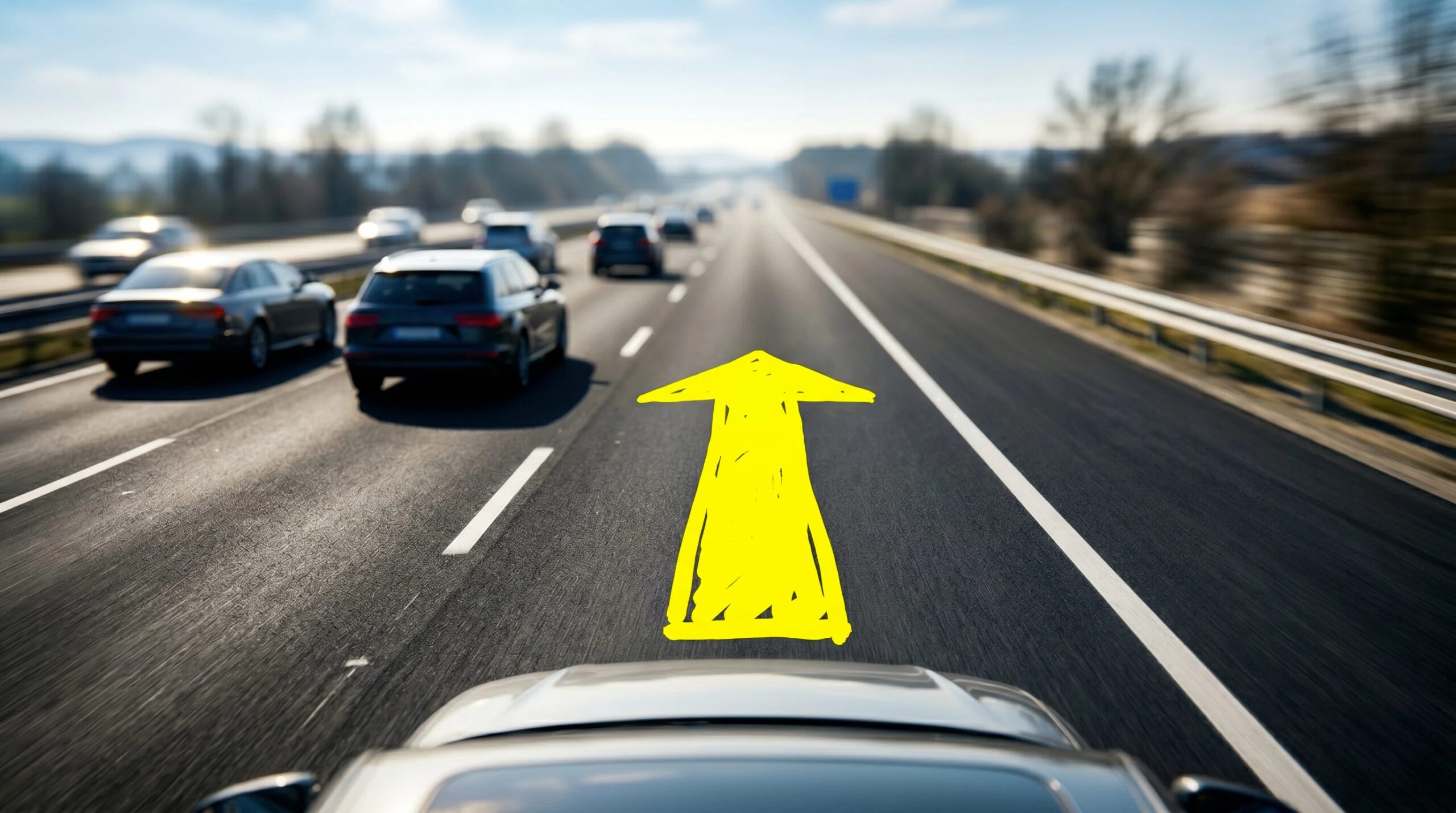
Those who often travel along Italian motorways know this: the right lane is often half-empty, the central one is permanently occupied by cars proceeding at moderate speed and the left one is transformed into a sort of permanent fast lane. The result is traffic that is compressed into two lanes (or worse, just one) with risky overtaking, continuous flashing lights and dangerous braking.
Yet, the rules on how to use motorway lanes are clearly written in the Highway Code, and have been in force for decades. Nonetheless, many drivers today still confuse the concepts of overtaking and passing on the right and ignore the correct use of motorway lanes, risking heavy fines and endangering their own lives and those of others.
Incorrect use of the motorway, in fact, is among the main causes of accidents and the numbers confirm this: in 2024, according to the latest ISTAT report, accidents on Italian motorways increased by 6.9%, with 7.1% more victims.
How to use the motorway lanes correctly according to the CdS
The basic rule is contained in article 143, paragraph 5, of the Highway Code:
Unless otherwise indicated, when a roadway has two or more lanes in each direction, you must take the freest lane on the right; the left lane or lanes are reserved for overtaking.
This means that, on three-lane motorways:
- The right lane is the travel lane, i.e. the one in which you should travel most of the time.
- The central lane, therefore, is not considered a “cruising lane”, but is used to overtake slower vehicles on the right.
- The left lane is reserved exclusively for overtaking and is intended as a temporary space, not as a high-speed lane.
Once overtaking is completed, the driver has the obligation to return to the rightmost available lane.
The rule, therefore, also applies to motorways with more than 3 lanes: you always travel in the free lane furthest to the right, and all the lanes to the left of the latter are reserved for overtaking (with the exception of heavy vehicles for the transport of goods with a full load mass exceeding 5 tonnes and for vehicles or vehicle complexes longer than 7 metres, which can exclusively use the first and second lanes on the right).
Article 143 itself, in paragraph 1, establishes an even more general principle:
Vehicles must circulate on the right side of the roadway and close to its right edge, even when the road is free.
In other words, even when the highway is deserted, the rule remains the same: stay on the right. It must be said, however, that in heavy traffic conditions the majority of motorists tend not to return to the right lane so as not to have to be constantly stuck behind a slower vehicle: this, however, is not the correct behavior required by the Highway Code.
A separate discussion concerns the emergency lane, governed by article 176: in this case it is forbidden to drive there, except to stop in the event of a breakdown or illness or to continue driving. The only exception allowed concerns traffic jams: in that case it is allowed to pass through them, but exclusively to exit the motorway and only starting from the warning sign located 500 meters from the junction. Using it to skip the queue or as a shortcut is a violation.
Among other things, the correct use of motorway lanes is not a recommendation, but an obligation: anyone who does not respect it risks a fine ranging from 42 to 173 euros.
Overtaking or passing on the right?
But the point on which there is perhaps the most confusion concerns the distinction between overtaking and overtaking: while in common language the two terms are used as synonyms, in the Highway Code they describe two very distinct maneuvers, with opposite legal consequences.
More specifically, as reported in article 148 of the Highway Code, overtaking on the right is a prohibited maneuver both on the motorway and on urban and extra-urban roads (with some exceptions) and consists of moving to the right lane, overtaking a slower vehicle and then returning to the left. Clearly, this is a dangerous maneuver because the overtaken driver, who expects to be overtaken from the left side, may not notice the vehicle coming from the opposite side.
Overtaking on the right, however, occurs when on the motorway a vehicle continues traveling in the right lane and, without changing lanes, finds itself passing next to a slower vehicle, which unduly occupies the central or left lane. In this case there is no lane change and no active maneuver: the driver is simply continuing in his own lane, overtaking a vehicle that is proceeding at too low a speed.
This principle was also clarified by the Traffic Police, in a video published on social channels: the maneuver of those driving in the right lane, despite the presence of vehicles in the left lanes, does not represent overtaking on the right, but constitutes a simple overtaking and cannot be sanctioned. Among other things, the driver who would risk being sanctioned, in this case, is the one who occupies the left lane without any reason, in violation of article 143.
This means that, if I were to be in the rightmost lane and passed the one in the middle (always respecting the speed limits and without changing lanes), I would not be breaking the law.
In summary:
- Overtaking on the right (while changing lanes) is prohibited and punished with a fine ranging from 83 to 332 euros.
- Overtaking on the right (without changing lanes), however, is not considered an infringement: on the contrary, the driver who can be penalized is the one who unduly occupies a left lane by not returning to the lane, which is always the freest one on the right.
Data on motorway accidents in Italy
Unfortunately, the incorrect use of motorway lanes causes thousands of accidents every year, even serious ones: according to the latest ISTAT Report on road accidents, in 2024 (the latest year available) 9,443 accidents, 256 deaths and 15,479 injuries were recorded on Italian motorways. The situation, among other things, has worsened compared to the previous year, with a 6.9% increase in accidents, 7% in injuries and, above all, 7.1% in victims.
It must be said, however, that among the most frequent causes are distracted or indecisive driving (15.7% of causes), failure to respect the right of way (13.5%) and too high speed (8.6%). Meanwhile, travel on the motorway network exceeded 83 billion vehicles per kilometer in 2024, up 2.2% compared to 2023. More cars on the motorway therefore mean more interactions, more overtaking, more potential conflicts between lanes.