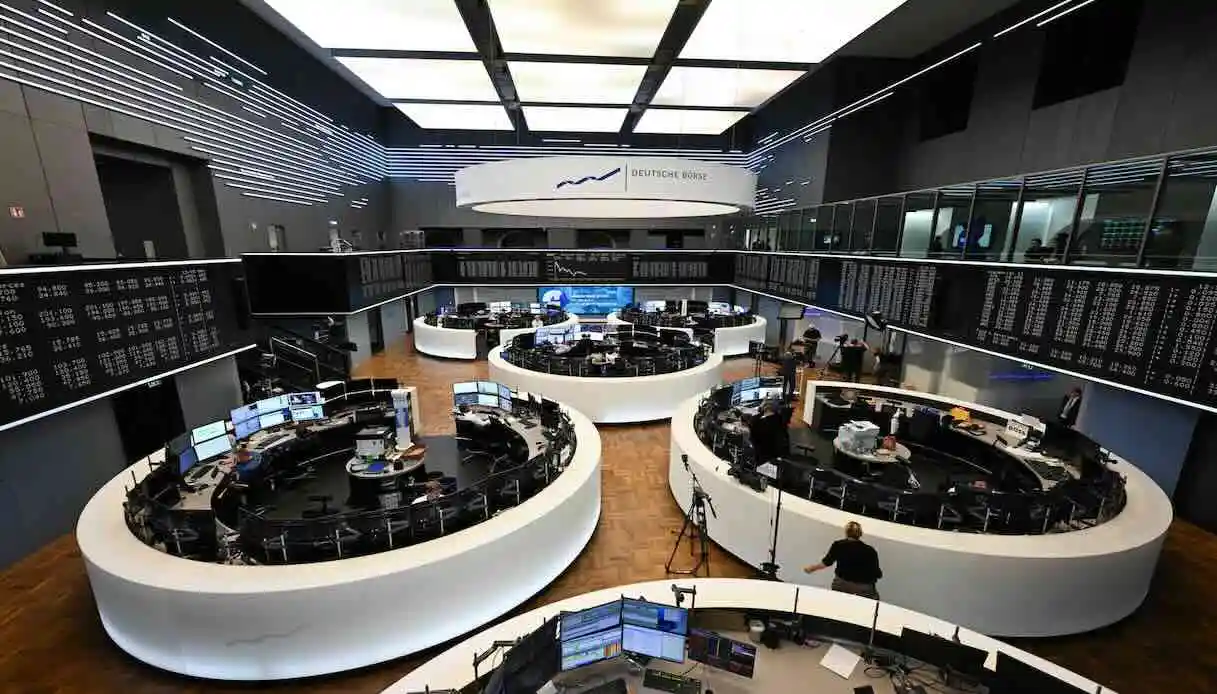
This week too, the news arriving from the Middle East was above all driving the European stock markets, in an economic climate that is anything but encouraging for Europe. Milan is the only one to close in the five days with a minus sign (-1.76%), Paris on parity (+0.05%), London and Frankfurt do better (+0.3% and +0.6% respectively). The positive note is represented by the week of declines in oil prices (around -5% in Brent, around -7% in WTI). Above all, the optimism shown by the White House regarding a possible peace agreement with Tehran has favored the return from the highs of the price of crude oil, even if there remains a profound difference of views on the nuclear issue, with Iran opposing the transfer of enriched uranium abroad.
The European Commission’s forecasts
Meanwhile, the European Commission has published the Spring 2026 Economic Forecasts, significantly revising growth estimates downwards and inflation estimates upwards compared to autumn 2025, due to the energy shock triggered by the conflict in the Middle East. For the euro area, 2026 GDP is now expected at +0.9% (from +1.2% in the autumn forecast, -0.3 percentage points) and at +1.2% in 2027 (from +1.4%). For the EU as a whole, growth falls to +1.1% in 2026 (from +1.4%) and rises back to +1.4% in 2027. Inflation in the euro area is revised to 3.0% in 2026 (a full percentage point above the autumn estimates of 1.9%) and to 2.3% in 2027 (from 2.0%). The EU scores 3.1% and 2.4% respectively.
The indications of the macro data
The latest data on Eurozone inflation arrived this week, confirmed to be accelerating. According to the European Statistical Office (EUROSTAT), consumer prices recorded a +3% on a trend basis, in line with the preliminary estimate, compared to the +2.6% recorded in the previous month. On a monthly basis, there was an increase of 1%, as indicated in the first reading, compared to +1.3% in the previous month. Core inflation, stripped of the more volatile components such as fresh food, energy, alcohol and tobacco, was confirmed at 2.2% on an annual basis, as per the preliminary estimate and slightly below the previous month (2.3%). The monthly variation is equal to +0.9%, equal to the initial estimate, against +0.8% the month before.
Bad news also on the economic activity front of the private sector in the eurozone. PMI survey data for May 2026 marks a further decline after that of April. Contractions worsened for output, new orders and employment, while confidence slipped further lower. The main reason for the decline in activity levels is related to increasing cost pressure. Input prices showed the fastest rise in three and a half years, and selling price inflation also accelerated.
Today’s session
Among the European stock markets, Frankfurt is well positioned, showing an increase of 1.15%, with London, which grows by a modest +0.22%, and a modest performance for Paris, which shows a moderate increase of 0.37%. Slight increase for the Milan Stock Exchange, which shows an increase of 0.70% on the FTSE MIB; along the same lines, the FTSE Italia All-Share is rising, increasing compared to the day before, reaching 52,147 points. The FTSE Italia Mid Cap performed well (+1.1%); with a similar direction, the FTSE Italia Star rose (+0.95%).
Among the best performers in Milan, Avio (+5.84%), STMicroelectronics (+5.17%), Stellantis (+3.19%) and Unicredit (+2.02%) stand out. The strongest declines, however, occurred on Amplifon, which closed the session at -2.36%. Saipem suffers, showing a loss of 2.13%. Prey of ENI sellers, with a decrease of 2.08%. Nexi undertone showing a reduction of 1.46%.