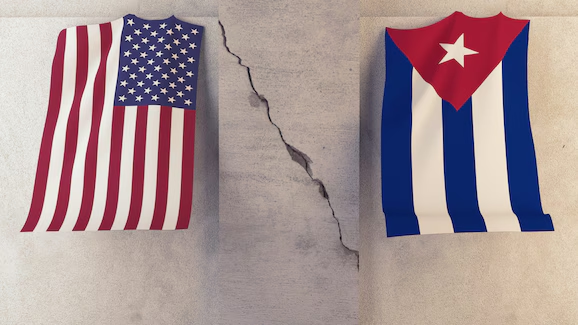
Over the last 67 years of history, starting from the Cuban Revolution of 1953-1959 until today, relations between the United States of America and the Republic of Cuba have mostly been characterized by mutual hostility. Countless times over these nearly seven decades, successive presidential administrations in Washington have attempted to suffocate the Cuban regime and get rid of its leadership but have never succeeded.
Today, with the Second Trump Administration in command at the White House, it seems that the Americans are determined to resolve this perpetually pending conflict once and for all: also in light of recent events, with the regime weakened by the economic crisis and the lack of food, electricity and fuel, it has become of primary importance to understand whether, in the event of war actually breaking out, Cuba actually has the means (such as the 300 drones it recently received from Iran) and the capabilities to be able to defend itself from a US invasion.
How Trump’s US could act against Cuba
The first thing we need to ask ourselves is what kind of action the political and military decision makers in Washington want to take.
The possibilities are different and would imply the mobilization of very different forces and means: they could opt for a large-scale special forces operation as happened in Venezuela; or for a generalized air offensive in the hope of a popular revolt as in the course of the war in Iran, or even for armed action by means of groups of exiles (as happened against Cuba during the Bay of Pigs events in 1961). They could also attempt an unrestricted invasion of the country as in Afghanistan in 2001 or Iraq in 2003.
The experience of the Iranian War dramatically exposed all the limits of “air power”, which alone was not enough to win the conflict. Given the historical experience of the Bay of Pigs and all the other attempts at internal subversion in relation to which Cuba has proven to be very tough and considering that the Cuban scenario is very different from the Venezuelan one (the removal of a single individual would not at all guarantee a change in the political course of the country) the only option left to the Americans is that of a large-scale invasion leading to the definitive “debellatio” of the Cuban state and all its political, ideological, administrative and military. And this is precisely the scenario on which Cuban political and military planners have been focusing since 1959.
Havana and the military legacy of the “Cold War”
The Revolutionary Armed Forces (official name of the Armed Forces of the Republic of Cuba) were forged from scratch by the government of Fidel Castro, the winner of the Cuban Revolution, during the “Cold War” with two official missions:
- The first, aimed at protecting the territorial integrity of Cuba and the stability of the revolutionary regime from any American attempt to regain control of the island;
- The second, to help export the “internationalist revolution” to Latin America, Africa and Asia by supporting both conventional and non-conventional means (what in current parlance would be defined as “hybrid war operations” or “asymmetric operations”) the armed forces of the “fraternal socialist countries”, engaged in operations against imperialist countries or ideologically similar guerrilla movements.
The Soviet Union immediately recognized Cuba’s potential usefulness as an “assault battering ram”, especially in the countries of the so-called “Third World”. In addition to thoroughly supporting the Cuban economy, he also provided very generous assistance in the decades-long process of expansion and modernization of its armed forces, which became de facto a small-scale reproduction of those of the USSR – although presenting points of notable divergence such as, for example, in the doctrines of use of the air forces and in the development of special forces clearly oriented towards guerrilla scenarios.
The current situation of the Revolutionary Armed Forces
At the end of the 1980s, Cuba could boast the third largest armed forces in terms of number of personnel (after the United States and Brazil) and the second largest in terms of power and operational capacity (after the United States) in the entire American continent. However, this “elephantiasis” was no longer sustainable in a historical era in which the collapse of Communism and the disintegration of the USSR had deprived Havana of its main geopolitical protector, ideological sponsor and outlet market.
Under the slogan of: “Less bullets, more beans”, in the following two decades the Cuban Communist Party proceeded to cut military spending by 97% but, at the same time, the entire military doctrine of the Caribbean island was reformed based on the dictates of “asymmetric warfare” so that, despite being in a situation of clear strategic disadvantage, the Cubans could still defend themselves effectively from an American invasion.
Today the Revolutionary Armed Forces operate within the framework represented by the doctrine called “War of All the People”. At the first signs of an imminent invasion, the Cuban Communist Party, through the armed wing of the “Committees for the Defense of the Revolution”, would issue orders for the general mobilization of the population while the Revolutionary Armed Forces would have the task of buying time by using their conventional arsenals, dated but still numerous, to slow down the opposing operations and ferry the country into the next phase of the war. During this phase, the state structures would completely go into “guerrilla mode” and, in an updated re-edition of the Vietnam War or the Balkan front of the Second World War, would try to exhaust and expel the occupying forces with an all-out struggle.
The unknown of drones and anti-ship missiles
In recent days there has been much talk about the possibility that Cuba has added the drone element to its “War of All the People” doctrine.
Based on intelligence leaks published by the newspaper Axiosthe island would have started receiving military drones from Russia and Iran since 2023 and recently received a batch of 300 examples. These probably belong to one of the many iterations of the HESA Shahed 136, the drone of Iranian origin that became a symbol of both the Russo-Ukrainian War and the latest wars that have bloodied the Middle East.
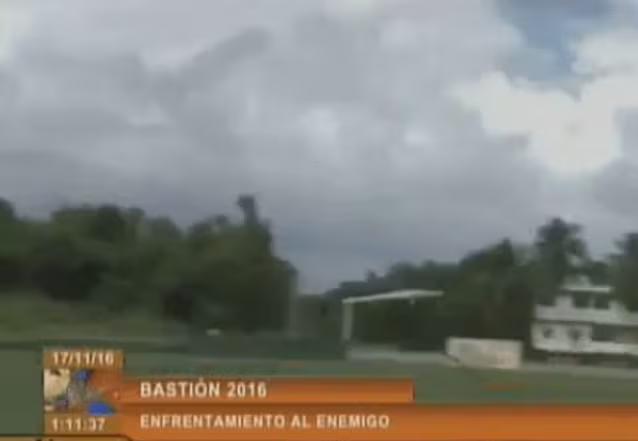
At the moment, however, no photographic evidence has emerged to corroborate these rumors even if in 2016, during the “Bastión 2016” military exercise, state TV briefly framed a reconnaissance UAV of an unknown model.
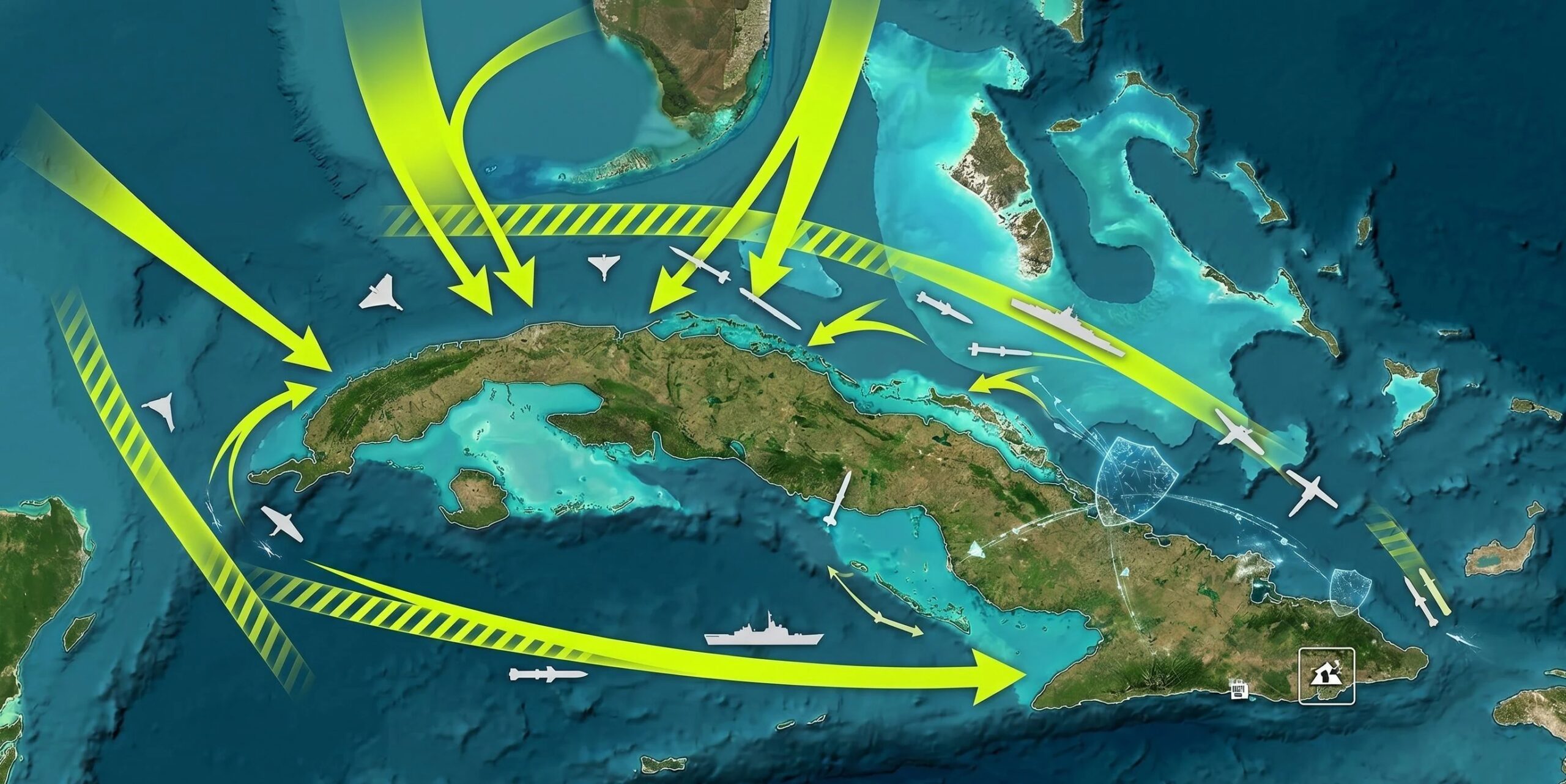
In the absence of more detailed information it is really difficult to speculate on what the impact on all levels of the introduction of drones might be. Unmanned aerial vehicles could be used in conjunction with artillery to neutralize the strategic Guantanamo base or to strike targets located in Florida.
The most profitable use that the Cubans could make of drones, especially paired with anti-ship missiles, would be to use them to block naval routes that pass through the straits located around Cuba (the Windward Passage, the Yucatán Channel and the Straits of Florida), potentially isolating the Gulf of Mexico and thus emulating the strategy that the Iranians are using with great effectiveness in the area of the Persian Gulf, the Strait of Hormuz and the Gulf of Oman since the beginning of the current Iranian War.
In this scenario, Cuba would not limit itself to implementing a purely defensive strategy but, by exploiting geography to its advantage, could further increase the economic and political costs of such a conflict to the point of leading the USA to the point of having to desist from continuing hostilities.