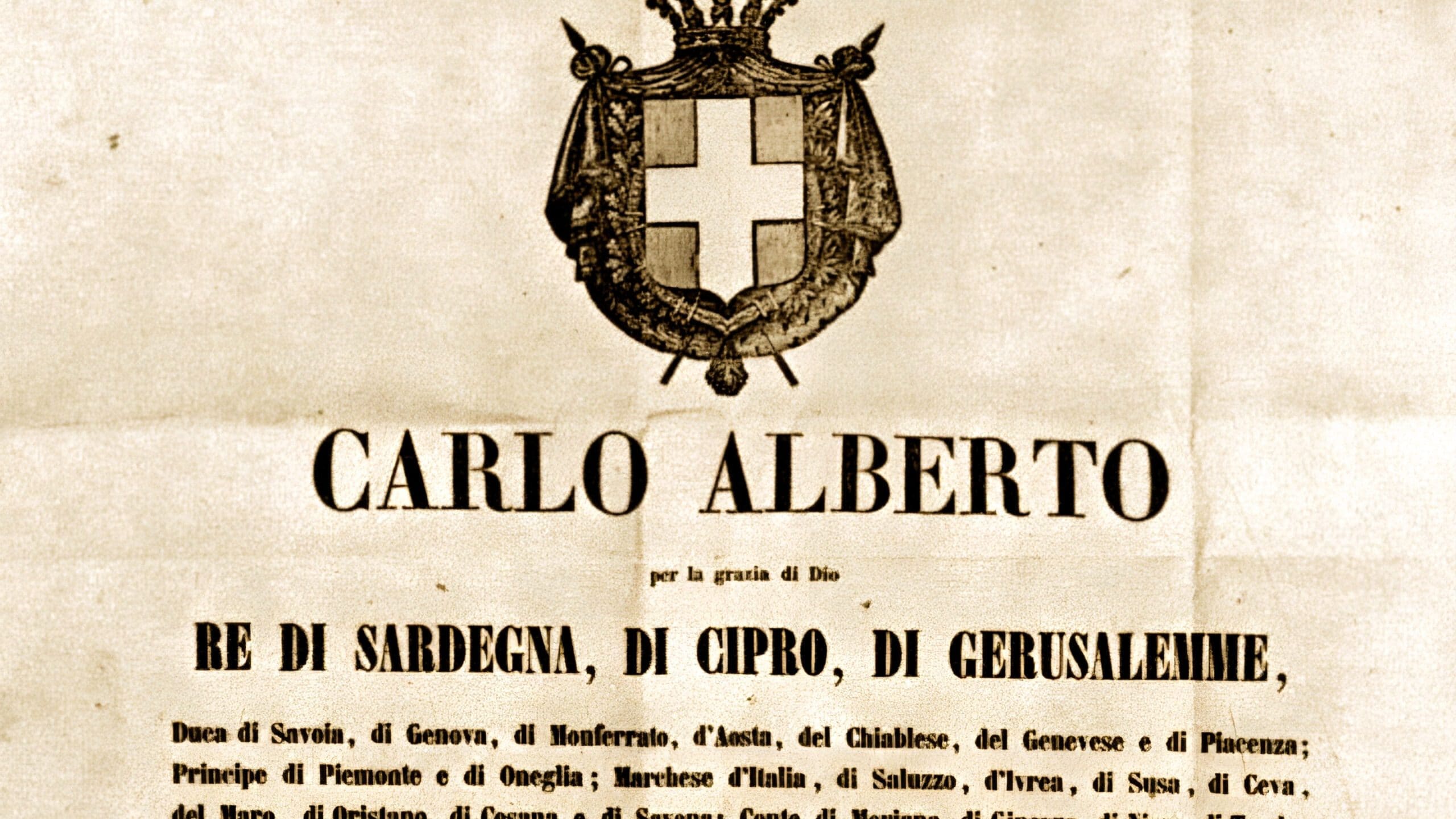
The Albertine Statute was issued at the behest of the King of Sardinia Carlo Alberto on 4 March 1848. In 1861 it became the fundamental law of the entire Kingdom of Italy and remained formally in force until the establishment of the Republic in 1946 and until the Republican Constitution of 1848 came into force. Over the years, however, many provisions were disregarded.
The Statute was an “ottriata” constitution (granted from above) and reserved most of the powers to the sovereign. Nonetheless, for the time in which it was drawn up it constituted a major progress and meant that the Kingdom of Sardinia was a more advanced state than the other pre-unification Italian states, in which the absolute monarchy was in force.
Why the Albertine Statute was enacted and what it was in brief
The Albertine Statute – constitutional charter of the Kingdom of Sardinia first and then of the Kingdom of Italy – was issued in 1848 by Carlo Alberto, sovereign of the Kingdom of Sardinia (which included Piedmont, Liguria, Valle d’Aosta, Sardinia and some territories later ceded to France). It should be remembered that at the time in all Italian states absolutist monarchical regimes were in power and no constitutions existed, because the king’s authority had no limits, at least on a legal level. Precisely the request to issue a constitution, moving from absolute monarchy to constitutional monarchy, supported by the most progressive sectors of society, was at the basis of the various revolutionary movements that broke out in the first half of the nineteenth century. However, the constitutions granted in some states after the uprisings were withdrawn as soon as the revolutions were repressed.
In 1848 another revolutionary wave took place and some sovereigns were forced to issue the constitution again, only to withdraw it as soon as order was re-established. In the Kingdom of Sardinia things went differently. No revolutions broke out but the sovereign, Carlo Alberto, despite being initially against issuing the constitution, decided to grant it to prevent possible rebellions and to meet the wishes of the most advanced sectors of society. Therefore in February he announced the Statute with a proclamation and in March he promulgated it. The text was written by his advisors. The following year the sovereign, defeated by the Austrians in the battle of Novara, was replaced on the throne by his son Vittorio Emanuele II, who decided to leave the Statute in force. The Kingdom of Sardinia therefore placed itself on a more modern position compared to the other Italian states, which withdrew their constitutions and continued to govern with a now anachronistic absolutism.
The characteristics of the constitutional charter of the Kingdom of Italy
The Albertine Statute, composed of a preamble and 84 articles, was an “ottriata” constitution, that is, granted by the king, and not voted by the citizens or their representatives. The sovereign granted it, as we read in the preamble, “with the loyalty of a King and with the affection of a Father” with the aim of “conforming their (subjects’) fate to the times, to the interests and dignity of the Nation”.
The Statute established first of all that the only religion of the State was the Catholic one and other cults were tolerated. Article 1 reads:
The Catholic, Apostolic and Roman Religion is the only Religion of the State. Other cults now existing are tolerated in accordance with the laws.
In the next article, the Statute established that the Kingdom was governed by a representative monarchical government. For succession to the throne, the Salic law was in force (i.e. only the male descendants of the sovereign could inherit it). Article 2:
The State is governed by a Representative Monarchical Government. The Throne is hereditary according to Salic law.
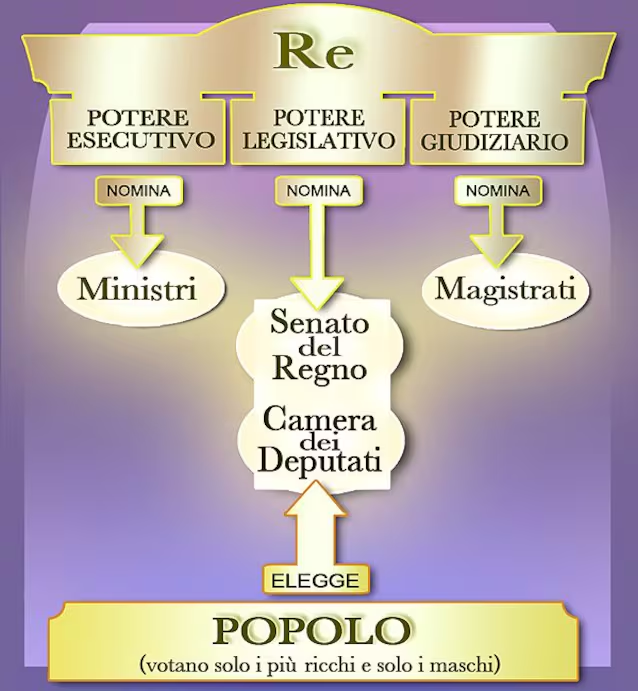
In subsequent articles, the Statute established that executive power belonged to the king, while legislative power was shared by the sovereign with a parliament composed of two chambers: a royally appointed Senate and an elective Chamber of Deputies (the electoral law, not contained in the Statute, provided that only the richest people had the right to vote). The judicial power was administered by magistrates appointed by the king, from whom justice “emanated”. More generally, the Statute reserved extensive powers for the sovereign: he was head of the armed forces, promulgated laws, appointed state offices, had the power to dissolve the Chamber of Deputies (however he would have had to reconvene it within four months). The government, according to the Statute, was responsible to the king and not to the Chambers.
The subjects (the term “citizens” was not used) were guaranteed some fundamental rights, including personal freedom (one could not be arrested unless ordered by the judicial authority), the right of association, freedom of the press (with the clarification that the law would repress abuses), the inviolability of the home.
The Statute also contained provisions regarding compulsory military service, the recognition of noble titles, state symbols and other matters. However, there was no provision for a procedure to amend the Statute (it is debatable whether it should be considered a rigid or flexible constitution).
Comparison with the Constitution of the Republic and the effects of the Statute
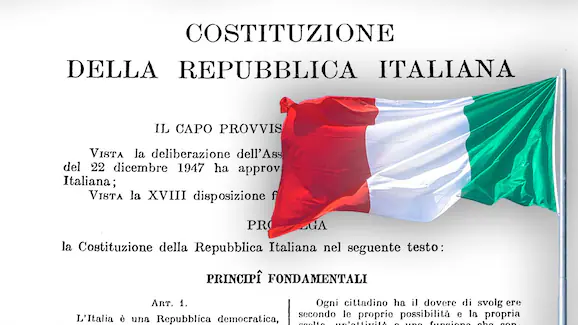
In our eyes, the Albertine Statute may appear retrograde and autocratic, especially when compared with our republican Constitution. The Statute, in fact, was granted from above, and not voted on by the citizens, and reserved most of the powers to a non-elective authority, the sovereign. Furthermore, compared to the Constitution, numerous rights were missing, primarily those of work (on which the Constitution founded our Republic) and many other “modern” characteristics.
The main difference, in summary, was that it Albertine Statute it was a granted and flexible charter, based on the power of the monarch, while the current Constitution of 1948 was instead a text voted by the people, rigid and democratic, where sovereignty belongs to the citizens.
For the time in which it was drafted, the Albertine Statute was an advanced and progressive text. First of all, it allowed the birth of Parliament, which placed a limit on the absolute power of the sovereign. Furthermore, by recognizing the rights of the inhabitants of the Kingdom, he facilitated the progress of society. For example, the right of association, guaranteed by Article 32, led to the creation of mutual aid societies in the Kingdom of Sardinia, which acted as a social security fund, guaranteeing a subsidy to sick or elderly workers: a far-reaching progress in an era in which there were no welfare systems managed by the State. More generally, the rights guaranteed by the Statute meant that the Kingdom of Sardinia was more advanced than the other pre-unification states. It is no coincidence that it will be the Sardinian state that will take the lead in the process of national unification.
The application to all of united Italy
In 1861, when the Kingdom of Italy was proclaimed, the Albertine Statute was extended to the entire Kingdom. It remained in force until the establishment of the Republic and was never formally modified. However, many features of the political system changed over the years. Since the nineteenth century, Parliament took on a more important role than the Statute envisaged and the government became de facto responsible to the Chamber of Deputies. The king, in fact, lost part of the powers guaranteed to him by the Statute and the political system became more liberal
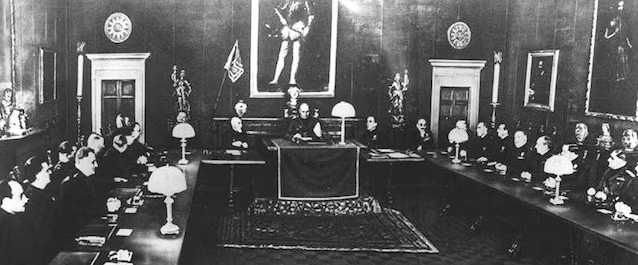
The Albertine Statute remained in force, formally, even during the fascist regime, but many of its provisions were no longer applied. First of all, the rights of citizens provided for by the Statute, starting from personal freedom and the right of association, were denied by the dictatorship. Furthermore, the regime created new institutions, not foreseen by the Statute, such as the Grand Council of Fascism and, in 1939, the Chamber of Fasci and Corporations, which replaced the Chamber of Deputies. The Statute ceased to be applied after the fall of fascism and with the establishment of the Republic it lost all value.
The referendum of 2 June 1946, as we know, abolished the monarchy and definitively eliminated the applicability of the Statute. On January 1, 1948, the Constitution of the Republic came into force.