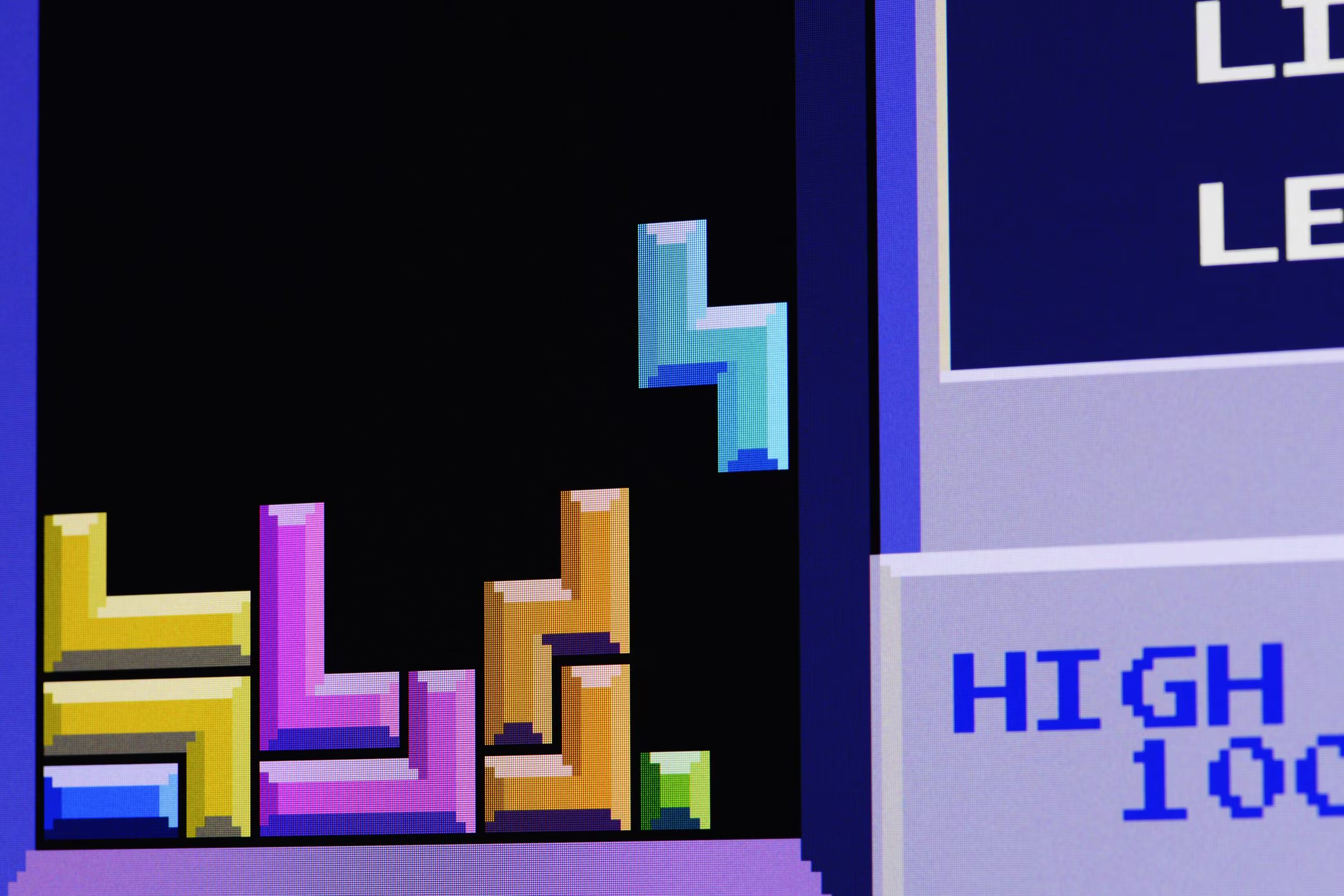
The history of Tetris, the famous video game officially presented on June 6, 1984, represents one of the most fascinating chapters of the entire software industry. It all began between 1984 and 1985 in Moscow, inside the Dorodnicyn Computer Center of the Russian Academy of Sciences. Twenty-eight-year-old researcher Alexey Pajitnov decides to digitize classic pentamino puzzles in his free time. To make the experience more fluid, he simplifies the concept by reducing the blocks from five to four squares – thus giving life to tetrominoes – and programs the code in Pascal on an Electronika 60, a computer with little computing power and no graphical interface.
The gameplay soon infects his colleagues in the laboratory. With the help of programmer Dmitry Pavlovsky and sixteen-year-old Vadim Gerasimov, the game is converted for IBM PC systems, gaining colors and a score table. Since Soviet legislation gives the state a monopoly on intellectual property, Pajitnov cedes the rights to the computer center for ten years, giving up profits but allowing the title to cross national borders. Via Hungary, a copy of the software is intercepted by Robert Stein of Andromeda Software, who – misinterpreting a reply telex from Moscow as a formal concession – sells the distribution rights to Mirrorsoft in Europe and Spectrum HoloByte in the United States. The game thus arrived on the Western market at the beginning of 1988, packaged with a highly exoticized imagery of Soviet origins.
In the meantime, the state body ĖLORG intervenes to regularize the intricate issue of international licenses. It is in this climate of legal disputes that Dutch entrepreneur Henk Rogers enters the scene: struck by the potential of the title, he senses the synergy with Nintendo and personally flies to Moscow in 1989. He forms a bond of friendship with Pajitnov and secures the rights for portable systems. The move proved to be a good one: in the same year Nintendo launched the Game Boy including Tetris in every package, pushing sales to over 35 million copies and consecrating the game as a global phenomenon. Only in 1996, with the founding of the Tetris Company by Pajitnov and Rogers, did the creator of the game finally manage to regain the economic rights of his invention, now with hundreds of editions and billions of games played all over the world.
After this quick summary on the history of Tetris, we leave you with 15 curiosities related to the famous game (some of which have already been anticipated in the previous lines).
- The country of origin no longer exists. Tetris circulated for the first time within the Soviet Union as non-commercial software, while the first real sale took place in the West in 1988. It is one of the few remaining symbols of that long period of division into blocs, capable of uniting humanity beyond the Iron Curtain.
- Inspired by pentaminoes. The initial idea came to Pajitnov from pentaminoes, puzzles based on five-square figures. He reduced the blocks to four to keep the game accessible and not overly complicated.
- The pieces are called “tetraminoes”. As just mentioned, each piece of the game is a tetromino, which is a flat geometric figure made up of four squares of the same size joined along the sides. In total there are seven possible combinations.
- The origins of the name. The word “Tetris” comes from the fusion, created by Pajitnov, between “tetramino” and “tennis”, the game’s creator’s favorite sport.
- Born on a computer without graphics. The first version from 1984 was developed on the Electronica 60, which had no graphics capabilities. The pieces were represented on the screen using spaces and square brackets ( ), as was typical of phosphor monitors of the time.
- A sixteen year old prodigy behind the IBM version. To convert the game to IBM computers, Pajitnov was joined by his colleague Dmitry Pavlovsky and Vadim Gerasimov, a sixteen-year-old prodigy programmer at the time.
- No profits for the inventor. Due to Soviet copyright laws, intellectual property was controlled by the state through ĖLORG. Pajitnov signed away the rights to his computer center for ten years, as he could not make any personal profit from his invention.
- The push of a misunderstood telex. The game came to the West thanks to Robert Stein of Andromeda Software, who had seen it in Hungary. He telexed Moscow to obtain the rights and interpreted a vague, non-binding response as a definitive agreement, selling the license to a British publisher before he actually owned it.
- The exoticism of the Cold War. When Spectrum HoloByte released the game in the United States in 1988, it chose to emphasize the game’s Soviet origins: the packaging was red, decorated with St. Basil’s Cathedral, and accompanied by typically Russian music and images.
- The Game Boy boom thanks to the bundle. The 1989 Game Boy version sold over 35 million copies, driven by Nintendo’s choice to include it in the console box along with a cable for two-player mode.
- The soundtrack is about a street vendor. The famous “Type A”, composed by Hirokazu Tanaka, is based on Korobeiniki, a Russian folk song from 1861 that tells the story of a street vendor and mentions fabrics such as chintz and brocade.
- Mathematics says that you always lose. Several mathematicians have demonstrated that Tetris cannot last forever: even at the simplest level, an alternating and repeating sequence of S and Z pieces will inevitably fill the screen, leading to game over.
- In space. According to the Guinness Book of Records, Tetris was the first video game in history to travel into space, an achievement achieved in 1993 aboard the Mir orbital station, in low Earth orbit. The credit for the feat goes to the Russian cosmonaut Alexander A. Serebrov, who brought with him a Tetris cartridge for Game Boy.
- Train your brain and save energy. A 2009 research showed that beginners consume a lot of brain energy to play Tetris, while after a period of practice the mind optimizes, significantly reducing the expenditure. 30 minutes a day for 90 days would be enough to improve overall cognitive abilities.
- The Tetris effect. Regular players can develop the so-called “Tetris effect”: a psychological phenomenon whereby the mind tends to geometrically organize objects in the real world – boxes, parked cars – and to perceive geometric shapes in the peripheral visual field or with eyes closed, just before falling asleep.