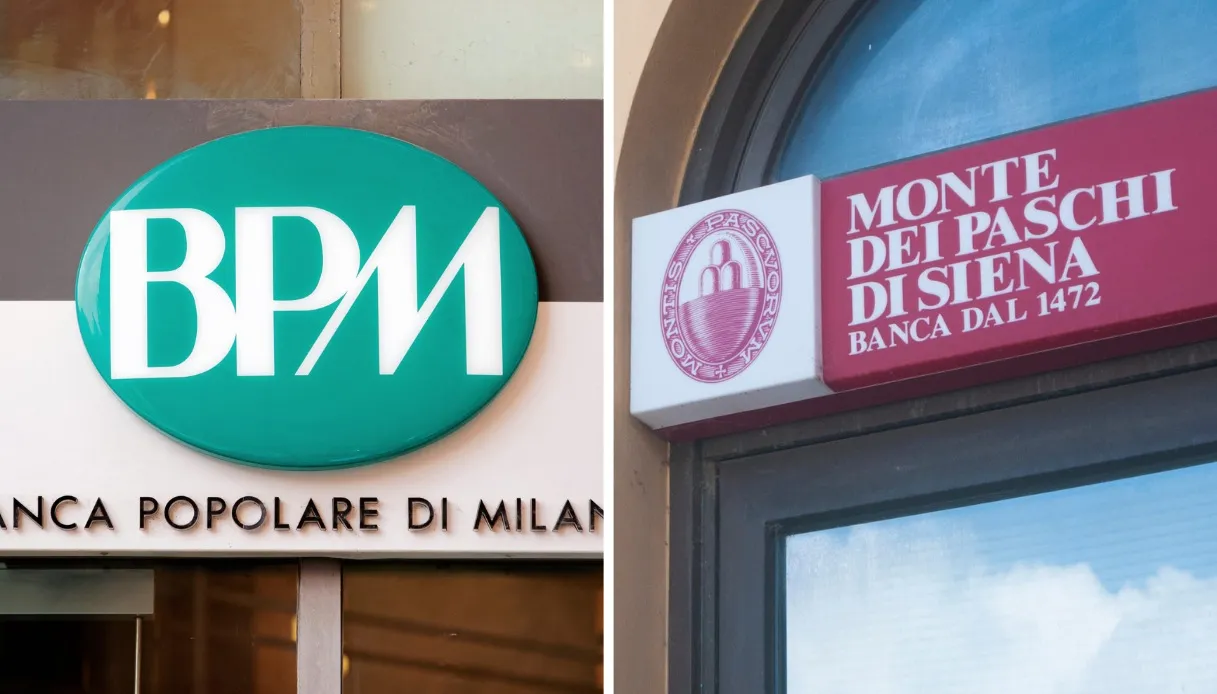
Banco Bpm, one of the largest Italian banking groups participated by the French Crédit Agricole, has proposed a merger of equals with Monte dei Paschi di Siena, another important Italian bank, which has just acquired Mediobanca. The operation would create a group worth 50 billion euros, the third largest in Italy.
The news has stirred the so-called Italian “banking risk”. The banks of our country are controlled by a complex network of mutual shareholdings and by a group of families, ranging from the Del Vecchios to the Caltagirones, among the richest in Italy. Every operation in this area therefore has many repercussions not only on the banking institutions involved, but also on the entire sector.
Banco Bpm has proposed a merger with Montepaschi
In the board of directors of Banco Bpm which took place on 7 June, the Milanese bank proposed a merger of equals with Monte dei Paschi di Siena. In the press release issued by Bpm we read:
The Board of Directors of Banco Bpm unanimously resolved to send Banca Monte dei Paschi di Siena a communication in which Banco Bpm represented its interest in starting a dialogue aimed at discussing and agreeing on a potential aggregation operation agreed between the two institutions.
The proposed form for the merger is that of the “merger of equals”, the merger between equals. Neither bank, therefore, would acquire the other. The operation should generate synergies, savings and advantages that emerge from the cooperation between the two banks, for 1.1 billion euros, divided into:
- 650 million in cost synergies, therefore operational savings;
- 450 million in revenue synergies, of which 250 million from increased revenues on networks and 200 million from product optimization.
How the merger of equals works
The merger of equals does not mean that the two banks will agree to value each other equally. Banco Bpm has a market capitalization (the sum of the value of all its shares) of approximately 20 billion euros, MPS of 27 billion. The term simply means that the transaction is agreed upon. It is therefore not a hostile takeover.
Even if the two banks were to reach an agreement on the merger, a long process would begin for the actual union of the two groups, which involves:
- the choice of the new governance, therefore the new Board of Directors and the new directors;
- operational integration, with the unification of the workforce, from offices to branches;
- rationalization, with overlapping branch closures and other duplications.
At the end of this journey, a group worth 50 billion euros should be born. This would be the third Italian bank, the so-called “third banking hub”, after Unicredit and Intesa San Paolo, whose market capitalization is however approximately double compared to the value of the new entity that should arise from the merger.
The consequences on “banking risk”
The third banking hub is one of the most important issues of the so-called “Risiko” among Italian banks. The credit institution sector in Italy is dominated by two companies that are much larger than any other: Intesa San Paolo and Unicredit. To avoid the formation of a duopoly, governments and observers have often called for the creation of a third bank that could compete with these two.
Bpm and Mps are the two largest banks after Intesta San Paolo and Unicredit, so their merger to achieve this goal is the simplest way. The alternative would be a foreign group, generally French, given that banks such as Crédit Agricole (which controls just under 20% of Bpm) and Bnp Paribas are very present in Italy.