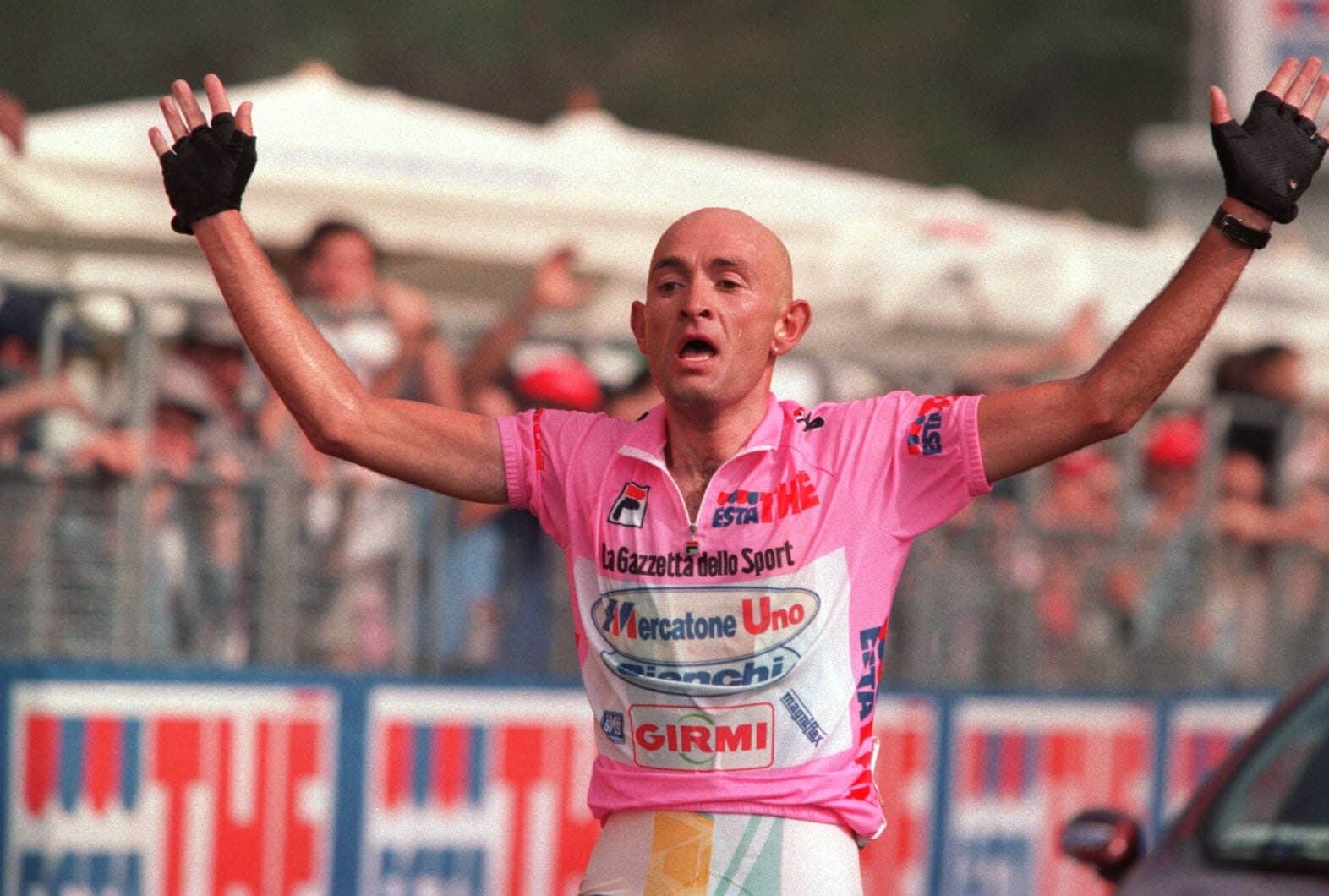
Marco Pantani, nicknamed “The Pirate” was one of the most iconic and talented cyclists in Italian history. 1998 marked the highest point of his career, triumphing both at the 81st edition of the Giro d’Italia – securing victory after an epic duel against the Russian Pavel Tonkov at Plan di Montecampione – and at the Tour de France in the same year, he scored a historic “double” achieved before him only by limited legends of this discipline, such as Fausto Coppi and Eddy Merckx.
However, his career suffered a sudden and dramatic collapse in 1999. While dominating in the Maglia Rosa, he was suspended from the race in Madonna di Campiglio due to a blood test that recorded a hematocrit above the maximum threshold of 50%. From that controversial exclusion, considered by the cyclist to be a conspiracy, Pantani never truly recovered, culminating in his tragic discovery lifeless in Rimini, aged just 34, on 14 February 2004. Even today, the Giro d’Italia honors his priceless sporting legacy with the special “Montagna Pantani”, dedicated every year to one of the key climbs of the race.
Who was Marco Pantani in 1998
Marco Pantani was born in Cesena in 1970 and became a professional cyclist in 1992. He is a pure climber: a type of runner specialized in climbs, with an extremely light physique (56 kilos by 172 centimeters) which allows him to tackle the mountains at a pace that almost no one, in those years, was able to keep up with. His style is unmistakable: sharp shots standing on the pedals and with his hands positioned at the lower part of the handlebars, often preceded by a gesture that has become iconic: removing the iconic bandana from his head before each decisive attack. In those years, helmets were not yet mandatory.
At the 1994 Giro d’Italia he won two stages and finished second in the general classification. However, the following seasons were marked by injuries: in 1995 he was hit by a car during the Milan-Turin race and seriously fractured his legs. In 1997, after returning to the Giro, he was forced to retire due to a fall caused by a cat that ended up in the group. In the same year he took part in the Tour de France, finishing in third place. He arrived at the 1998 Giro as a possible protagonist, but his difficulties in the time trial stages (that Giro involves 81 km against the clock divided into 3 stages) make him a candidate for the podium, not the final victory. At the Tour ’97 Pantani had lost a total of over 8 minutes to the winner Jan Ullrich in the 3 time trial stages alone.
The 1998 Giro d’Italia: how Pantani won it
The 81st edition of the Corsa Rosa starts on May 16th from Nice. The main favorite is the Swiss Alex Zülle, winner of the Vuelta a España in 1996 and 1997. Among the other top-level opponents there is also the Russian Pavel Tonkov, winner of the Giro in 1996 and 2nd place in ’97, a solid rider both uphill and in the time trial.
The race has its turning point on 2 June, in the Alpine stage that goes from Asiago to Selva di Val Gardena: 220 kilometers with 5 Mountain Grands Prix including the Sella Pass, the highest point of that Giro with its 2214 meters of altitude. Pantani, already winner of the stage with arrival in Piancavallo, attacks on the Marmolada, clears the way for the other men in the classification and wears the pink jersey for the first time in his career, giving Zülle five minutes. The Swiss never recovered, finishing the Giro more than half an hour late.
With Zülle out of the picture, however, Tonkov emerges, recovering in the following stages and moving to just 27 seconds in the general classification. The showdown comes on June 6th in the long stage from Cavalese to Plan di Montecampione, the last uphill finish of that Giro. The two started a long duel that will remain in the history of cycling, trailing any other opponent by more than 3 minutes. Attacks and counterattacks, with Tonkov raising the white flag only 2 km from the finish line. Pantani arrives alone, 57″ ahead of the Russian.
On Sunday 7 June, in Milan, Marco Pantani wins the Giro d’Italia.
The double with the Tour: the impossible mission that makes Il Pirata a legend
Winning the Giro and Tour in the same year is considered one of the most difficult goals in professional cycling. The two Grand Tours take place within a few weeks of each other, which makes post-Giro recovery and pre-Tour preparation complicated.
Such tight calendars and selective routes lead athletes aiming for the general classification to choose which of the two races to prepare for, with a few recent exceptions: Tadej Pogacar in 2024, author of the double, and Jonas Vingegaard, fresh winner of the Giro and who will start the Tour on July 4th.
At the 1998 Tour the favorite is Jan Ullrich, the defending German champion, who will dominate the first part of the Grand Boucle. Pantani arrives at the fifteenth stage, from Grenoble to Les Deux Alpes, five minutes behind in the general classification, almost all of which was accumulated in the two previous time trials.
That stage, run in pouring rain, passes through some of the iconic mountains in the Tour’s history, such as the Croix de Fer and the Col du Galiber. Right on the Galibier, 47 kilometers from the finish line, Pantani attacks: he will win by almost 2′ over the second place, Ullrich will reach the finish line 9 minutes later. Pantani wore the yellow jersey for the first time in his career and was able to defend it all the way to Paris, with the iconic finish on the Champs-Élysées.
The last Italian to win the Tour was Felice Gimondi in 1965, who for the occasion will be on the podium to reward Pantani, giving Italy one of the most iconic and recognizable images of modern cycling.
Before Pantani, the Giro-Tour double had only been achieved by some legends of this discipline: Fausto Coppi (1949 and 1952), Jacques Anquetil (1964), Eddy Merckx (1970, 1972 and 1974), Bernard Hinault (1982 and 1985), Stephen Roche (1987) and Miguel Indurain (1992 and 1993). After Pantani, only Tadej Pogacar managed it in 2024.
The 1999 Giro, the suspension and death: what happened
A year later Pantani is back at the Giro and is dominating it. On 4 June 1999 he won the stage arriving in Madonna di Campiglio, his 4th personal seal in that edition with two stages remaining at the end of the pink race. On the morning of June 5th, the doctors of the International Cycling Union carried out routine blood tests. For Pantani the result is a hematocrit of 52%, above the permitted limit of 50%.
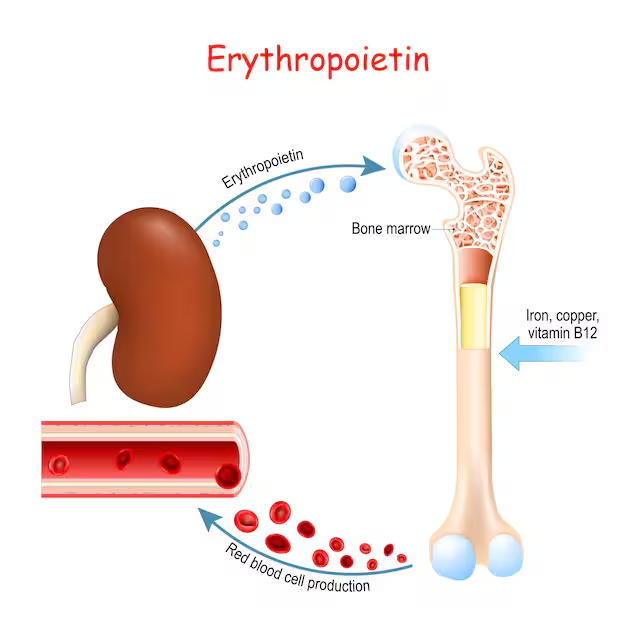
Hematocrit is the percentage of red blood cells in the total blood volume, with a value that normally varies between 42% and 52% in adult men. Red blood cells transport oxygen from the lungs to the muscles: the more numerous they are, the more oxygen reaches the muscles, and the better the sporting performance of an endurance athlete.
In the 1990s, the use of EPO (erythropoietin) became widespread in cycling, a hormone that stimulates the production of red blood cells and which, when artificially injected, made it possible to significantly increase performance in the saddle. At the time, however, there was not yet a direct test to detect EPO during anti-doping controls, the only tool available was therefore the indirect measurement of the hematocrit, with the logic that a very high value could signal use of the substance.
In 1997, also at the request of the runners’ association itself, the UCI had established a threshold of 50%: those who exceeded it were suspended for 15 days, not as a sanction for proven doping, but as a precautionary health measure, because very high hematocrit values make the blood more viscous and increase the risk of thrombosis. The rule was clear, but the system was imprecise: Hematocrit can vary due to many natural factors, including dehydration, altitude and individual variations, and there was no way to definitively distinguish a high value due to EPO from one due to other causes.
Marco Pantani was then suspended for too high a hematocrit, and lost the chance to win the 1999 Giro d’Italia. The affair is still very controversial today, because Pantani had measured his hematocrit the evening before the check-up, and will have it measured again at the Imola hospital a few hours after the UCI test, with data around 48%. His team, Mercatone Uno, withdraws en masse from the race in protest. Paolo Savoldelli, who has become the new leader of the Giro, refuses to wear the pink jersey because he believes the disqualification is unfair.
What exactly happened that morning of June 5, 1999 has never been clarified, but Pantani never truly recovered from that exclusion, certain that he was the victim of a conspiracy against him. Victim of a serious depression, he returned to racing intermittently, with some flare-ups in 2000 in which he won two Alpine stages at the Tour de France. On 14 February 2004 Marco Pantani was found lifeless in a room at the Residence Le Rose in Rimini, aged 34.
The Giro d’Italia remembers Pantani by assigning every year to one of the most important climbs of the race the title of “Montagna Pantani”, a recognition previously granted only to Fausto Coppi with the “Cima Coppi”, the point with the highest altitude reached by the Giro from year to year.