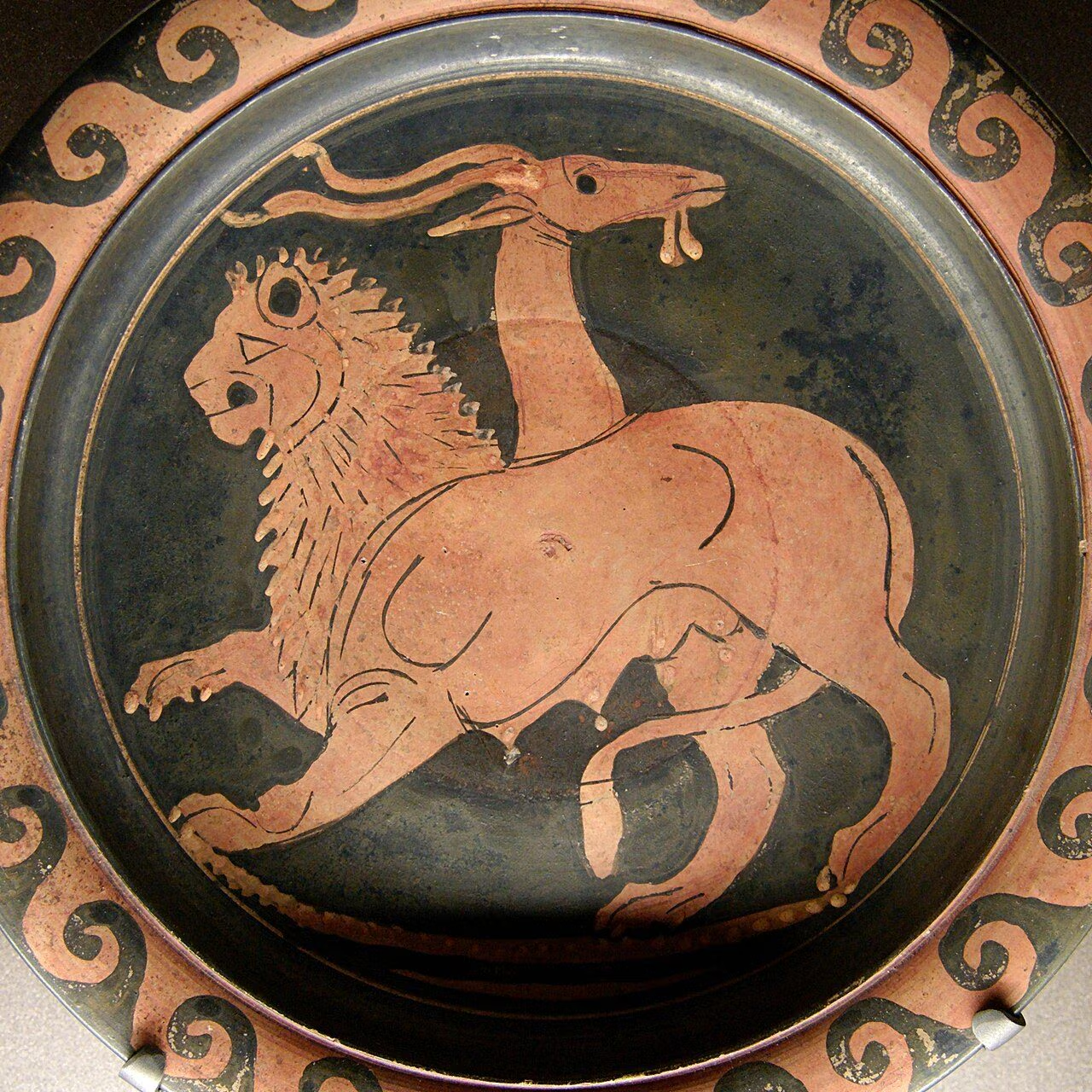
There Chimera it’s one monstrous beast from the Greek mythologyRoman and Etruscan, whose body is composed of different animals: depending on the historical source that describes it, it can be composed of the body and head of a lion or goat, with a second head of a goat, it often has the tail of a reptile (snake or dragon) and is capable of breathing fire.
The origins of the myth are very ancient: already in the 2nd millennium BC references to “hybrid” animals are found in the area of Mesopotamia and Anatolia, and a specific reference to the myth of the chimera is present inIliadwhere the story of Bellerophonthe hero who killed her. It was thought that the Chimera lived on a mountain, called Mount Chimera, from whose slopes flames still emerge due to underground combustion.
Today the Chimera, from the Greek Χίμαιραis also associated with sayings like “chasing a chimera”, which means chasing an impossible and vain dream, precisely because the creature, as imagined, does not exist.
The Chimera in Greek mythology: the story of Bellerophon
In Greek, Χίμαιρα (pronounced Chimaira) literally means “goat”, one of the animals from which the beast is formed.
“He was of divine, not human, lineage: a lion in front, a serpent in the back, a goat in the middle, and he breathed terrible fire.”
Thus Homer, in book VI ofIliad (composed in the 1st century BC), describes the Chimera. The speaker is Glaucus, a Lycian – Turkish warrior, originally from the Lycia region – an ally of the Trojans. Glaucus tells his adversary Diomedes, a very valiant Greek warrior, the story of his ancestor Bellerophon who faced and defeated the Chimera.
There Chimeraaccording to Greek mythological narration, she was the daughter of Typhon, a winged giant with a hundred dragon heads, and Echidna, half woman and half serpent. From the union of these two creatures the Chimera and his brothers and sisters are born, including the Lernaean Hydra, a many-headed serpent who fought Hercules, and the three-headed dog Cerberus, who guards the entrance to the Underworld.
It is said that the Chimera terrorized the inhabitants of Lycia: King Iobates therefore hired the hero Bellerophonson of Poseidon, to kill her. Bellerophon climbed on the wings of the winged horse Pegasus and managed to kill her with a ruse: he stuck a lead spear into the Chimera’s throat which, setting it on fire, melted it, and he died of suffocation.
The spread of myth in antiquity
Greek mythological belief placed the Chimera in present-day Türkiye, where as early as the 7th century BC it was believed that this “hybrid” monster lived on a mountain from whose slopes flameswhich was more recently discovered to be due to the underground combustion of methane gas encountering flammable rocks.
The mountain was obviously considered a dark and dangerous place, perfect for hosting such a terrible being. This mountain was called the Mount Chimera: is located in the province of Antalya, in southern Turkeyand even today the flame emissions are present and the place can be visited.
The myth of the Chimera is deeply felt and between the 5th and 3rd centuries BC it spread rapidly throughout the Middle East: Homer spoke about it in the Iliad telling the story of Bellerophon, and the belief in the existence of the Chimera also reached Italy.
One of the most accurate historical testimonies regarding the chimera is in fact the Chimera of Arezzoextraordinarily well-preserved Etruscan bronze, which depicts the beast with the body of a lion, a snake’s tail and a goat’s head arising from its back. Dated around the 5th century BC, this bronze was produced by Etruscan artisans in the area of today’s Arezzo, and is today preserved in the National Archaeological Museum of Florence.
After the birth of Christ, with the spread of paganism and Christianity, this, as well as many other stories from ancient mythology, are reinterpreted in a symbolic key. During the Middle Agesthe Chimera becomes a symbol of vices, of the confusion of chaos: precisely in this way it is represented in medieval bestiaries, including the Physiologus, an allegorical text that collects symbolic descriptions of animals, plants and stones, accompanying them with a moral or theological interpretation.
The Chimera from the Renaissance to its current meaning
In the Renaissance the classical texts are rediscovered and, with them, also the mythological figures present in them, who begin to populate narratives and artistic representations again.
Among these, the Chimera is also back in vogue as an object of study, an artistic figure and a symbol of imagination and creativity, in line with the humanist spirit of the time.
We often find the Chimera in Renaissance grotesques – fantastic decorations full of hybrid beings – and in the ornamental sculpturesfor example in the facades of buildings.
Today, in common languagespeaking of “chimera” means referring to a vain and unachievable dreamsomething that you can chase but never grasp, precisely because it doesn’t exist.
Furthermore, the Chimera came to us in novels and films – we find it for example in Harry Potter by JK Rowling, and in the film Fantastic Beasts and Where to Find Them, written by the same author, and in Percy Jackson, a series by Rick Riordan – and in some video games, such as Final Fantasy and Gods of War. Furthermore, in biologywhen we talk about “chimera”, we are referring to a single organism composed of genetically distinct cells, deriving from two or more different zygotes, with an open reference to the origin of this term.