The global market for bunkers and private underground shelters – built to provide shelter from nuclear attacks, radioactive contamination and chemical-biological weapons – was worth around $3 billion in 2024. Projections for 2035 estimate it will rise to almost $10 billion, with annual growth of around 11%. It is a booming sector, with specialized companies on four continents, dedicated architects, hyper-specialized engineers and a clientele that grows with every international crisis.
If after the Russian invasion of Ukraine in 2022 the market recorded a surge in requests from ordinary citizens, the real economic engine of this industry is another: the super rich. Reid Hoffman, co-founder of LinkedIn, estimated that over 50% of Silicon Valley billionaires has already purchased some form of emergency shelter. But how are these bunkers made, how much do they cost and, above all, what are the most powerful men in technology running away from?
How fallout shelters are made and how much they cost: from prefabricated to luxury
Forget the old spartan reinforced concrete fallout shelters of the 1960s. Modern bunkers are true technological fortresses, scalable according to your wallet.
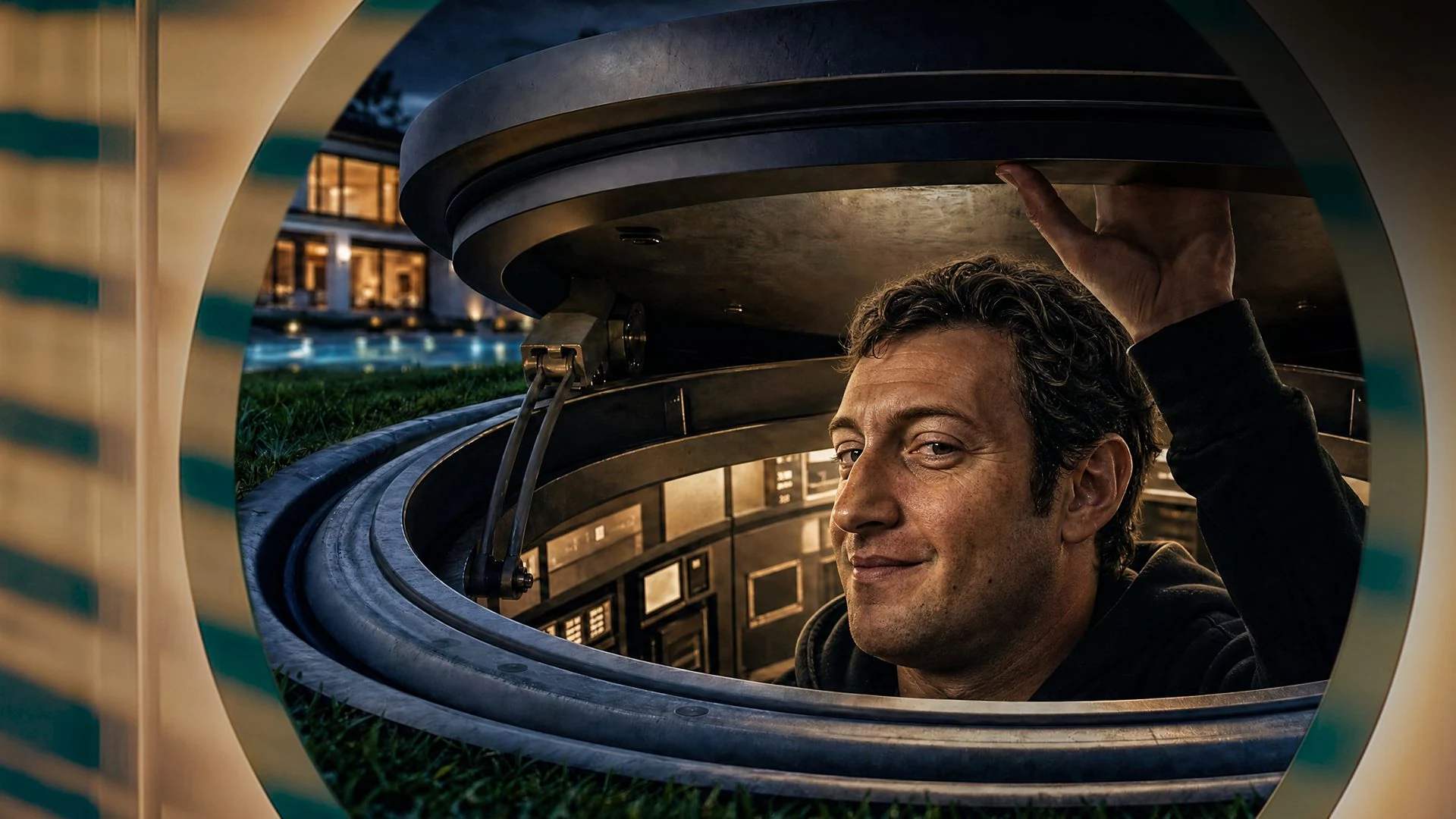
- Basic range (20,000 – 80,000 euros): They are prefabricated steel shelters to be buried in the garden (about 9 square meters). They offer space for 4-6 people, an NBC (Nuclear, Biological, Chemical) air filtration system, an access hatch and basic supplies to last a few weeks.
- Medium range (100,000 – 500,000 euros): Custom-made family bunkers (20-50 m2) integrated under the existing villas. They include working kitchens, separate sleeping areas, diesel generators, 6-12 month supplies and satellite connection.
- High range (500,000 – 5 million euros): Autonomous structures up to 500 m2. They add hydroponic systems to grow food without sunlight, aquaculture tanks for fish, medical rooms with surgical equipment and decontamination rooms. They are often built on remote properties (ranches in Montana or farms in Patagonia).
- Extreme range (Over 10 million euros): We enter the territory of the tech elites. These are entire underground ecosystems. The most famous case is the Survival Condo Project in Kansas: a 60-meter-deep former missile silo converted into an extreme luxury condominium. Includes swimming pools, gyms, movie theaters, shooting ranges and dog parks. Individual apartments cost up to $2.4 million (with condo fees of $2,600 a month), and there’s a long waiting list.
Rich people and underground bunkers: what are they running away from
Those who study this phenomenon have grouped billionaire phobias under a single collective term: “The Event” (The Event). It doesn’t matter what the specific cause is, the important thing is to prepare for a systemic collapse that makes it justifiable to lock yourself behind an armored door. Here are the main scenarios:
- Nuclear War: An ancient fear, which has become forcefully current again with the war in Ukraine and tensions in the Middle East.
- The next pandemic: COVID-19 has demonstrated global logistical fragility. The fear is that a future pathogen, whether natural or engineered, could be much more lethal.
- Climate collapse and natural disasters: We do not fear the end of the world, but the increase in extreme local crises (devastating fires, floods) that make entire rich areas unlivable.
- Collapse of digital infrastructures and blackouts: A giant cyberattack or a powerful solar storm (like the Carrington Event of 1859) could fry global electrical transformers, shutting down the internet, waterworks and logistics for years.
- Financial collapse: The collapse of interconnected banking systems and the disruption of global supply chains.
- The revolt of the masses (caused by AI): It is the most interesting fear because it comes from the person artificial intelligence is creating it. The fear is that automation will destroy tens of millions of jobs too quickly, sparking mass unemployment, collapse of social order and violent uprisings against technocrats.
Billionaire “Preppers”: Who They Are and Where They Build Them
The names involved in this race for survival are among the best known on the planet.
First of all, Mark Zuckerberg (Meta) is building a 1,400-acre ranch on the Hawaiian island of Kauai (estimated cost: $270 million), which includes a 450-square-foot underground shelter with a blast door. Peter Thiel (PayPal, Palantir)however, purchased 193 hectares in New Zealand and obtained citizenship of the country after spending just 12 days there. In the end, Sam Altman (OpenAI) he stated that he keeps a go-bag (an emergency backpack) ready with gold, weapons, antibiotics, gas masks and potassium iodide. His plan A in the event of an extreme pandemic was to fly to New Zealand with Thiel.
It is no coincidence that New Zealand has become the “refuge” par excellence: politically stable, isolated, rich in natural resources and far from nuclear powers. Specialized Texan companies confirm that they have shipped several 150-ton steel bunkers there.
The paradox of the armed guardian (and the psychology of the bunker)
There’s a structural problem with all this, which writer and media theorist Douglas Rushkoff highlighted after advising a group of billionaires. The question these men asked themselves was, “How will I keep control of my armed guards when my money is no longer worth anything?”
It’s the great paradox of the billionaire bunker. The entire structure assumes that society has collapsed (no police, no laws, no banks), but simultaneously assumes that the internal staff (guards, doctors, engineers) miraculously continue to obey the “boss”. The truth that these projects try to ignore is that survival is never individual, but purely social.
According to the psychology of prepping (disaster preparedness), building a multi-million dollar bunker is not a rational response to a calculated risk, but rather an extreme attempt to manage existential angst and death anxiety (as explained by Terror Management Theory). It’s the techno-capitalist illusion that, if you have enough money, you can buy a “survival algorithm” that separates you from the rest of humanity.
Is preparing for catastrophe wrong?
In reality, preparing for emergencies is an act of rational common sense. Many governments (such as Italy and Sweden) recommend that citizens have 72 hours of supplies. Finland has even built 50,000 underground shelters capable of housing almost its entire population.
But there is a substantial difference. The Finnish model is public: it starts from the idea that survival is a collective issue and that society must save itself together. The Silicon Valley model does the exact opposite: it invests hundreds of millions of dollars to build a private escape route for a few, effectively betting on the collapse of everyone else.