The July 3 is a special date for all Back to the Future fans: on this very day, in 1985, the film by Robert Zemeckis bursts into US theaters, starting one of the most famous and loved film trilogies in the history of the seventh art. There is a chapter in this saga which, today more than ever, invites us to deal with time, and this is it Back to the Future – Part II, the film that 37 years ago tried to imagine what the world would be like on 21 October 2015, the day in which Marty McFly, Doc Brown and Jennifer they land in the Hill Valley of the future.
To make this film the director Robert Zemeckis and the screenwriter Bob Gale they found themselves faced with a significant challenge, namely to imagine what the world would be like 26 years later and consequently create a work that would make an important imaginative leap, inserting into the visual material of the film a whole series of elements, inventions, intuitions that could strike for their verisimilitude, or otherwise remain pure science fiction. Gale himself reiterated in an interview, released on the occasion of Doc and Marty’s arrival in the future, that he and Zemeckis had set a specific goal: to build a positive, optimistic 2015, a future that the viewer would have liked to experience.
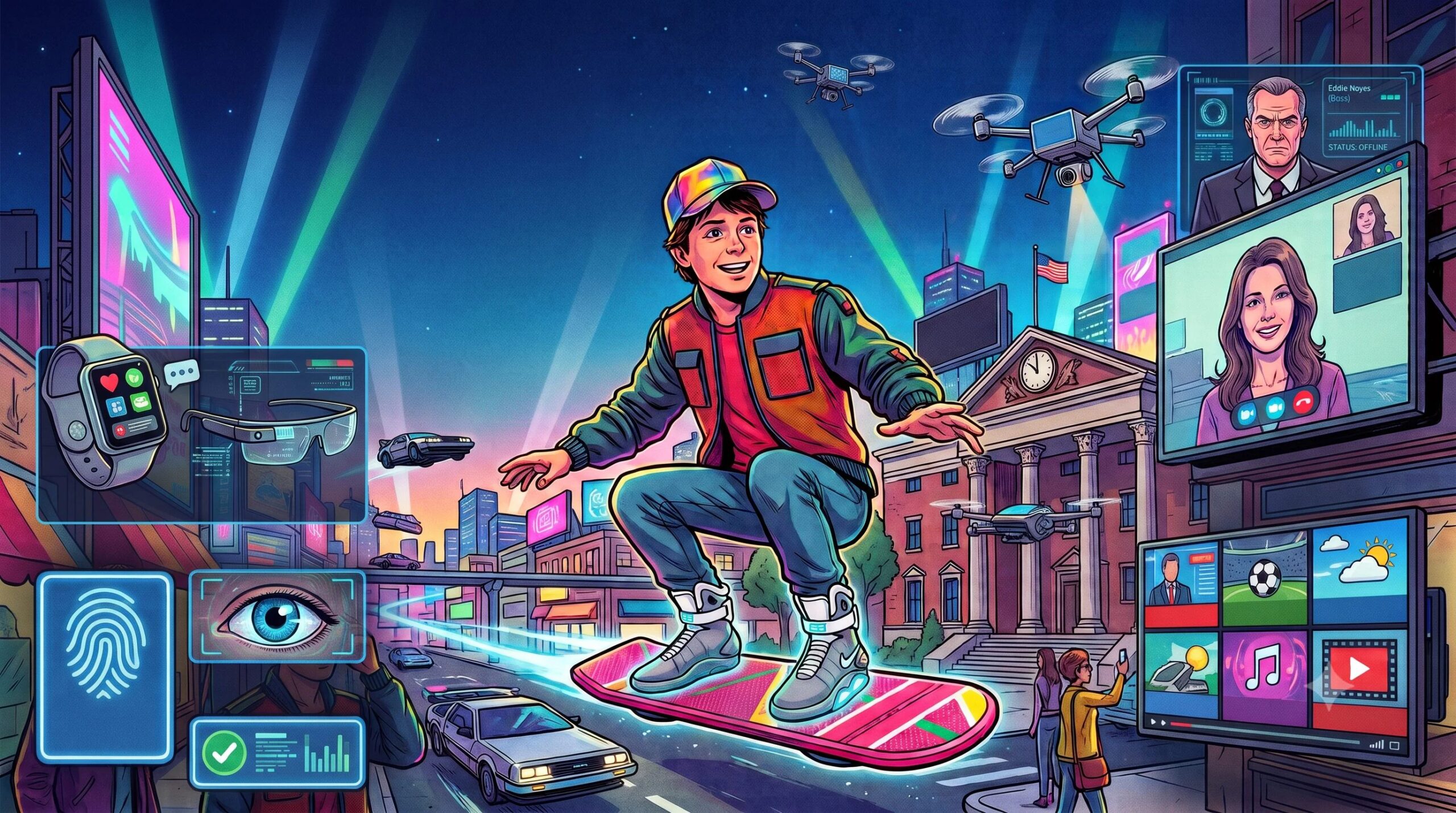
By counting the objects and situations shown in the film we can observe video calls, wearable devices, drones, electronic payments, self-tying shoes. So how many technological predictions were later confirmed in reality?
- 11. Video calls
- 22. Flat and multi-view screens
- 33. Wearable devices
- 44. Biometric recognition systems
- 55. Drones
- 66. The hoverboard
- 77. Self-lacing shoes
1. Video calls
The scene where Marty as an adult is fired by his boss during a video call on the big screen of your living room is perhaps one of the most prophetic of the film. In 2015 platforms such as Skype And FaceTime they were already present in everyday life, and video meetings are still practically normal today. An element that can be noticed on the call screen is the personal information of the interlocutor, such as profession, hobbies, age, address, date of birth, a detail that in a certain sense seems to involuntarily anticipate the use of social profiles even before they were even thought of.
2. Flat and multi-view screens
In the living room of the McFly house there is a flat television hanging on the wall on which Marty’s son watches six channels at the same time, a scene that at the end of the 80s seemed extravagant to say the least. Today the idea of multivision, of the simultaneous consumption of multiple contents has certainly become more understandable, considering that it is something we know quite well, between smartphones, PCs, television, tablets, in addition to the fact that flat screens only became an accessible technology at the beginning of the 2000s.
3. Wearable devices
Today i wearable deviceswearable devices are very widespread, from smartwatches, to smartglasses, to viewers, to earphones, to smart rings. All objects that were difficult to imagine in 1989, yet Robert Zemeckis and Bob Gale managed to intuit that in the future Marty’s children could use technological glasses to watch television or answer the telephone. On a technological level, the prediction came true quite literally, considering that i Google Glass arrived in 2013followed by an entire generation of augmented and virtual reality headsets.
4. Biometric recognition systems
One of the predictions of which the screenwriter is most proud is biometric technology, that is, when in the Hill Valley of the future the doors of the house are opened by placing the thumb on a sensor and payments are authorized in the same way. In fact, in an interview in 2015, he said that he had read articles at the time about fingerprint identification technologies being developed and that he was right. Only in 2013 did this technology become widespread through smartphones that unlock with a fingerprint and subsequently with payments made via Touch ID, starting with Apple, and today it is practically normal to authorize transactions with a touch, open locks or unlock screens with facial recognition or fingerprints.
5. Drones
In Back to the Future – Part II you can clearly see how drones are used for the most disparate jobs, from journalism to the most common services. When Griff and his gang are arrested after the crash into the Hill Valley courthouse, a flying drone records the scene and documents the event in real time. A little further on, another drone appears in the guise of a dog-sitter, busy walking a dog. Reality seems to have followed the script only partially given that drones with cameras today are widespread and used both in the military, in journalism, in film shooting and in surveillance, while the drone that walks the dog is not yet a commonly used technology, but perhaps it is only a matter of time.
6. The hoverboard
One of the most famous objects in the Back to the Future saga is precisely this skateboard of Marty, which became the symbol of the film, together with the DeLorean, the legendary Nike and the Flux Capacitor. In 2015, however, this iconic object also underwent a transformation, becoming a flying object, a full-fledged hoverboard, or a floating skateboard without wheels. Just in 2015 Lexus presented Slides, a glider that worked with magnetic levitation, and also the Californian company Arx Pax has developed in the same period a similar object called Hendo, which could only fly on specific routes.
7. Self-lacing shoes
Impossible not to mention the iconic Nikes that Marty wears Back to the Future – Part IIself-lacing shoes which actually found a counterpart in reality. Indeed, in 2011 Nike created a limited edition model precisely inspired by the film, collaborating with The Michael J. Fox Foundation for Parkinson’s Research for research on Parkinson’s. Later, in 2016, Nike launched a new version with an automatic lacing system, the HyperAdapt 1.0, which uses digital technology, pressure sensors, to detect movement and adapt to the shape of the foot.