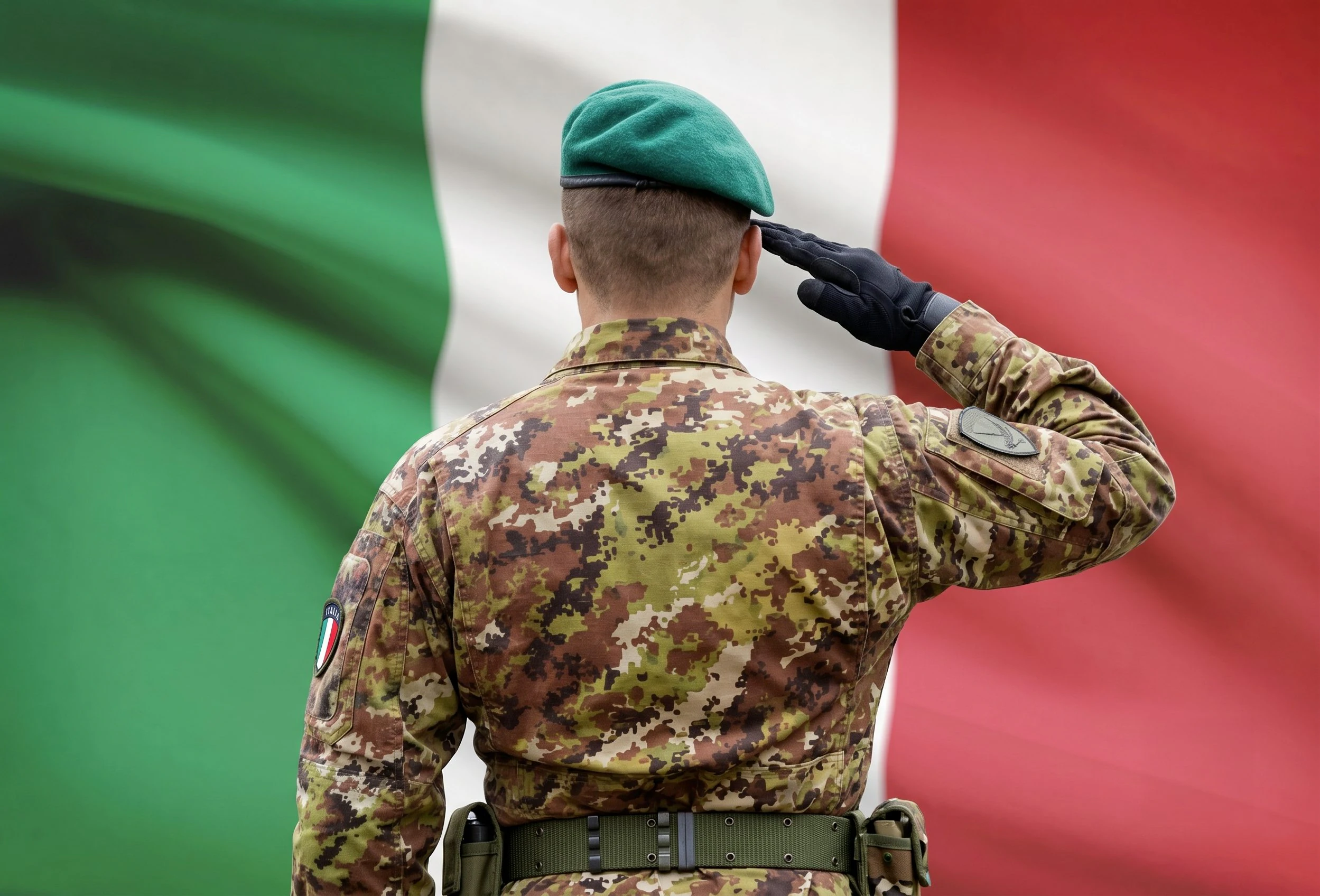
For the past 21 years in Italy, military service has no longer been compulsory: today, in fact, enlistment in the Armed Forces takes place only on a voluntary and professional basis. After having put an end to compulsory conscription starting from 1 January 2005, with Legislative Decree 115 of 1 July 2005 the Italian Government allowed the last soldiers still in service to submit an application for early termination.
However, there is a very important aspect to remember, which perhaps not everyone knows: compulsory military service has not been abolished, but suspended. This means that, under certain conditions, the lever could be reactivated with a Decree of the President of the Republic, following a resolution by the Council of Ministers. This is why, even today, it is mandatory for Municipalities to publish draft lists.
For civilians, however, there is nothing to fear: even in the unlikely event that the call to arms were reinstated, the first to be conscripted would be members of the regular Armed Forces and former soldiers who finished their service less than 5 years ago. Only as a last resort would citizens, men, aged between 18 and 45 and deemed physically fit, be summoned.
How military conscription worked in Italy
Compulsory military service, in reality, is a citizen’s duty, as established by Article 52 of the Constitution:
The defense of the homeland is the sacred duty of the citizen. Military service is compulsory within the limits and methods established by law. Its fulfillment does not prejudice the citizen’s employment position or the exercise of political rights.
The military system worked by age class: every year, the Municipalities compiled the draft lists (i.e. the lists of citizens born in a specific year who reached the age required for being called up to arms, in this case the 19th year of age). Once included in the lists, the young people were summoned before the draft boards, the bodies responsible for ascertaining the requirements, both legal and health, necessary to serve or to obtain dispensation.
The military medical examination was the first real step of the process: those who were judged suitable received the assignment to one of the bodies of the Armed Forces (Army, Navy or Air Force), where they would complete the period of service.
The length of service has changed several times over the decades. In the last years before the suspension, among other things, enlistment had been reduced from 12 to 10 months, a period which, as highlighted in the Ministry of Defense documents, left a period of real operation considered insufficient to effectively employ conscripts in technical sectors or with complex weapon systems.
Why was compulsory military service suspended and when
With the end of the Cold War, the geopolitical landscape had changed radically: Italy no longer had the need to maintain a mass army designed for border defense. The Armed Forces, increasingly involved in international missions within NATO, needed a more flexible, dynamic and outward-looking instrument. As stated in the official documents of the Ministry of Defence, at the end of 1900 the need arose to «transform the military instrument from its static configuration to a more dynamic one of external projection, with quicker response times when the need arises and a more complete and complex professional preparation».
In this context, the voluntary enlistment of the Armed Forces was the one that best responded to this new connotation of the military instrument.
To consider, then, there were also other factors such as the demographic decline, which made it increasingly difficult to reach adequate conscript contingents, while more and more young people were exempted from military service for study reasons or after having submitted a request for conscientious objection.
The legislative path towards the suspension, however, was gradual. The first stage was law no. 331 of 2000, which started the transition towards a professional army by providing for the gradual replacement of conscripts with enlisted volunteers and the reduction of overall personnel to 190,000 units. This law also introduced, for the first time, the possibility of voluntary enlistment for women.
Subsequently, Law no. 226 of 2004 (the so-called “Martino law”, from the name of the then Minister of Defense who proposed it) brought forward the suspension, initially scheduled for 2007, to 1 January 2005. Finally, Legislative Decree 115 of 2005 also allowed conscripts still in service to submit an application for early termination starting from 1 July of that same year.
From that moment, therefore, enlistment in the Italian Armed Forces became exclusively on a voluntary and professional basis.
For what reasons could it be reactivated and which citizens would be called
As also reported in the accompanying report of the Military Service Reform law, the objective was not to abolish compulsory conscription, “but only to provide for it in exceptional cases, such as those of war or crises of particular importance, which require organic interventions”.
The Military Order Code, in article 1929, provides that compulsory military service can be reinstated if:
- The State of War has been decided, as provided for in article 78 of the Constitution, or
- If a serious international crisis, in which Italy is involved directly or due to its membership of an international organisation, justifies an increase in the numerical strength of the Armed Forces.
Even if one of the two conditions were to occur, a Decree from the President of the Republic would still be necessary, following a resolution by the Council of Ministers, but only in the event that the voluntary military conscription personnel in service are insufficient and it is not possible to fill the staff vacancies.
In other words, if Italy were to find itself implicated in a war involving NATO and the number of soldiers in the Italian Armed Forces were not sufficient, then we could opt for a reinstatement of compulsory military service.
Even in the event of a declaration of a State of War, however, enlistment would follow a gradual principle: the regular Armed Forces would first be called up, i.e. the Army, Navy, Air Force and Carabinieri (while the Police Forces and Fire Brigade would be exempted).
Secondly, all former soldiers who completed their service less than 5 years ago would be called up. Only as a last resort could the State decide to also recall civilians, i.e. men between 18 and 45 following a medical examination to verify their suitability.
As regards women, the law does not expressly indicate them among the civilians involved in the hypothetical compulsory military conscription. The entry of women into the Italian Army is in fact regulated by Law 380/1999, later included in the Military Order Code in article 623, which recognizes conditions of absolute equality between male and female personnel.
However, Article 1929 of the COM, which regulates the possible reintroduction of compulsory military conscription, does not expressly indicate women among citizens between 18 and 45 who should respond to the call to arms and, consequently, does not imply the obligation to defend the homeland for the female population.