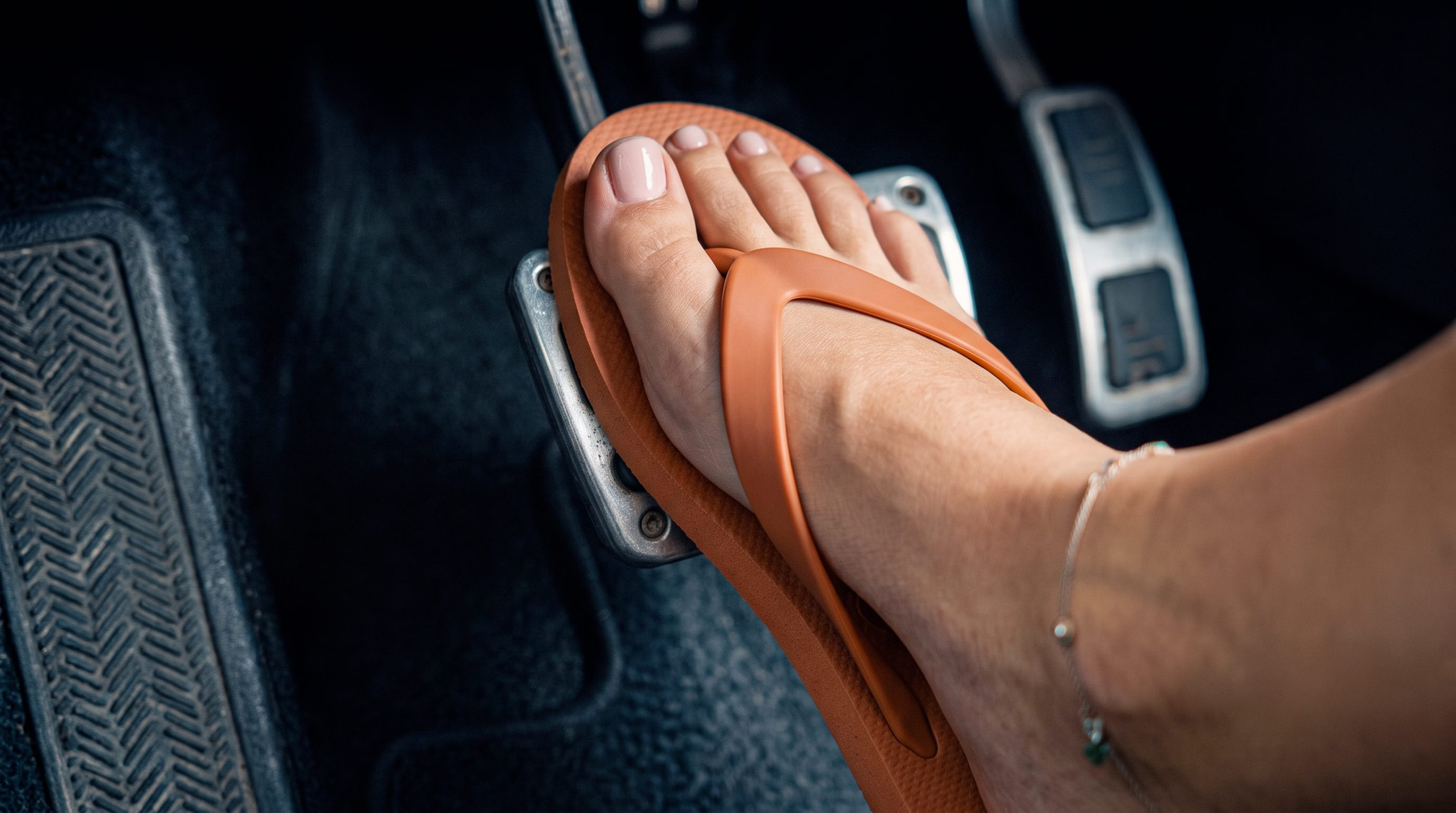
Every time we start driving in the summer, perhaps when returning from the sea or the swimming pool, a doubt always arises: is it possible to drive with flip-flops, or do closed shoes have to be worn?
The short answer is that no, the Highway Code does not expressly prohibit the use of flip-flops while driving. By the same principle, not even heels are prohibited and, despite what one might think, it is not even prohibited to drive barefoot, without any type of footwear – it has no longer been prohibited since 1 January 1993.
Therefore, it is legal to drive barefoot, with flip-flops, and sandals open at the back, but be careful, because this does not mean that the driver does not have any type of responsibility: if that footwear does not allow us to maintain control of the car at all times, the behavior is potentially punishable, based on articles 141 and 169 of the Highway Code.
At the same time, in the event of accidents, insurance companies may limit compensation.
Why driving with flip-flops, heels or barefoot is no longer prohibited and what happens if we do it
Let’s start with a historical fact: until 1993, driving with flip-flops, sandals or similar footwear was expressly prohibited, because it was believed that this type of shoe was not suitable for ensuring safe driving. However, since 1 January 1993, with the entry into force of the new Highway Code (Legislative Decree of 30 April 1992, n. 285), that ban has been repealed: no rule has been included in the new Code which expressly prohibits or limits the use of certain types of footwear while driving motor vehicles or motor vehicles.
This means that those who drive in flip-flops, heels or barefoot do not, in themselves, commit any infringement – even if specific risks remain, linked to safety, as well as possible discretionary sanctions and possible problems with the insurance in the event of an accident.
The point is that, while eliminating this specific prohibition, the Code has not left a void: it has shifted the focus to control of the vehicle, which is the driver’s responsibility. And this is where Articles 141 and 169 come into play.
What articles 141 and 169 of the Highway Code say and when the sanction could be triggered
According to article 141, paragraph 2, of the Highway Code «The driver must always maintain control of his vehicle and be able to carry out all necessary maneuvers in safe conditions, especially the timely stopping of the vehicle within the limits of his field of vision and in front of any foreseeable obstacle».
In other words, the driver must also discipline himself in the choice of clothing and accessories, so as to guarantee effective driving action with his feet to maintain full control of the vehicle in the event of an unexpected event.
Added to this is article 169 of the Highway Code which in paragraph 1 imposes an equally clear rule: in all vehicles the driver must have the “widest freedom of movement to carry out the maneuvers necessary for driving”.
In short, if a flip-flop that is too large or a heel that gets stuck in the pedal prevents us from braking in time or moving freely, we are no longer in compliance. At that point, if the police were to certify that the careless driving was also caused by the type of footwear, then the sanctions provided for by these two rules would be triggered.
Violation of article 141 entails a fine of between 42 and 173 euros, to which can be added the one provided for by article 169, which reaches up to 344 euros.
Among other things, as mentioned, there is also a second level of risk, perhaps the most concrete one. In the event that a road accident occurs while we are driving with slippers, sandals, flip-flops or bare feet, we may be forced to contribute to insurance compensation, with figures reaching up to tens of thousands of euros.
As reported by the ACI, in fact, the driver could be accused of imprudence, lack of or inadequate attention and assessment of the situation. In this case, it is possible that the report drawn up by the police forces involved indicates that the type of footwear used by the driver was inappropriate.
And, when the insurance company intervenes to compensate the injured party, the latter could recognize a reduced reimbursement if it can be demonstrated that the shoe prevented a correct manoeuvre.
In short, the advice is to leave a spare pair of shoes in the car, so that you can use them in case of need and avoid running into possible sanctions or, worse, risking accidents.