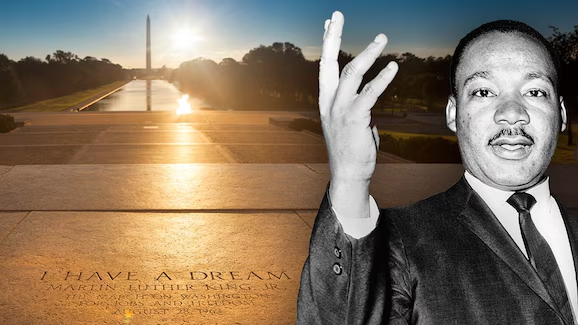
“I Have a Dream”: four simple words were enough to compose one of the most famous phrases in the history of the twentieth century, which immediately became a symbol of the fight for freedom, equality and civil rights.
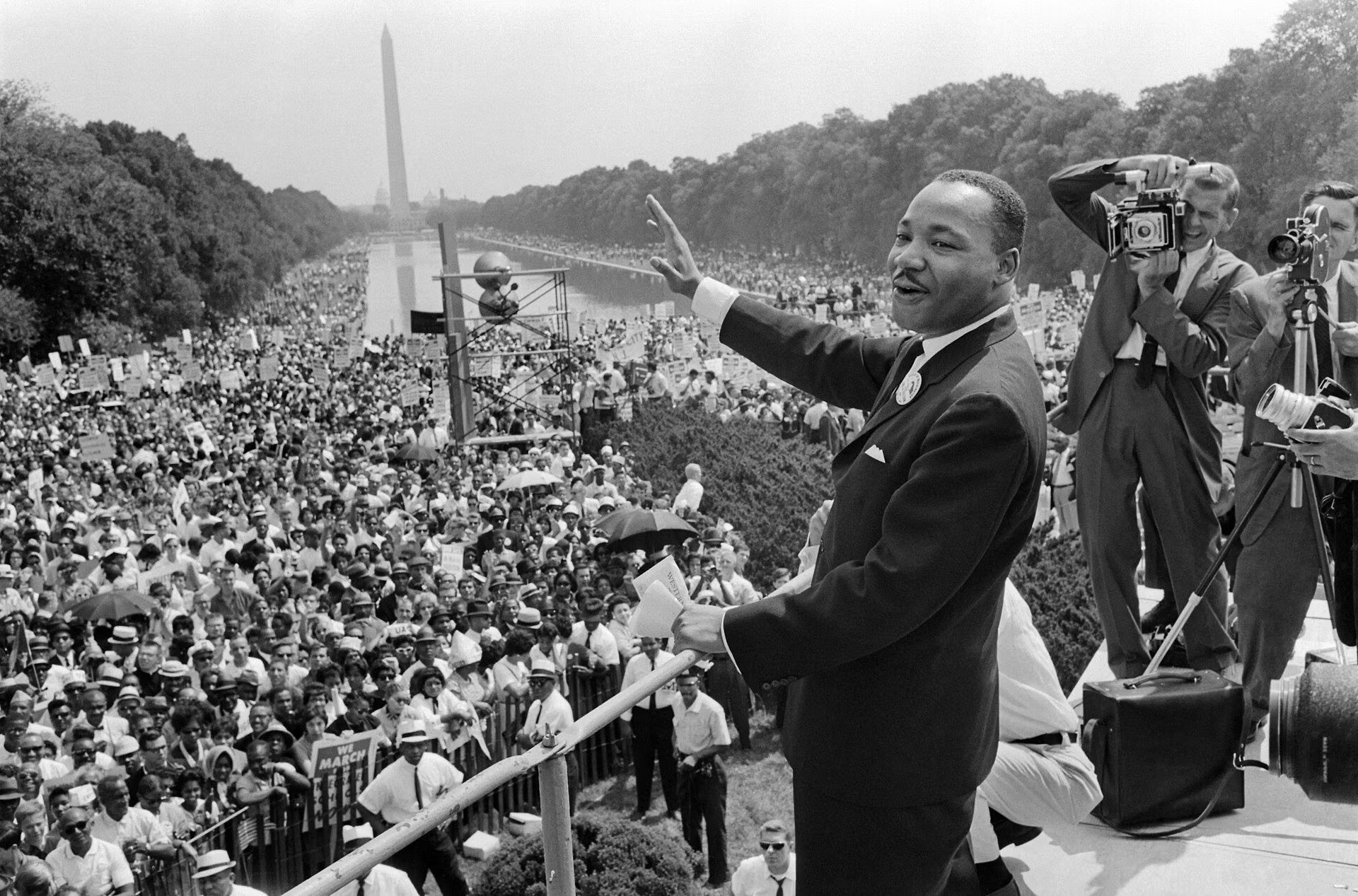
Pronounced in front of the Lincoln Memorial in Washington on 28 August 1963 by Martin Luther King Jr., in front of a crowd of over 250,000 people, these words depicted an America deeply torn by racial discrimination. At the heart of that speech was a radical hope: the vision of a future in which skin color was no longer a cause for division.
But why did this speech make history? And what was its real influence on the future? To understand its significance, we need to take a step back and analyze the context in which it was born. “I Have a Dream” was not only an oratorical masterpiece, but the culmination of a long battle to free African Americans from the yoke of segregation.
The historical context behind the speech: Racial segregation in the United States
Martin Luther King Jr.’s speech has its roots in a past of profound systematic oppression in the United States, especially in the Southern states. Although the slavery had been formally abolished in 1865 (with the Thirteenth Amendment after the Civil War), the end of slavery had not led to equality at all.
In the years immediately following, known as the Reconstruction era, a brief period of hope opened in which many African Americans even obtained political office. However, this push soon ran out: white Southerners, in fact, reacted by introducing a system of ferocious social control, leaving millions of freed people in a condition of total economic and political vulnerability.
On this fertile soil the read Jim Crowa true system of legalized racial segregation that relegated African-American citizens to the condition of “second-class citizens”.
People of color were forced to attend separate schools and universities, almost always unfunded or far inferior to those for whites, to board buses sharing spaces or to travel in separate train carriages and to be banned from restaurants, parks, hotels and even public toilets. All this was reserved exclusively for whites.
Two crucial factors ensured that this system of submission was not undermined. On the one hand, the systematic deprivation of the right to vote: Through impossible literacy tests, discriminatory taxes and constant intimidation, African Americans were excluded from political life.
On the other, the ferocious and unpunished violence of Ku Klux Klan (KKK). Born in Tennessee in 1865 as a white supremacist paramilitary organization, the KKK terrorized black communities and anyone who dared to defend their rights through threats, church burnings, systematic beatings and lynchings, often covered by the silence of local authorities. And it is precisely against this wall of terror, humiliation and injustice that black people have had to fight for years.
The Civil Rights Movement under King’s leadership
The situation, after having continued for decades, had reached its peak, becoming intolerable. Thus, between the 1950s and 1960s, the Civil Rights Movement was born in Montgomery (Alabama).
The movement was inspired by the philosophy of non-violence of Mahatma Gandhi and by the principles of love for one’s neighbor and forgiveness of Christianity, and it was Martin Luther King who naturally emerged as a leader, thanks to his great charisma and moral caliber.
The activist’s first famous action within the movement was the Montgomery bus boycotttaken after the arrest of Rosa Parks, a black woman who refused to give up her seat to a white man. For 381 days, the African American community gave up public transportation, walking for miles or organizing carpools, until the Supreme Court was forced to declare transportation segregation unconstitutional.
In 1957, again based on the cardinal principles of the movement, Martin Luther King founded the Southern Christian Leadership Conference (SCLC). From that moment on, he guided or inspired the most crucial stages of the struggle. At first he did it with i sit-ins peaceful in whites-only bars and restaurants, where activists sat orderly and were assaulted without reacting.
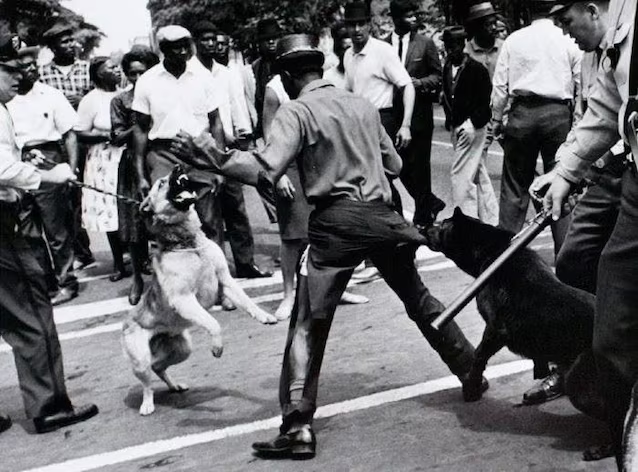
Then with the Birmingham marches in 1963, where the brutal police repression, which used high-pressure water cannons (capable of tearing clothes off and seriously injuring people) and dogs against demonstrators, was broadcast on television, outraged world public opinion and pushing President Kennedy to send federal troops to restore order and protect the African-American population from the police.
The March on Washington and the speech that changed the United States
Despite the climate of very high tension, in which it was very difficult to organize marches, demonstrations and protests, the trade unionist Asa Philip Randolph and the activist Bayard Rustin managed to organize the March on Washington for jobs and freedom, a march which took place on August 28, 1963.
That day, more than 250 thousand people, African Americans and whites united in the same cause, gathered peacefully (in fact, any form of civil disobedience had been prohibited by Rustin to avoid giving the police pretexts to attack the movement) in front of the Lincoln Memorial to ask Congress and the Kennedy administration for urgent reforms and full civil and economic equality.
In fact, the US administration had been mired in bureaucracy and nothing done for months: it had presented a law to Congress to abolish segregation and guarantee protection, but the text was blocked by the opposition of conservative and segregationist politicians. The march was designed precisely to put pressure on that law to be approved.
It was in this context that Martin Luther King took the podium: his speech had been written and rewritten several times and had the title “Normalcy, never again”, but the gospel singer Mahalia Jackson, who was with him that day, shouted at him several times to talk about his “dream”. At that moment, King understood that that very sentence had more impact than what he had written and needed to be repeated out loud. So, he put the papers aside and started speaking off the cuff.
“I have a Dream”
King’s speech read:
And so, despite the difficulties of today and tomorrow, I continue to have a dream. A dream deeply rooted in the American dream.
I dream that one day this nation will rise up and live by the true meaning of its creed: “We hold these truths to be self-evident, that all men are created equal.
I have a dream before me: that one day on the red hills of Georgia the children of those who were once slaves and the children of those who once owned slaves will be able to sit together at the table of brotherhood.
I have a dream before me: that one day, even the state of Mississippi — a state filled with the arrogance of injustice, filled with the arrogance of oppression — will transform itself into an oasis of freedom and justice.
I have a dream before me: that my four little children will one day live in a nation where they will not be judged by the color of their skin, but by the qualities of their character. I have a dream in front of me today!
I have before me a dream that one day, in Alabama, with its evil racists, with its governor from whose lips come words of veto and nullification, that one day, right here in Alabama, little black boys and little black girls will be able to join hands with little white boys and little white girls as if they were brothers and sisters. I have a dream in front of me today!
I have a dream before me: that one day every valley will be exalted, every hill and mountain will be humbled, rough places will be made smooth and crooked places will be made straight, and the glory of the Lord will be revealed and all living things will see it together. This is our hope. This is the faith with which I set out towards the South.
With this faith we will be able to snatch a stone of hope from the mountain of despair. With this faith we will be able to transform the strident discords of our nation into a beautiful symphony of brotherhood.
With this faith we will be able to work together, to pray together, to fight together, to go to prison together, to defend freedom together, knowing that one day we will be free. That will be the day when all the children of God will be able to sing with new meanings: my country, of you, sweet land of freedom, of you I sing; land where my fathers died, land of pilgrim’s pride, from every mountain slope let freedom ring; and if America wants to be a great nation let this happen.
So let freedom ring from the prodigious peaks of New Hampshire.
Let freedom ring from the mighty mountains of New York State.
Let freedom ring from the high Alleghenies of Pennsylvania.
Let freedom ring from the snow-capped Rocky Mountains of Colorado.
Let freedom ring from the rolling slopes of California.
But not only that.
Let freedom ring from Georgia’s Stone Mountain.
Let freedom ring from Tennessee’s Lookout Mountain.
Let freedom ring from every hill and mound of Mississippi. From every slope let freedom ring.And when we let freedom ring, when we allow it to ring from every village and every hamlet, from every state and every city, we also hasten that day when all of God’s children, black and white, Jew and Gentile, Catholic and Protestant, will be able to join hands and sing in the words of the old spiritual: Free at last, free at last; Thank you Almighty God, we are free at last.
With his extraordinary oratory King even impressed President Kennedy, who had followed his speech live on TV. The major American newspapers picked up on the activist’s great success, and the Los Angeles Times even praised him for his “incomparable eloquence”.
The only contrary and negative reaction was that of the FBI, which proceeded to extend the internal counter-espionage program and defined the activist as the “main enemy of the USA”. But by now the human rights machine had been set in motion, and times were destined to change.
The legacy of Martin Luther King’s speech
King’s cry of hope, in fact, was a fundamental political accelerator: it contributed decisively to the approval of the Civil Rights Act (1964), which outlawed segregation in public places, and the Voting Rights Act (1965), which finally guaranteed African-American citizens access to the vote.
A further and painful push for this last conquest came following the marches from Selma to Montgomery, in the spring of that year, which culminated in the tragic episode of “Bloody Sunday” (March 7, 1965), when peaceful demonstrators were brutally repressed with truncheons and tear gas by the police.
While King’s Dream undoubtedly broke down legal barriers and transformed the United States forever, racial discrimination has unfortunately not completely disappeared. In fact, profound socio-economic inequalities and evident disparities in the judicial system remain.
The recent episodes of violence by the police against African-American citizens are now well known, which reached their peak in 2020 with the killing of George Floyd. Continued tensions in 2013 led to the birth of the global movement Black Lives Matterwhich organizes demonstrations against systemic racism and proposes reforms in the security system through the reduction of funds available to law enforcement and their reallocation in favor of programs to support black communities.