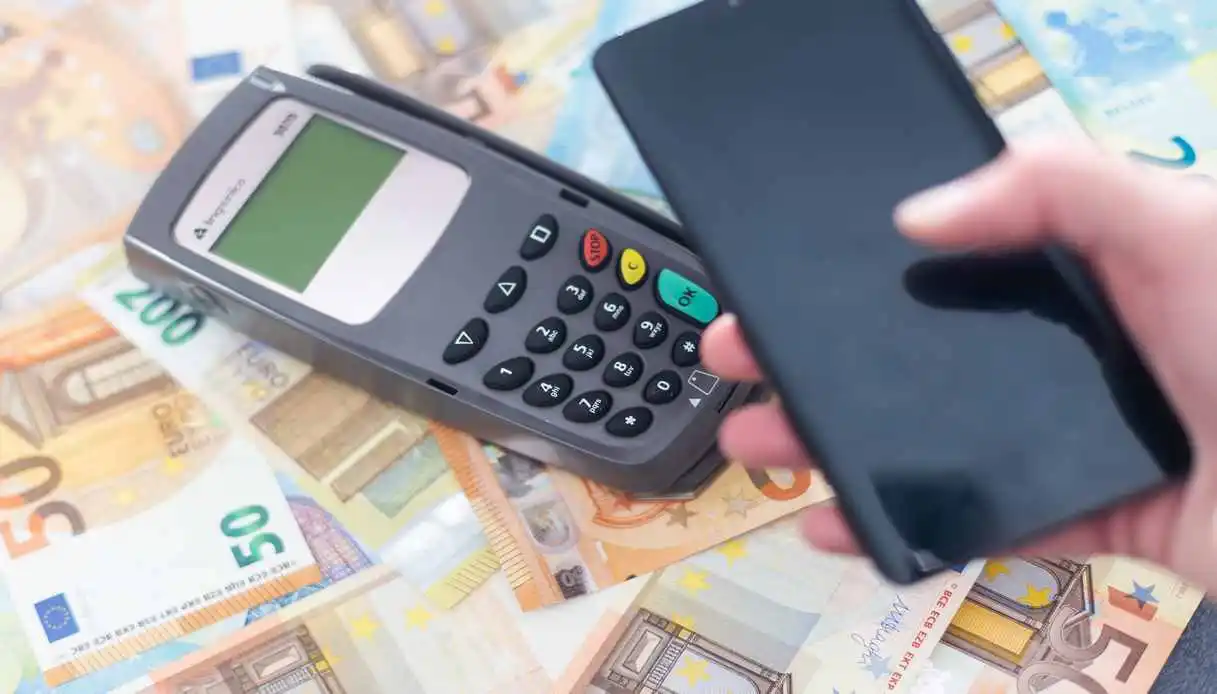
Italy pays faster and faster and less by physically inserting the card into the terminal. In 2025 88% of card payments made at the POS took place in contactless mode, compared to just over 50% in 2021. At the same time, smartphones, smartwatches and other mobile devices now represent 24% of transactions in physical points of sale.
It is one of the most significant data contained in the new one in-depth analysis by the Bank of Italy on payment instrumentswhich reconstructs how Italians’ habits have changed between 2018 and 2025. In seven years the number of operations carried out with alternative instruments to cash has more than doubled, exceeding 16 billion.
Yet the banknotes have not disappeared. Indeed: based on the latest available survey on payments at points of sale, referring to 2024, cash still represented 61% of transactions carried out in Italy by number of operations.
88% contactless doesn’t mean 9 out of 10 purchases are cashless
It is the most important distinction to read the data correctly.
88% do not indicate the share of contactless on all payments from Italians, but that on operations already made with card at the POS.
In other words, contactless isn’t just replacing the cash: it is above all replacing the old way of using the card, that is, inserting it into the terminal and typing the PIN when necessary.
However, the change is profound. Card operations at the POS have gone from approx 6 billion in 2022 to over 10 billion in 2025, with an average annual growth of 15.7%. The cards now represent approximately 75% of all transactions were non-cash, compared to 63% in 2018.
The ones that dominate are debit cardswhich in 2025 represented 71.2% of card transactions at the POS, ahead of prepaid and credit cards.
Because cash still remains the most used means
Digitalisation, the Bank of Italy itself observes, it does not automatically result in the disappearance of cash.
Withdrawals decreased: they were approx 1.4 billion in 2018 and just over 1.2 billion in 2025, but the possibility of obtaining cash remains widespread in the area.
Although the number of bank branches has fallen by more than 40% compared to 2008 and bank ATMs have decreased by around a fifth, at the end of 2025 98% of the Italian population lived within 5 kilometers of a cash access point. The average distance was just 1.2 kilometers and the average time needed to reach it by car was about 2.3 minutes.
The data helps explain why Italy is not suddenly transitioning from a cash economy to a fully digital one. The two systems, at least for now, continue to coexist.
Smartphones and instant transfers still change payments
Transformation isn’t just about cards.
In 2025 beyond 85% of transfers were made through digital channels, such as internet and mobile banking. The total number of bank transfers it almost doubled compared to 2018, going from around 970 million to over 1.8 billion transactions.
The development of instant bank transfers was particularly rapid: in 2025 they reached approx 298 million operations, reaching 24% of the transfers made through the European schemes considered by Bankitalia.
The new European framework also contributed, which obliges operators who offer ordinary bank transfers in euros to make instant ones available and prevents the latter from having higher commissions than the corresponding traditional bank transfer.
The South is the area where digital payments are growing the most
The payments revolution is also reducing some territorial differences.
Between 2020 and 2025 the number of operations per capita with instruments other than cash grew throughout Italy, but in the South the increase was 121%, the highest in the country. In the Center the growth was 88%.
The gap, however, has not yet disappeared. In 2025 they were registered 194 POS card transactions per inhabitant in the Centre, 179 in the North-West and 172 in the North-East, against 124 in the South.
Digital is therefore growing more rapidly precisely where it started from lower levels.
Italy isn’t saying goodbye to cash, it’s changing the way we pay
The Bankitalia data therefore reveal a transformation that is less simple than expected.
The Contactless has become virtually the standard when choosing to use a card, smartphones are taking a growing share of payments and instant bank transfers are accelerating, but cash continues to be used more frequently than any single alternative tool at the point of sale.
The real revolution is therefore not yet the disappearance of banknotes. It is the speed with which, when Italians choose not to use them, the gesture of payment is becoming increasingly more digital, immediate and invisible.