United States President Donald Trump, once again, has decided to rewrite geography and this time it was Lake Ontario’s turn to change nomenclature. We are talking about one of the five Great Lakes of North America, on the ridge between the US state of New York and the Canadian province of Ontario. Last Thursday, August 27, Trump signed an executive order changing its name to Lake America (a decision that came while the United States and Canada are in the midst of a trade dispute) while the Canadian government immediately made it known that it will continue to call the lake by its historic name, ignoring the American renaming.
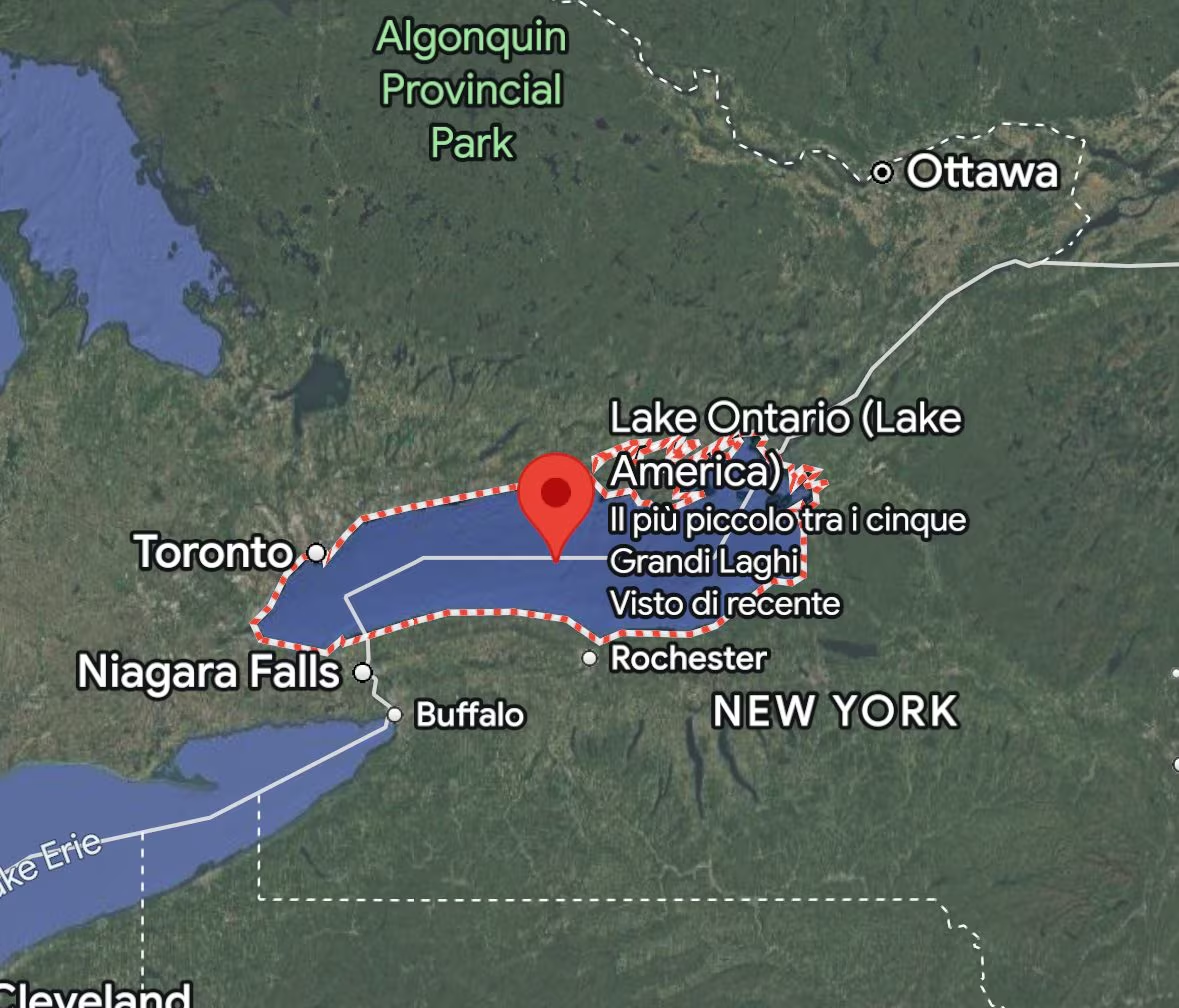
Within a few days, Google implemented the decision and the new name is already available on Google Maps for US users.
What Trump’s order entails and where Lake Ontario is located
Those who open the app from the United States can read the change “Lake America“, while those who open the app from Canada continue to see “Lake Ontario“, while in the rest of the world both names appear, with the new name in parentheses. As reported by CBS News, the executive order instructs Secretary of the Interior Doug Burgum to update the Geographic Names Information System (GNIS), the federal database that collects the official names of all geographic features for the United States, which works with the US Board on Geographic Names to standardize geographic names for federal use.
But where is the lake at the center of the dispute located? Its waters wash the state of New York to the south and the Canadian province of Ontario to the north. With its 19,529 km² of surface area, a maximum depth of 244 meters, a length of 311 km and a width of 86 km, it is the easternmost of the five Great Lakes of North America. With a coastline of 1146 km, its waters touch Toronto, Mississauga, Hamilton and Kingston on the Canadian side and Rochester on the American side.
Its fresh and bathing waters come largely from the Niagara River, the same one that generates the famous waterfalls, and then continue towards the Atlantic along the St. Lawrence River. Over 2 million people live on the American shore of the lake.
Who decides the names of places in the USA: could Google Maps refuse the change to Lake America?
The legal point is that this executive order is valid only in the United States, and therefore can only establish what the United States calls a place in its charters and deeds. At the same time, no law obliges Google, Apple or other platforms to adapt, being private, the decision to rename remains a corporate choice.
For its part, Google stated on its official page that its maps are being updated “to reflect name changes in official government sources”, before concluding by saying that “these updates follow our long-standing policy for water bodies whose names vary from country to country, and their release has begun now.” This is a consolidated practice, that is, applying name changes when they are updated in official government sources, but showing each country the locally recognized name.
And in Italy? How to change the name of a place
For us, a similar scenario would be difficult to replicate, because in Italy skills are distributed across multiple levels. For example, for the names of municipalities, the Constitution, according to Article 133 establishes that “the Region, having consulted the populations concerned, can with its laws establish new Municipalities in its territory and modify their districts and names”.
For lakes, mountains or rivers, the renaming is up to the competent territorial bodies, and the physical toponyms are regulated by the official cartographic bodies of the State, such as theMilitary Geographic Institute which also manages the Database of Italian Toponymy.
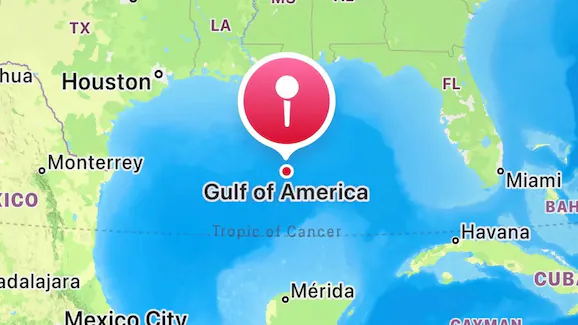
When the Gulf of Mexico became the Gulf of America
In 2025, on the day of his inauguration, Trump signed an executive order that changed the name of the Gulf of Mexico to the Gulf of America, and returned Denali, the highest peak in North America, to the old name of Mount McKinley. On that occasion the President of the United States declared: “We will change the name of the Gulf of Mexico to the Gulf of America, which is beautiful and appropriate precisely because it covers a vast territory”, a decision which today, as then, is valid only in the United States.
Even then Google announced that it would adapt once the change was made official, with the same geographical scheme, “Gulf of America” for US users, “Gulf of Mexico” for Mexican users, and both names elsewhere.