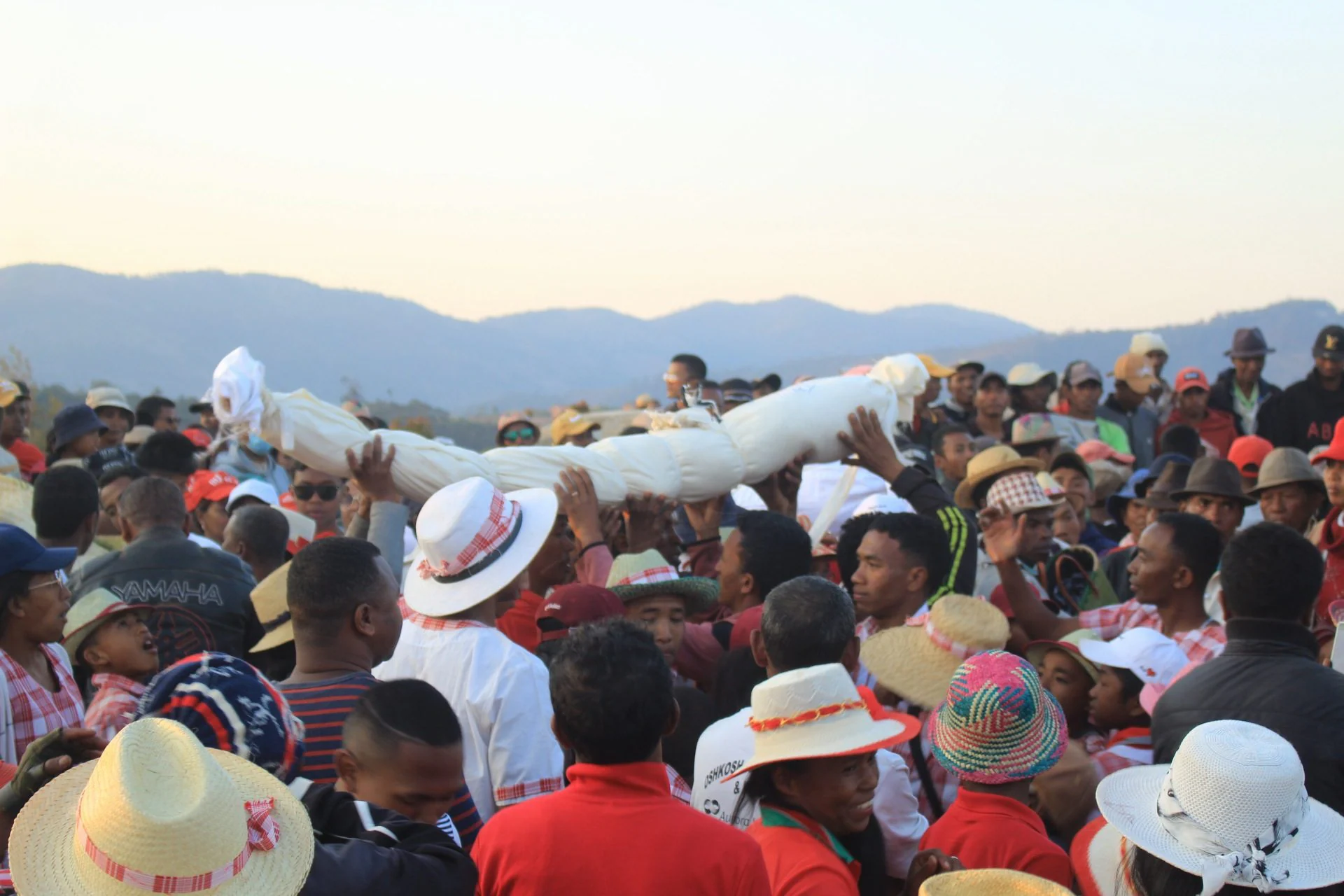
Let’s imagine a funeral: a community gathered, the body of the deceased, family members and, suddenly, laughter.
In contemporary Western sensibility, dominated by the idea of mourning as a solemn and silent experience, such a scene might appear disrespectful. Yet, in various societies laughter can find space in funeral rituals, taking on meanings that go far beyond fun.
Furthermore, anthropology – starting from Marcel Mauss’s fundamental studies on the social expression of feelings – has amply demonstrated how emotions do not possess a single cultural grammar. This is why crying, singing, dancing or joking do not necessarily represent contradictory responses to death: they can constitute different languages through which a community faces separation.
To understand why in some cultures it is welcomed to laugh during a funeral, therefore, we must first abandon the idea that there is only one appropriate way to show respect for the dead.
Rice as a ritual language: from Indonesia to Madagascar
In the Indonesian region of Tana Toraja, on the island of Sulawesi, funeral ceremonies can last for several days and involve many members of the community.
The ritual, known as Rambu Solo’includes animal sacrifices, family gatherings, banquets and social moments. Alongside the pain, there is space for conversations, stories and convivial occasions.
For the Toraja, death does not necessarily coincide with an immediate separation. In some traditional practices, the deceased is kept in the family home until the funeral is celebrated, as part of a gradual process of transformation of his social and spiritual status.
In Madagascar, the practices of “famadihana”, widespread in particular among some communities in the highlands, involve the periodic reopening of family tombs and the relocation of the remains of ancestors in new shrouds. The ceremony can be accompanied by music, dance and celebrations.
The anthropologist Maurice Bloch, in “Placing the Dead” (1971), analyzed the relationship between funerary rituals, kinship and social continuity in Madagascar. In fact, the celebration does not only concern individual loss: it also reaffirms the bond between the living and ancestors, transforming death into an occasion for joyful collective recomposition.
These examples do not mean that all participants laugh or that pain is absent. Rather, they show how solemnity does not constitute the only possible language of respect.
Why do we laugh in the face of death according to studies
Laughter during funeral rituals can be interpreted through different theoretical perspectives.
Arnold Van Gennep, in “Rites of Passage” (1909), described rituals of passage as processes divided into separation, transition and reintegration. Death does not only involve those who disappear, but changes the entire social organization: an individual becomes an ancestor, a spouse becomes a widower, a family redefines its relationships.
Victor Turner, in “The Ritual Process” (1969), developed the concept of “communitas”, a particular experience of solidarity that can emerge during the liminal phases of rituals.
In this context, shared rice can help temporarily reduce social distances and strengthen a sense of belonging.
A different perspective comes from Henri Bergson’s theory of laughter, expounded in “Le Rire” (1900). For the French philosopher, comedy has an essentially social dimension: laughing also means recognizing, negotiating and sometimes correcting the rigidities of collective life.
Applied to funeral contexts, this insight suggests that humor can help a community grapple with the eruption of death into the everyday order.
Laughter during a funeral, therefore, does not necessarily demonstrate the absence of suffering: it can represent a form of emotional regulation, a fond memory or a moment of shared relief.
The funeral as a reversal of order: jokes, ancestors and carnival
In some traditions, funeral laughter takes on an even more complex function: symbolically interrupting the power of death.
Among some communities in Ghana, especially within Akan funerary traditions, funerals include music, dance, elaborate dress, and public celebrations. Collective participation expresses the social prestige of the deceased and the continuity of community ties.
In other contexts, such as some traditional Irish wakes, humorous tales, games and pranks have historically accompanied the presence of the body, alongside prayers and displays of grief.
Humor allowed us to remember the deceased through episodes of his life and to support family members in the vigil.
This co-presence of solemnity and comedy recalls the concept of carnival developed by Michail Bakhtin in “L’œuvre de François Rabelais et la culture populaire au Moyen Âge et sous la Renaissance” (1965). In its interpretation, carnival laughter temporarily suspends hierarchies, overturns conventions and allows us to confront what normally arouses fear.
Although Bakhtin did not propose a general theory of funerals, his thought offers an interesting key: laughter can represent a symbolic response to the rigidity of the social order and the inevitability of death.
From this perspective, laughing does not mean mocking the deceased. It means, sometimes, reaffirming the ability of the living to maintain relationships, produce meaning and continue to exist despite loss.
Who decides how we should suffer? Emotions as cultural constructions
The idea that a funeral must necessarily be silent and austere is not universal, but belongs to specific historical and cultural traditions.
The anthropologist Marcel Mauss, in the essay “L’expression obligatoire des feelings” (1921), showed how the manifestations of grief in funeral rituals are not only individual reactions, but also socially regulated behaviors.
Ritual crying, for example, can follow precise conventions, regardless of the intensity of the personal feeling.
This insight anticipates a central question in the anthropology of emotions: we do not necessarily experience different emotions, but we learn culturally appropriate ways of expressing them.
The sociologist Arlie Russell Hochschild, in “The Managed Heart” (1983), introduced the concept of “feeling rules”, that is, social rules that guide what we should feel and manifest in certain situations.
A funeral is a particularly clear example of these expectations. In some communities it is appropriate to cry publicly, in others the demeanor, celebration or ability to recount funny episodes from the life of the deceased are valued.
The distinction between respect and irreverence therefore depends on the meaning attributed to behaviors, not simply on their external form.
This does not imply that all laughter is acceptable at any funeral. Even in societies where humor finds space, there are limits, moments and shared codes. What appears respectful in one context may be offensive in another.
Laughing during a funeral does not necessarily mean trivializing death. In certain cultural contexts, humor can accompany grief, strengthen community bonds and transform separation into a moment of social continuity.
Perhaps what makes laughter seemingly out of place is not its incompatibility with pain, but our habit of imagining that suffering must have a single expression.