A refrigerator that goes out of control due to a hacker attack can force a supermarket to throw away its goods. But if the same problem concerns collective catering and healthcare, the consequences could go beyond economic losses.
This is the risk highlighted by the latest episodes reported in Europe. Alongside the attacks on supermarkets in France, those that occurred in Belgium, Sweden, Luxembourg and Estonia and the cases recorded in Italy, two other episodes emerged involving a company that prepares thousands of meals and three French facilities where plasma for transfusions is stored. The two events show why the stakes change depending on what is kept in the cold.
Hacker attacks, the canteens of Florence and plasma in France: what happened
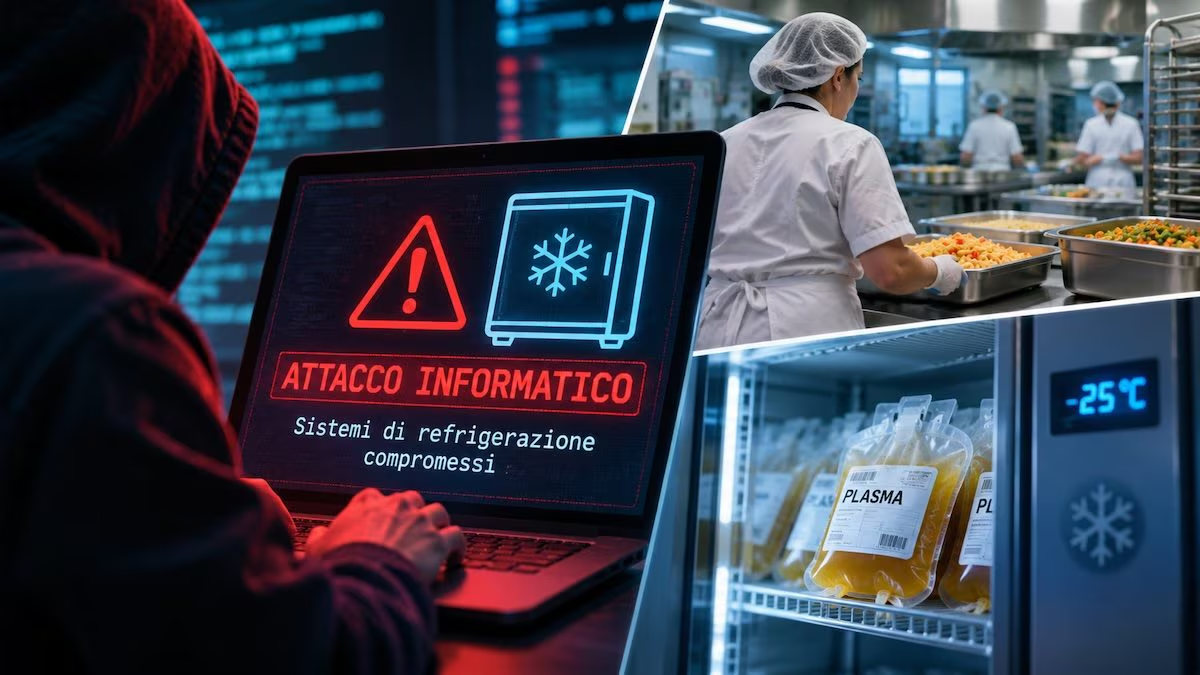
On 2 November 2026, a cyber attack affected the refrigeration management systems of SIAF, a company based in Bagno a Ripoli, in the province of Florence. The company prepares approximately 16,000 meals a day for schools and healthcare facilities, as well as providing corporate catering.
The company reported that it had promptly identified the anomaly and activated the necessary measures to limit it. Supplies to the canteens continued without interruption. According to what emerged, however, the problem would have involved six cold rooms in the cooking areas, causing the deterioration of some raw materials, with damage estimated at around 500 euros.
The attack affected the systems used by those who prepare meals, not the refrigerators of hospitals or schools supplied by SIAF. Even a supplier company, therefore, can become a critical point for the activities of other entities.
In France, on the same day, a different episode was recorded. Three sites of the Établissement français du sang (EFS), the public body that manages the collection and distribution of blood and its components, were involved in a cyber incident that affected a supplier of the refrigeration equipment used to store plasma.
According to reconstructions in the French press, the parameters relating to temperature and defrost were altered, with values set up to 110 °C. This data does not indicate the temperature actually reached by the plasma. The alarms allowed staff to secure or relocate the bags before they were damaged. EFS confirmed that no blood products were lost and that collection and distribution activities continued as normal. A direct link between this episode and the supermarket attacks has not been established.
What happens if the cold chain is broken
In kitchens that prepare meals on a large scale, cold rooms are part of an organization that must receive raw materials, store them, prepare dishes and deliver them according to specific times. If a system stops cooling properly, scheduled processes can be affected, even before the food reaches the recipients.
The cold chain consists of maintaining the required temperatures during the different phases of conservation and transport. To understand whether an anomaly has compromised the preservation of food, it is not enough to check the display of a refrigerator just once: it is necessary to reconstruct how long and at what temperatures the products were left, identifying the affected batches.
This is where food self-control procedures based on HACCP (hazard analysis and critical control points) principles come into play. This system involves identifying risks, monitoring critical phases and adopting corrective measures when certain limits are exceeded. An anomaly does not automatically render all food unusable, but if its safety cannot be guaranteed, the affected batches must be excluded from the preparation of meals.
For frozen foods, for example, the expected storage temperature is normally -18°C or lower, while other perishable foods require different values. The cold slows down the proliferation of microorganisms, but does not sterilize the food, which is why even the defrosting of frozen foods must take place in suitable conditions. If part of the stock has to be discarded, a canteen may therefore find itself having to source replacement ingredients, change the menu or reorganize the preparation of meals.
Hospitals, drugs and vaccines: the risks for other sectors that depend on refrigeration
Healthcare adds another dimension to the problem. Plasma is the liquid part of the blood and contains proteins, including clotting factors. It can be used in transfusions or sent to the pharmaceutical industry to make medicines. To maintain its characteristics, fresh frozen plasma intended for clinical use requires very low temperatures, generally -25°C or lower. Any deviations may require quality checks before authorizing use.
Storage temperatures, however, vary from one healthcare product to another. Most vaccines, for example, require values between 2 and 8°C. For some, even accidental freezing can compromise its effectiveness.
In addition to blood transfusion facilities and vaccination centers, refrigeration is essential for some medicines, biological samples and laboratory materials. On the food side, however, it involves production plants, warehouses, logistics centers and temperature-controlled transport. These are potentially exposed areas when they use connected and vulnerable equipment, not a list of services already compromised by the November attacks.
In the healthcare sector, the possible loss of medicines or blood products could temporarily reduce the supplies available for some treatments. To limit the consequences, alongside IT protection, continuity plans are needed that include alarm systems, alternative structures in which to quickly transfer products and procedures to isolate those potentially compromised, pending the necessary checks.