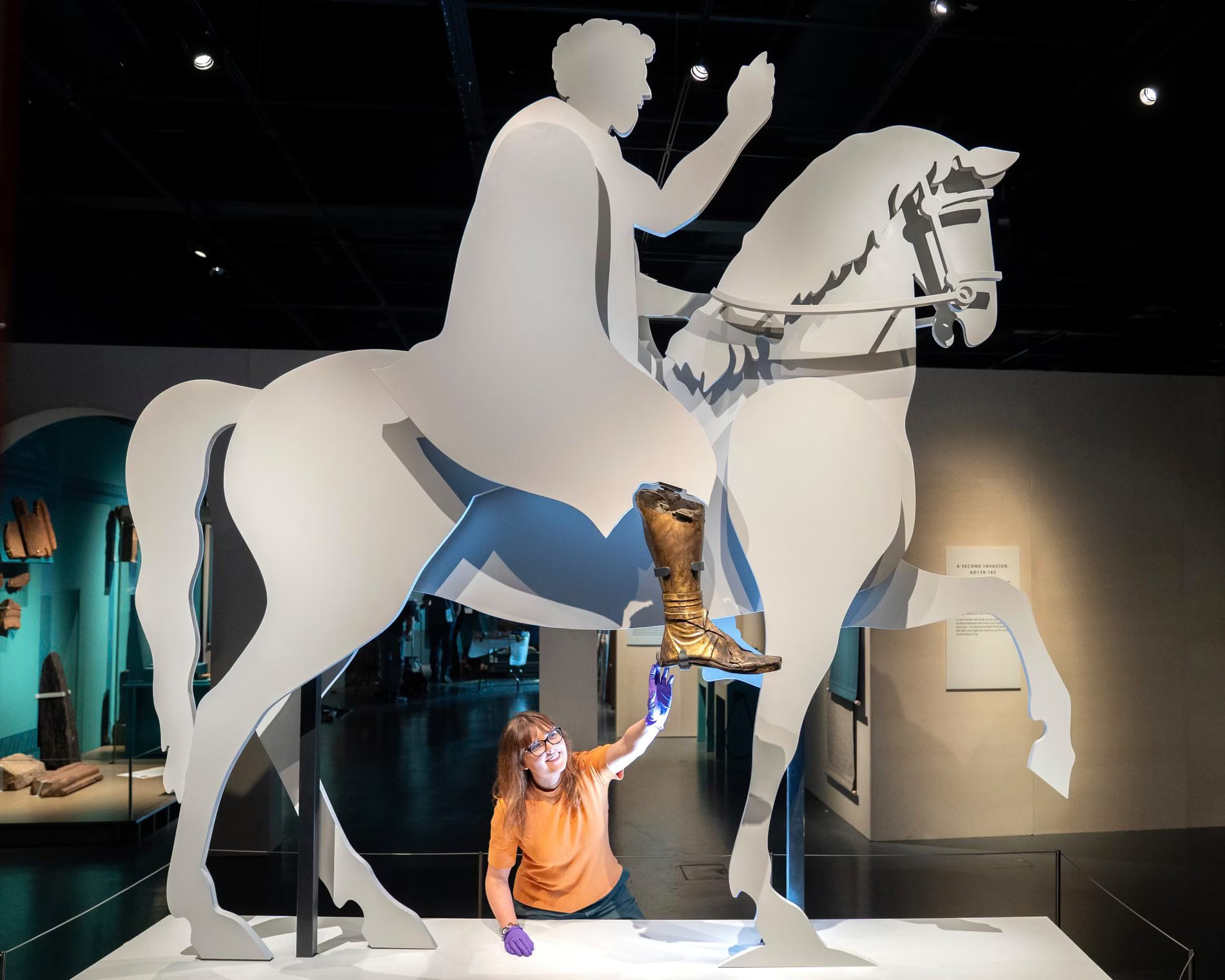
A gilded bronze leg – recovered over two centuries ago in a peat bog in southern Scotland – may belong to a monumental equestrian statue of the Roman emperor Antoninus Pius (his reign began in 138 and ended in 161 AD). This is the new interpretation proposed by scholars at National Museums Scotland, who re-examined the find for the exhibition Roman Scotland: Life on the Edge of Empireopening November 14, 2026 in Edinburgh.
The fragment, known as Milsington legwas discovered in 1820 in a marshy area near Hawick. It is the lower part of a right leg, complete with foot fitted with a boot, made of gilded bronze. Its dimensions indicate that it belonged to a sculpture of considerable proportions, probably depicting a high-ranking figure, as was common in Roman statuary of the 2nd century. d. C. For a long time it was hypothesized that the find came from a Roman statue located further south, perhaps in York, the ancient Eburacumand that it had been transported to the place of discovery. The new reconstruction, supported by archaeologist Fraser Hunter, suggests that the sculpture was originally located near Hawick, in an area affected by the Roman military presence during the occupation of southern Scotland.
According to this interpretation, the statue may have depicted Antoninus Pius, emperor from 138 to 161 AD. It was during his reign that the Romans advanced north again, occupying part of present-day Scotland and building the so-called Antonine Wall, a fortified line that crossed the territory between the Firth of Forth and the Firth of Clyde, at the narrowest point of Scotland. It is a less well-known and less preserved defensive structure than the more famous Hadrian’s Wall, located further south.
An interesting element concerns the ways in which the leg was separated from the rest of the sculpture. The fragment has no obvious cut marks in the upper part, which could indicate intentional disassembly rather than violent destruction. Scholars hypothesize that the statue was dismantled by the Romans during the progressive abandonment of the more northern territories, perhaps to recover the precious metal.
However, the proposal remains a hypothesis: the fragment does not preserve an inscription that allows us to identify with certainty the character depicted, nor has the exact place where the monument stood has been identified. The new interpretation, however, gives the find a possible historical context, connecting it to the Roman imperial presence on the northern borders of Britain, and shedding light on a marginal area of the empire such as present-day Scotland.