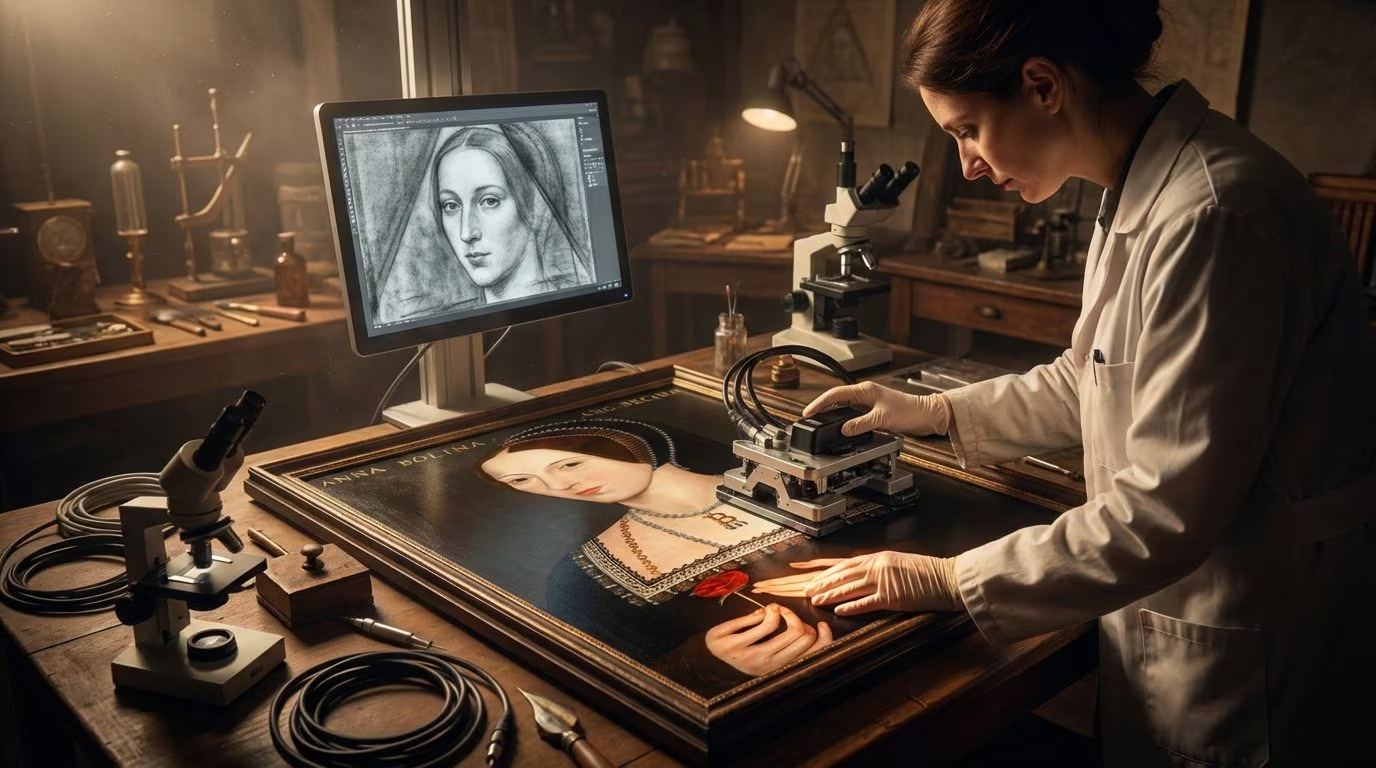
A detail that remained hidden under a famous painting for almost five hundred years has come to light, revealing a forgotten but precious story. It is the Guardian that reveals that, using infrared technology, a group of scholars has found another drawing, a triangular shape, under the superficial layers of a famous sixteenth-century English painting, which tells us what some English intellectuals thought of Anne Boleyn, Queen of England.
Let’s take a step back.
It was 1533 when the King of England Henry VIII divorced his wife Catherine of Aragon, an act that led him to break with the Catholic Church and found the Anglican Church. At that point he was able to marry Anne Boleyn for a second time.
This was a fact which led to the emergence of heavy accusations of witchcraft against the new queen consort throughout England. These worsened with the passage of time, also given the bad reputation that Anna earned with her husband by failing to conceive a male heir. In 1536 she was imprisoned for adultery in the Tower of London, then found guilty of treason and beheaded.
In the following years, Henry VIII, who married six wives, had every trace of Anne erased, to the point that no portrait made during her lifetime has survived to the present day. However, a famous painting from a later period survives, the portrait of Anne Boleyn of Hever Castle, also called “Rose”: it is one of the most famous paintings in the history of English art, created on a wooden panel a few decades later during the years of the reign of Anne’s daughter, Elizabeth I of England.
The scientific analysis of the painting has both made it possible to date the panel to around 1583 (through dendrochronology, i.e. the counting of the rings of the wood) and, through infrared, to discover the precise moment in which the Elizabethan artist moved away from the preparatory drawing: this model actually presented a triangle below the subject, which would have ensured that the hands could not be seen. The author instead decided to discard this option to depict Anna in the gesture of holding a red rose, with her hands and fingers clearly visible.
But what does this choice mean, and why is it so relevant? Showing all the fingers had a specific purpose in the eyes of those who looked at it, namely to exonerate the unfortunate wife of Henry VIII from the accusation of being a witch.
The artist, in fact, removed the “sixth finger” that Anna was said to have on her right hand. This rumor had been put into circulation by the writer Nicholas Sanders, who in the 16th century fought for the restoration of Roman Catholicism in England and tried to discredit Elizabeth I. The portrait, in this way, restored dignity to the mother and legitimacy to the daughter.