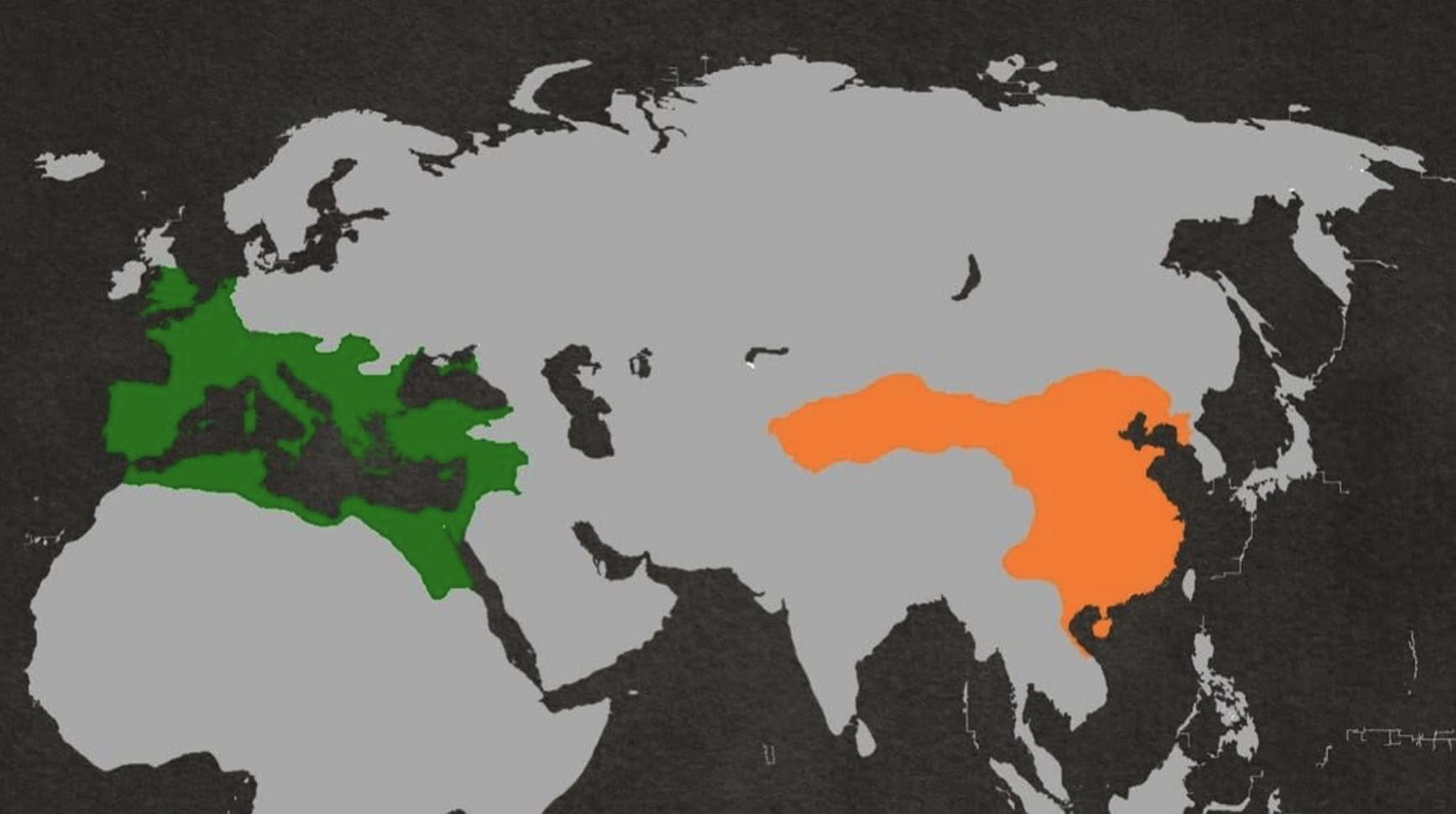
The two largest empires in the ancient world, namely the Roman and the Chinese one, knew about mutual existence, but the direct contact between them was precluded from the presence of the Persian empire, which had all the interest in placing itself as a mediator between Rome and China, above all to maintain control over the Silk Road in Central Asia. The two empires exchanged luxury goods, and the mediation of Persia also allowed the latter to enrich themselves.
Although historical and archaeological sources point out as starting from the 1st century. The commercial contacts between Rome and the kingdoms of ancient India were quite narrow, with the presence of Roman merchants in the subcontinent and perhaps of Indian merchants in the Empors of the Red Sea, the same cannot be said regarding China. The direct contact between the Roman Empire and the Chinese one, which at the time was held by the Han dynasty, was impossible, since the main commercial streets of Central Asia were in the hands of the Persian Empire, governed by the parties, historical enemies of Rome.
However, it should not be excluded that commercial contacts between Roman and Chinese merchants, perhaps mediated by Indian intermediaries, could take place in India or Indochina. The presence of products of Mediterranean origin is archaeologically attested in the territories of the current Vietnam, at the time part of the Chinese empire, and even in the Japanese archipelago, although it is more likely to have been brought there by Chinese merchants. In geographical terms, most likely, the Romans did not know precisely where China was, and vice versa.
The good imported from China most appreciated in Rome was naturally silk. It is a material that is not preserved in the archaeological level, so what we know must have it to written sources. Possessing clothes made in this precious light fabric was an important status symbol within the Roman society of the imperial era. The use of silk caused a scandal in the most conservative fringes of Roman society, due to the fact that this fabric was coveted by the women of the aristocracy. Here is how the philosopher Seneca (4 A. C. – 65 D.) condemns the silk clothes, connoted as immoral:
Here are the clothes of silk, if you can call the clothes of the fabrics in which there is nothing that can protect the body or at least the modesty, that a woman, wear them, would sucking to swear that she is not naked.
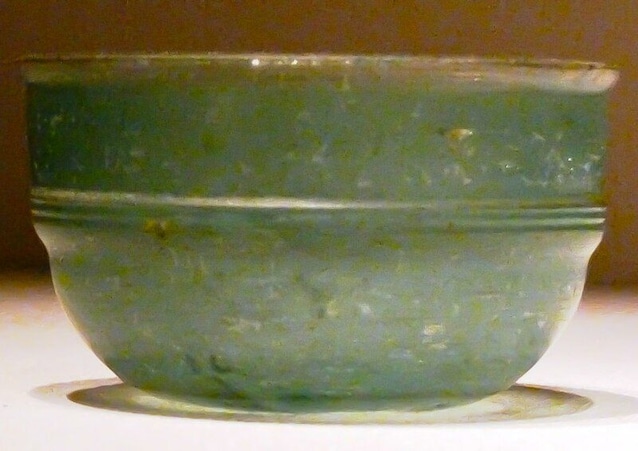
The mental association between the silk and the empire of the East was such, that in Latin, it was referred to that land by calling it it Sericaliterally the “land of silk”. The Chinese instead particularly appreciated the glass and silver products from the Mediterranean. The presence of these assets is archaeologically attested on Chinese territory.
In addition to commercial, most likely Rome and China also integrated diplomatic ties. The Chinese Empire recognized the Roman one as its peer, and it can also be seen from the deadline with which the Chinese called Rome, that is Daqinliterally “the great Qin“. The term with which in China was referred to one’s empire was just Qintherefore, connote Rome with the same term denotes a equal position. A flaking of the Seres, as the Romans called the inhabitants of the Sericais attested to the time of Augustus (31 BC – 14 DC), while at the end of the first century. DC, at the time of the emperors Nerva (96-98 d. C.) and Trajan (98-117 d. C.), a Chinese explorer named Gan Ying went to the Roman territories in Mesopotamia and Syria.
The first real diplomatic contact documented by Chinese sources took place in 166 d. C., when a group of emissaries, or more probably Roman merchants, went to the presence of Emperor Huan (146-168 AD). Here’s how the source describes the meeting:
The king of this state has always wanted to relate to Han. But the parties wanted to trade with them in the silk of the HAN and placed obstacles on their way, so as not to have direct contacts. It was so until the ninth year of Yanxi, under the reign of Emperor Huan, when Andun, king of Daqin, sent an ambassador beyond the frontier of the Rinan, and offered an elephant zanna, a rhinos horn, and a turtle shell. It was only then that communications were established.
Considering the year in which this meeting took place, 166 AD, “King Andun” can be identified as Emperor Antonino Pio (138-161 AD), or his successor Marcus Aurelio (161-180 AD), also known as “Antonino”. It is mentioned how the group passed the border of Rinanwhich was the Chinese name with which the southernmost province of the Empire was called, corresponding to the current Vietnam, an area in which the presence of Mediterranean goods is archaeologically attested. In addition, these merchants brought with them, clearly coming from Africa, reporting how probably travelers who came through the Indian Ocean, in the well -known commercial network that connected the coasts of the Red Sea with India.
Subsequently, other Roman ambassadors in China are attested by the Han sources during the third century. d. C. Subsequently, in a sporadic way, contacts between the Chinese Empire and the Roman Empire of the East (Byzantine) are remembered, to which the Chinese referred to the term “Fulin“, probably Chinese transliteration of the word with which the Persians referred to the Roman Empire of the East, or”frwm“, literally” Rome “.










