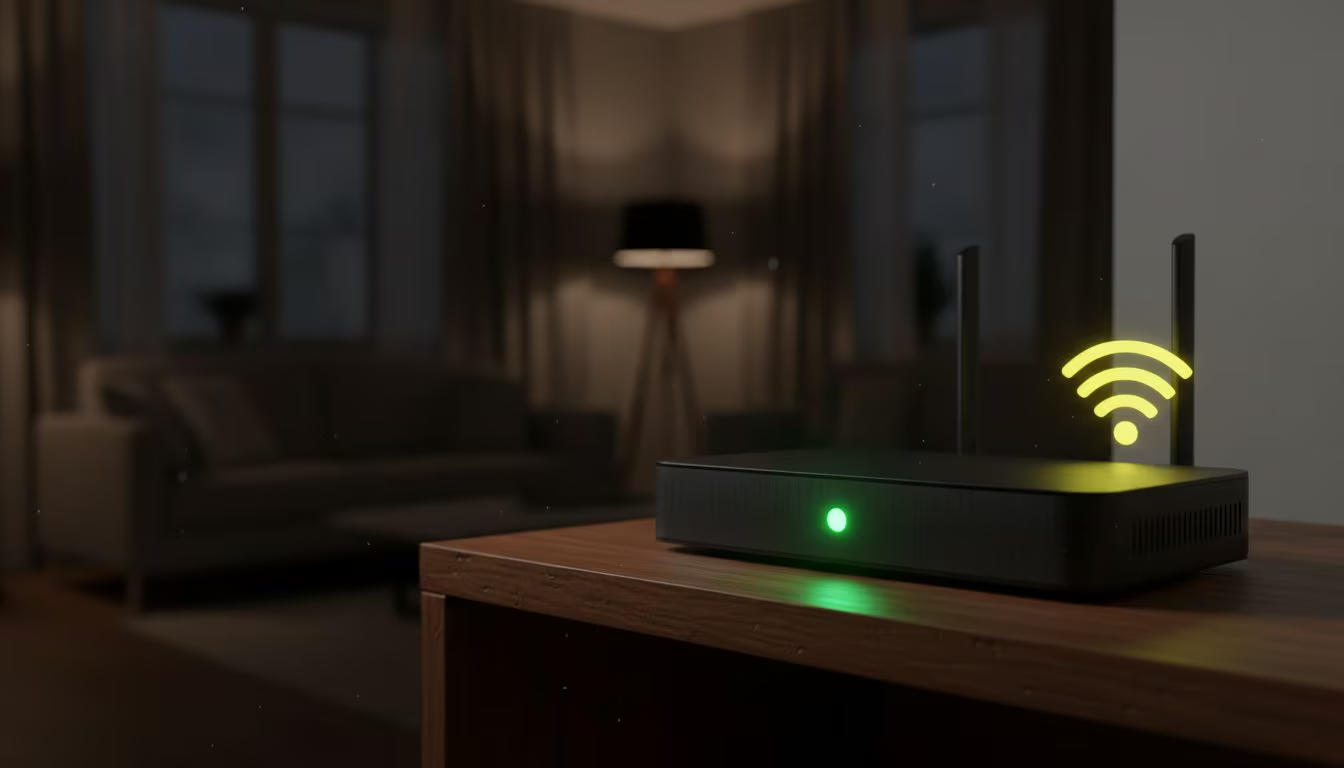
The little green light that flashes in the darkness of the corridor or living room has become a constant presence in our homes, and perhaps you too will have wondered at least once, looking at it, if there are any risks in keeping the Wi-Fi on all night, when we should be sleeping peacefully. To understand whether turning off the home modem during the night makes sense or not we must analyze the pros and cons using different “lenses”: that of ease of use and IT security, that of the effects of electromagnetic fields on our health and, last but not least, that of energy saving. As you will learn after reading the article, there is no right answer that is valid for everyone. So, consider your specific situation and draw your own conclusions.
Ease of use and IT security
Going into the heart of the purely technological issue, it is useless to hide behind a finger: leaving Wi-Fi always on is the solution that winks at ease of use. After all, modem routers were designed to operate 24 hours a day, 7 days a week. If we leave the router active, we guarantee that any sudden need for connectivity, even if caused by an episode of insomnia, will be satisfied immediately without the annoying waiting times necessary for it to restart. In fact, when we turn a switched off modem back on, the device must perform a series of hardware self-diagnoses, hook up to the line carrier and negotiate the connection with our Internet Service Provider (ISP), a process that can leave us isolated for a handful of minutes, enough to make us impatient if we need an instant Internet connection.
Even more critical is the scenario in which our home is equipped with a cloud-based video surveillance ecosystem or smart sensors for security: in this case, turning off the router means creating temporal “black holes” in the recording of images, making the home vulnerable precisely at the moment of greatest risk, at night. Not the best, especially for smart home fanatics.
However, keeping the device always operational exposes it to risks of a different nature, first and foremost cybersecurity. A router that is turned on is visible and potentially attackable: as long as the signal is transmitted, an attacker (be it a remote hacker or someone physically close enough to intercept the signal) could attempt to violate our network. If it manages to overcome the protection barriers, it would have free access to all connected devices, from smart TVs to our smartphones. Turning off the modem, therefore, makes us temporarily invisible and unassailable. For this reason, if we decide to leave it on, our first line of defense must be a robust configuration: the use of advanced encryption protocols such as WPA2 or, better yet, the more recent and advanced WPA3, combined with changing the factory default passwords, offers us a level of protection generally sufficient to sleep reasonably soundly (at least on the cybersecurity side) even with Wi-Fi active at night.
The debated issue of health
Then there is the often heated debate on the effects of electromagnetic waves on health. After decades of studies, the scientific community, represented by IARC (International Agency for Research on Cancer), or the International Agency for Research on Cancer, has classified radio frequency electromagnetic fields in Group 2B. This means that they are «possibly carcinogenic‘, a definition indicating limited evidence of risk in humans and insufficient evidence in experimental animals; to be clear, it is the same category in which we find common substances such as aloe vera extract or aspartame. To date, there is no proof of the cause-effect link between exposure to domestic levels of Wi-Fi and the onset of tumor pathologies, since it involves non-ionizing radiation, i.e. it lacks the energy necessary to break the DNA bonds in our cells. Despite this, for those who wish to apply the precautionary principle, turning off the router (or moving the smartphone away from the pillow) reduces exposure to zero, even if the emissions from a modem are already extremely low, often lower than those from a mobile phone on a call.
In this regard, Dr. Francesco Bochicchio, ofHigher Institute of Healthhe reassured al Corriere della Sera:
These devices (tablets, computers and Wi-Fi modems, Ed.) have an emission power similar to or lower than mobile phones, so there are no health risks (as regards electromagnetic fields) in keeping them turned on at night.
Savings on bills and energy
When deciding whether or not to keep the Wi-Fi turned on at night, we must also look at the issue of wallet and environment which, given the historical period we are living in, is absolutely central. On average a Wi-Fi modem can consume something like 8-10 watts. They may seem few, but with uninterrupted operation for 365 days a year it leads to a consumption of several kilowatt hours. By turning it off for around eight hours a night, we could save a modest amount, in the order of a few euros a year, which however, if multiplied by millions of families, represents a non-negligible collective energy saving. If the idea excites you and you don’t want to have to remember to physically unplug every evening, you can come up with some smart solutions, such as the use of timed sockets.