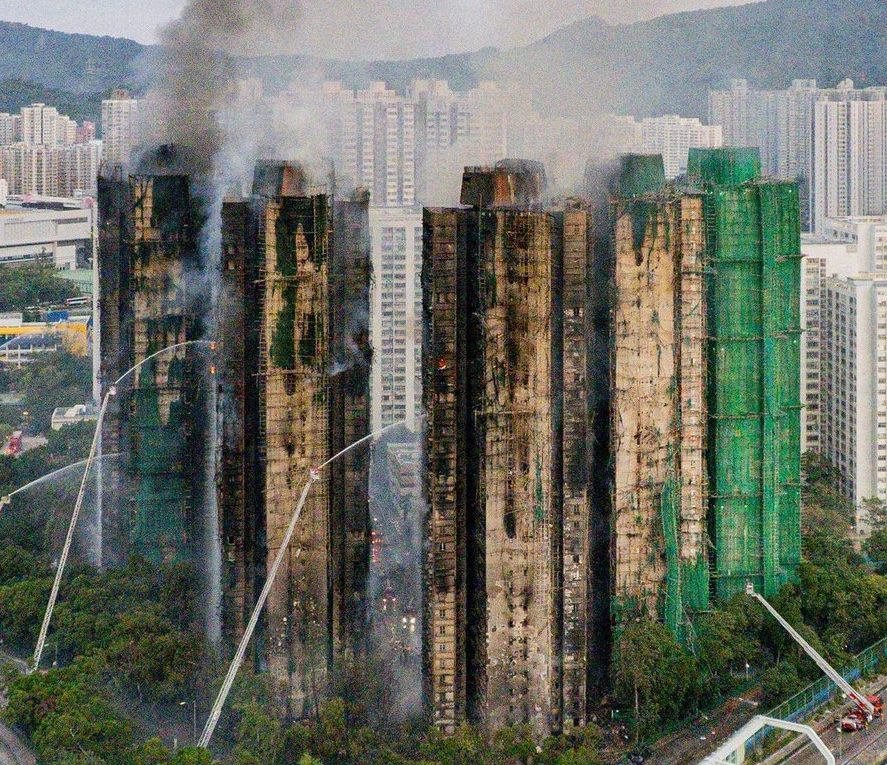
The fire that broke out in the Wang Fuk Court residential complex, located in the Tai Po district of Hong Kong (China), caused at least 65 deaths and around 279 missing: while the death toll continues to rise and the firefighters work incessantly to put out the flames that engulfed 7 of the 8 buildings, the authorities have opened an investigation to clarify the causes of the accident. In the residential complex – made up of 8 skyscrapers and around 4,000 tenants – renovation works were underway, for which external bamboo scaffolding had been used.
But why is bamboo still used for external scaffolding in one of the most advanced metropolises in the world? In reality, it is a material used historically in the construction sector in Hong Kong: bamboo, in fact, is cheap, easily transportable and quick to install. Also for this reason, it is sometimes used in other areas of China and throughout East Asia. But its use also brings with it risks, especially if certain safety criteria are not respected.
In any case, as also confirmed by some experts contacted by Geopopthe presence of bamboo scaffolding may have been an accelerator of flame spread, but cannot be considered as the main cause of the fire outbreak.
Reasons why bamboo is still used in Asia: advantages of the material and traditions
As numerous local newspapers have highlighted – including the South China Morning Post –, despite Hong Kong being one of the most modern metropolises, the bamboo is a material distinctive of this territory and was heavily used as scaffolding during the construction of the skyscrapers that today characterize the city’s skyline.
The use of bamboo in scaffolding, in fact, has its roots in local tradition dating back over a century, but still persists today thanks to a series of technical and economic advantages, to the point of being quite widespread even in some parts of continental China, India, South-East Asia and South America.
First of all, bamboo ensures extraordinary speed in assembly and disassembly cycles of scaffolding: it has been estimated that building a bamboo structure requires approximately half the time necessary to create an equivalent steel scaffold. At the same time, the overall cost for transportation and installation is significantly lower, which guarantees a significant economic savings. Scaffolding is usually held together by tightly knotted plastic bands or steel brackets and then anchored to buildings.
Among other things, from a structural point of view bamboo has a good strength-to-weight ratio: a pole made of this material is light enough to be carried up a ladder, but is also strong enough – if braced and tied correctly – to support workers.
In short, bamboo is still used today in Hong Kong for 3 main reasons: it is quick to assemble, easily adapting to even the narrowest buildings (an indispensable factor in the high urban density of Hong Kong), it is extremely cheap compared to the metal alternative and it is a material traditionally used in this area.
Risks and problems of bamboo scaffolding
Despite these benefits, the use of bamboo for scaffolding presents two major problems: the first certainly concerns the high flammability of the material. In fact, in an interview with the South China Morning Post Raffaella Endrizzi, professor at the Faculty of Architecture at the Chinese University of Hong Kong, underlined how bamboo is a material that is partly resistant to combustion, as it retains a considerable amount of humidity within it.
In the specific case of the Wang Fuk Court residential complex, the scaffolding had been erected last July: it is therefore possible that, over the course of these months, the bamboo has dried, thus becoming an ideal material for the spread of flames.
The second problem has to do with the fact that bamboo is an organic material and, as such, is strongly influenced by atmospheric agents, which can compromise its integrity over time. Also for this reason, the Hong Kong Building Department has drawn up clear guidelines for the construction of bamboo scaffolding, imposing specific criteria for the use of this material, including:
- age of bamboo;
- diameter of bamboo canes;
- degree of drying of bamboo;
- the presence of steel brackets to connect the bamboo canes;
- The authorities must also carry out frequent inspections, especially before bad weather.
Returning to our specific case, the causes of the fire have not yet been confirmed by the authorities, who are also investigating the presence of polystyrene on the windows and the possibility that the protective net placed around the buildings spread the fire. John Lee, governor of Hong Kong, declared the opening of discussions for the gradual replacement of bamboo scaffolding with metal ones.