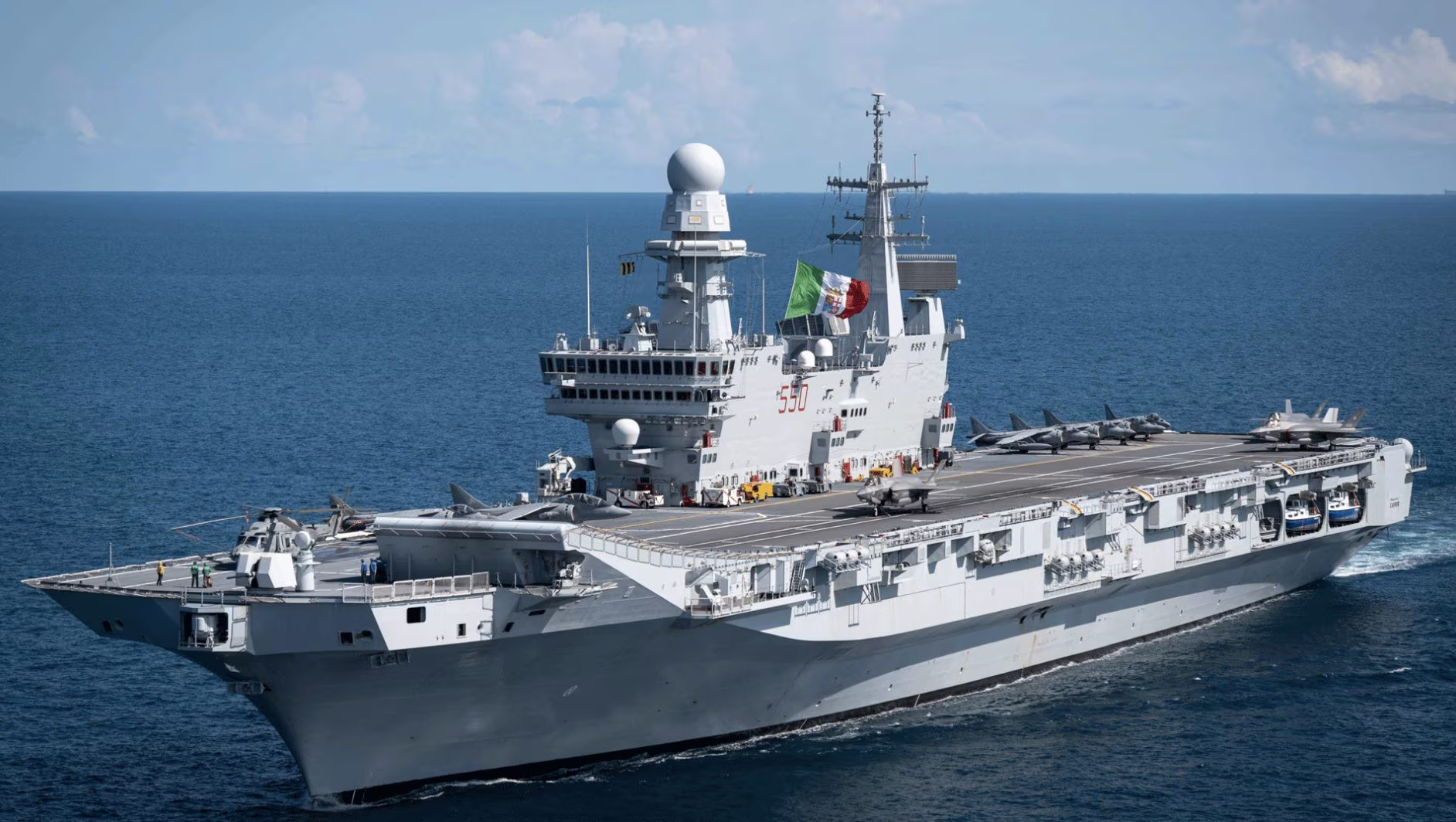
From the moment they made their debut during the First World War, aircraft carriers have gradually established themselves as an irreplaceable element of the naval strategies of all those countries which, from time to time, have had the technical capabilities and political-strategic will to deploy them and keep them in service, despite the exorbitant operating costs. Today, around 50 aircraft carriers are in service around the world with 15 different navies, with the Italian Navy falling into this elite club by currently having two aircraft carriers in active service: an in-service light aircraft carrier, the Cavour, and a second unit, the amphibious assault ship Trieste.
The Regia Marina and the Italian ships Aquila and Sparviero
Italy’s interest in aircraft carriers comes from afar and dates back to the period between the two world wars, when the deep-sea combat nucleus of the navies of the great powers was still made up of battleships and battlecruisers. In 1926 and 1927, at the request of the then Royal Navy, the Ansaldo shipyards of Genoa began work on two aircraft carriers which were renamed “Aquila” and “Sparviero” respectively. Curiously, these naval units did not constitute vessels from scratch since to obtain them the hulls of two transatlantic liners were converted, respectively the “SS Roma” and the “MS Augustus”.
However, the work proceeded slowly, not to mention the fact that the Royal Navy never managed to develop operational doctrines dedicated to the use of the aforementioned aircraft carriers, so much so that they were still incomplete not only at Italy’s entry into the Second World War (1940) but even at the date of the armistice (8 September 1943). Predictably, the two incomplete units were captured by the Germans who, on 5 October 1944, sank the Sparviero at the entrance to the port of Genoa to block access to the Allies.
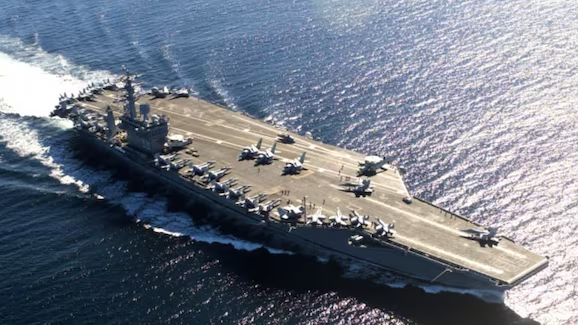
As for the Aquila, however, being 90% completed at the time of capture, it was chosen by the Germans as a future aircraft carrier for their Kriegsmarine, but their plans were frustrated by the fact that it was repeatedly damaged by Allied air attacks. Finally, the ship was sunk in the night between 18 and 19 April 1945 during an operation by the naval raiders of the Marivolto, that part of the 10th MAS Flottiglia, which after 8 September 1943 had remained faithful to the Kingdom of Italy, now a co-belligerent of the Allies.
The aircraft carrier Garibaldi during the Second World War
At the end of the Second World War, the hulls of the Aquila and the Sparviero were recovered and dismantled. Decades had to pass before Italy could venture into the field of aircraft carrier construction again, given that the clauses of the peace treaties sealing the end of the Second World War expressly prohibited our country from equipping itself with this class of ships with a markedly offensive role.
Things changed only several decades later when, on 26 March 1981, work began at the Fincantieri shipyards in Monfalcone (Trieste) which culminated in the construction of the “Giuseppe Garibaldi” aircraft carrier, which subsequently entered service on 30 September 1985. The first true “all-deck” aircraft carrier of our blue weapon, the Garibaldi was originally designed to act as a command center around which to organize a task force assigned to anti-submarine warfare. However, the presence of a decent air component on board (about twenty McDonnell Douglas AV-8B Harrier II fighter-bombers and Sikorski-Augusta SH-3D Sea King and AugustaWestland AW101 helicopters) soon allowed it to expand its use scenarios.
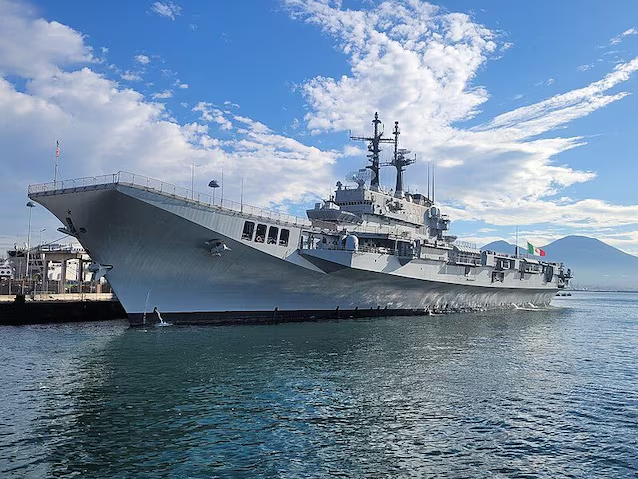
Overall, Garibaldi served under the insignia of the Navy for 39 years, from 30 September 1985 until 1 October 2024, accumulating a respectable career and participating in Italian military operations in Somalia, Kosovo, Afghanistan and Libya. Despite having been confined to inactivity for about a year, the Garibaldi is not technically decommissioned and could be brought back into service within a reasonable timeframe should necessity require it. Furthermore, in March 2025 rumors emerged regarding a possible sale of the ship to the Indonesian Navy, although the contours of the negotiations between the interested parties were unclear.
Cavour and Trieste, Italy’s two aircraft carriers in service today
However, the end of the operational career of the Garibaldi did not mean the end of the use of aircraft carriers by the Italian Navy, given that in the meantime two other aircraft carriers entered service. As part of the strengthening of the naval component of the Italian military instrument, in the early 2000s the “Cavour” was built by the Riva Trigoso shipyards in Sestri Levante (also part of the Fincantieri group), which entered service on 10 June 2009 and is now the flagship of the Navy.
During its 16 years of operational life, the Cavour has participated in numerous joint exercises with the navies of allied countries but, with the exception of the deployment at the time of the Libyan War in 2011, it has not had the opportunity to distinguish itself in actual theaters of war.
The same thing can be said of the even younger “Trieste”, which entered service on 7 December 2024 as a replacement for the aforementioned Garibaldi. To be precise, unlike the Garibaldi and the Cavour, which are aircraft carriers in all respects, the Trieste has been classified as a Landing Helicopter Dock (LHD), therefore it would be expressly dedicated to the use of helicopters. However, Italy’s purchase of vertical take-off F-35B fighter-bombers has de facto made the Trieste comparable in all respects to a full-fledged aircraft carrier as regards the possibilities of use.
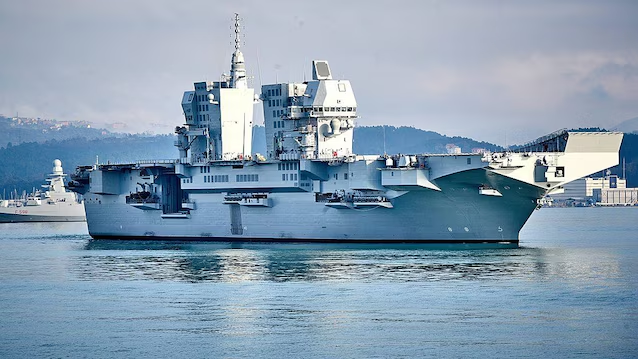
Having two aircraft carriers in active service today, the Italian Navy can therefore boast a respectable projection capacity, at least in the Mediterranean area, and, budgets permitting, Italy’s permanence in the restricted club of aircraft carrier operators seems to be assured for decades to come.