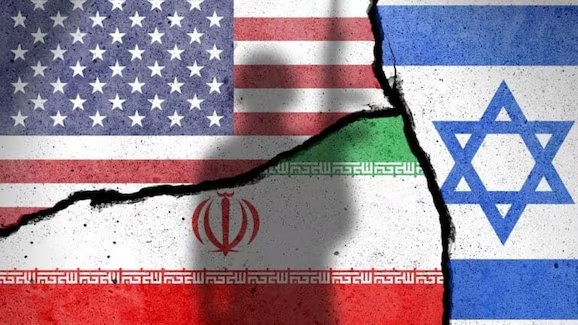
- Graphical representation generated with AI
The current war in Iran and the Middle East is not the first international conflict in the Persian Gulf region: it is no coincidence that we are talking about the “Third Gulf War”. For several decades the Persian Gulf has been the scene of wars and conflicts. The reasons are to be found both in the ethnic-religious tensions, with related hegemonic aspirations, of the countries in the area, and in the interference of the main powers, first of all the United States and its allies, interested in oil and other resources in the area. Let’s examine the major conflicts of recent years, which preceded the current conflict between the United States, Israel and Iran:
- the Iran-Iraq war of 1980-1988;
- the Gulf War of 1990-1991;
- the Iraq War (or Second Gulf War) of 2003;
- the conflicts in which the State of Israel is involved.
- 1The Persian Gulf and international tensions: geopolitical context
- 2War between Iran and Iraq (1980-88)
- 3First Gulf War (1990-91)
- 4Second Gulf War (2003)
- 5Israeli operations and the possible Third Gulf War
The Persian Gulf and international tensions: geopolitical context
The Persian Gulf, as we know, is located between the Arabian Peninsula and Central Asia. Seven Arab countries overlook its western shore: Iraq, Kuwait, Saudi Arabia, the United Arab Emirates, Bahrain, Qatar and Oman; the eastern bank is completely occupied by Iran.
The Gulf has been affected by geopolitical disputes and wars for a long time. It is in fact a particularly important area from an economic point of view, because the countries bordering its shores are rich in oil reserves, and because it constitutes a sea route of primary importance for the transport of resources. Furthermore, ethnic and religious tensions exist among the populations of the area. In Arab countries the majority of the population is Sunni (the majority denomination of Islam), while Iranians, in addition to not being Arab but Persian, are Shiite (the main Islamic denomination after Sunni).
Below is a brief summary of the main wars fought from the 1980s to today.
Iran-Iraq War (1980-88)
The war between Iran and Iraq lasted from 1980 to 1988. Both countries intended to exercise hegemony over the area and in 1980 Iraq, led by dictator Saddam Hussein, invaded Iranian territory to obtain a modification of the borders. The Islamic republic had recently been established in Iran, led by Ayatollah Ruhollah Khomeini, who resisted the invasion. Iraq enjoyed the support of the United States, but, nevertheless, Iranian troops, after being forced to retreat, recovered the lost territories. Both armies used chemical weapons and conducted operations with extreme brutality.
The victims were very numerous: the number of deaths was between 500,000 and one million. The war ended in 1988 with a ceasefire brokered by the UN, which left the borders virtually unchanged.
First Gulf War (1990-91)
The first Gulf War broke out in 1990, when Iraq invaded and occupied the emirate of Kuwait, annexing its territory. Saddam Hussein ordered the invasion because Iraq was heavily in debt due to the war against Iran and, in addition to not wanting to pay the debts contracted with Kuwait, he intended to appropriate its resources. The Iraqi army easily defeated the Kuwaiti armed forces. The international community, however, reacted heavily: at the instigation of the United States, led by President George HW Bush, a coalition of 35 states was formed, which attacked Iraq in January 1991. The United States found itself in a position of strength: it had effectively defeated the Soviet Union (which dissolved in 1991) in the Cold War and remained the only superpower. They could therefore attack without worrying about international reactions. Not all public opinion, however, supported the war: in all the countries involved there was an opposing component, according to which the real reason for the attack was oil.
The military operations, however, took place as planned. Among the states that participated were Italy, various European countries and some Arab countries, including Saudi Arabia. The coalition conducted an aerial bombing campaign, which lasted more than a month.
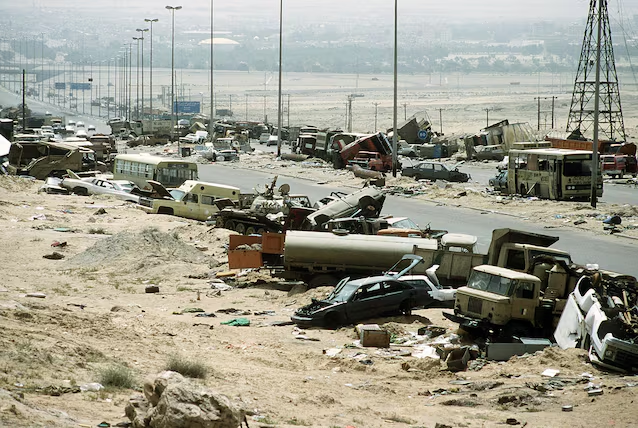
On February 24, after Iraqi defenses had been destroyed, ground troops invaded Kuwait, liberating the country from occupation and once again securing its independence. The soldiers, however, did not penetrate deeply into Iraqi territory, because the UN mandate only provided for the liberation of Kuwait, and left Saddam in power.
Second Gulf War (2003)
The second Gulf War, also known as the Iraq war, broke out in 2003. The country was in disastrous conditions: after the 1991 war the United States had imposed harsh economic sanctions, which had caused a profound humanitarian crisis. Furthermore, ethnic-religious tensions had exploded within the country and the Kurdish and Shiite minorities had been victims of brutal repression by Saddam’s government.
It broke out in 2003. The United States, led by George W. Bush (son of the president of the first Gulf War) and still shaken because two years earlier they had been hit by the attacks of September 11, 2001, accused Iraq of supporting terrorism and possessing weapons of mass destruction. The accusations were unfounded: none of the terrorists who carried out the September 11 attacks were Iraqi nor were there any links between the Baghdad government and al-Qaeda. Furthermore, it was not true that Saddam’s regime had begun producing weapons of mass destruction, as the United States had claimed.
The fact is that American troops, supported by British, Polish and Australian contingents, invaded the country on March 20, 2003. On April 9, they conquered Baghdad and overthrew Saddam’s regime (who was captured a few months later and executed in 2006).
A phase of profound political instability and humanitarian crisis began for Iraq, which continued even after 2011, when the United States withdrew its troops.
Israeli operations and the possible Third Gulf War
In addition to the main wars, other military operations took place in the Persian Gulf, partly due to the rivalry between some coastal countries, Iran and Iraq, and the State of Israel. The Israelis attacked Iraq in 1981, carrying out an aerial bombing to destroy a nuclear reactor. Furthermore, for several years, a sort of low intensity war has developed between Iran and Israel, conducted with intelligence operations and support for armed militias. Until 2023, however, the two countries never faced each other directly. In 2024, Israel attacked the Iranian consulate in Damascus and killed a Hamas leader in Tehran. Iran responded in both cases by attacking Israeli territory with missiles and drones. In 2025, Israel, together with the United States, attacked Iran again in the Twelve Day War.