When we talk about women’s suffrage in Italy, 2 June 1946 comes to mind, the day of the institutional referendum and the election of the Constituent Assembly. In reality, the “debut” of women in political life occurred a little earlier: on 10 March 1946, when many Italian municipalities voted for the first post-war administrative elections. On that occasion, Italian women were able to go to the polls for the first time.
Voting for women: an international overview
Throughout the world, women’s electoral rights – both active and passive – were recognized later than men. Until the nineteenth century, in the vast majority of states no one had the right to vote and power was administered by an authority, generally the sovereign, who held his position “by the grace of God”. Where voting was foreseen, it was limited to a few categories of men, generally those who were richer or had noble titles. Women were excluded on the basis of the idea that they did not have the skills to deal with public affairs, with the exception of very few limited cases.
In the 19th century, however, a movement developed in many countries for women’s right to vote, the suffragette movement (so called because they asked for suffrage).
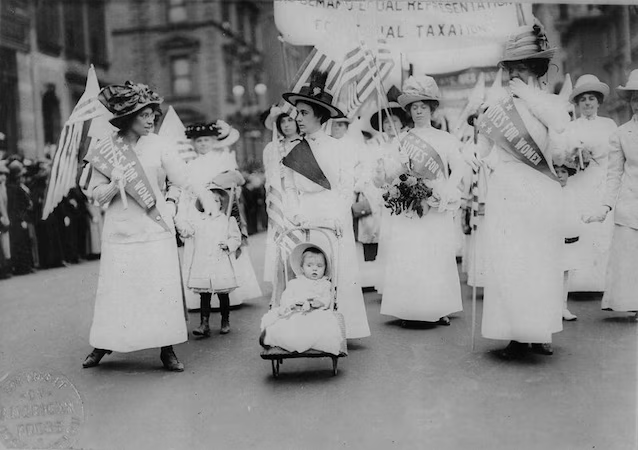
Gradually the movement succeeded in obtaining what it asked for. The first state to fully guarantee women the right to vote was New Zealand in 1893. In the following years other countries followed suit and between the 1910s and 1920s women’s suffrage was recognized in the United Kingdom, the United States and various states in central and northern Europe. Mediterranean countries were excluded, including France and Italy.
From war to turning point: 1945–1946
The turning point came in the final phase of the Second World War and in the political climate that accompanied the Liberation. The anti-fascists had a much more open and modern attitude and already in some partisan republics – the states temporarily established in the liberated territories – women, in certain cases, were allowed to vote and participate in political life.
At the end of the war, women’s suffrage was finally recognized. The first step was the Lieutenant Legislative Decree of 1 February 1945, n. 23, which extended the right to vote to women, but only mentioned the active electorate. The following year, the decree that defined the rules for the election of the Constituent Assembly recognized and specified the methods of female participation, recognizing the right to be elected.
Women voting: 10 March 1946
Italian women enjoyed the right to vote for the first time in the round of local elections which were held from 10 March to the beginning of April 1946 in almost all the municipalities of the country. On that occasion, the first women were elected to the municipal councils and two became mayors: Ada Natali in Massa Fermana (province of Ascoli Piceno, today Fermo) and Ninetta Bartoli in Borutta (Sassari).
It was a turning point of enormous significance: for the first time, women were recognized as full citizens, capable of influencing public choices.
After March 10: June 2 and the “constituent mothers”
A few months later, on 2 June 1946, women participated in the institutional referendum and elections for the Constituent Assembly. 21 women, the “constituent mothers”, were elected and participated in the work of the Assembly, making an important contribution to the drafting of the Constitution.
Here are the names of the 21 “constituent mothers”: Adele Bei (Communist Party), Bianca Bianchi (Socialist Party), Laura Bianchini (Christian Democracy), Elisabetta Conci (Christian Democracy), Maria De Unterrichter Jervolino (Christian Democracy), Filomena Delli Castelli (Christian Democracy), Maria Federici (Christian Democracy), Nadia Gallico Spano (Communist Party), Angela Gotelli (Christian Democracy), Angela Maria Guidi Cingolani (Christian Democracy), Nilde Iotti (Communist Party), Teresa Mattei (Communist Party), Angelina Merlin (Socialist Party), Angiola Minella Molinari (Communist Party), Rita Montagnana (Communist Party), Maria Nicotra (Christian Democracy), Teresa Noce (Communist Party), Ottavia Penna (Everyman Front), Elettra Pollastrini (Party Communist), Maria Maddalena Rossi (Communist Party), Vittoria Titomanlio (Christian Democracy).
Women’s suffrage has no longer been questioned, but full gender equality has not yet been achieved in our country. Just think of the difference in wages, the so-called gender pay gap.