Photo editing has accompanied photography since the very first experiments of the nineteenth century. Already a few years after the first images fixed on plate, we realized that photography was not only the capture of reality but also construction: a terrain in which to intervene to correct, emphasize or reinvent the scene. From manual manipulations on glass and film to modern software that automates complex operations thanks to algorithms and deep learning (a set of artificial intelligence techniques that train neural networks to recognize and transform visual content), in this study we will retrace the history of photo editing by analyzing when and how it was born and how it has evolved over time. We will see how negatives were retouched in the 19th century, why photographic printing on halogen-silver paper was a turning point, how the advent of color photography expanded the possibilities of intervention and what developments digital photography has allowed. Let’s start this journey!
When photo editing was born: the first approaches
If we want to find a starting point for photo editing, we must go back to the first plate photographs of the 19th century. Immediately after the pioneering creation of Joseph Nicéphore Niépce, who captured the first stable image in 1826 (to be fair, some sources also indicate 1825 and still others 1826), work began on both prints and negatives. In the darkroom, double exposures, combinations of plates and techniques such as “bleaching” were used, useful for lightening specific areas; on the printing, however, inks, paints or airbrush were added. Even Polaroids could be scratched during development for creative effects.
The first “documented” retouching came in 1846, when Calvert Richard Jones eliminated an unwanted friar from a group scene with a nib, creating a real erasure on the negative. In the same decades, fundamental processes for photo retouching became established, such as wet collodion and then gelatin-based halogen-silver photographic paper, which offered more resistant negatives and were suitable for slow and meticulous manipulations. In manuals from the late nineteenth century, it was recommended to position the workbench in front of a window facing north, because the more stable light allowed engraving and retouching with millimeter precision. Retouchers used abrasive powders, removable paints and scalpel-like tools to sculpt highlights and shadows on faces: the work of true image craftsmen.
Photography, meanwhile, was evolving rapidly. The introduction of roll film in the late 19th century, the first portable Kodak cameras and, in 1925, the launch of the Leica I made it easier to take many images; this further fueled the need to intervene on exposure and tonal rendering. In 1948 the Polaroid Land 95 appeared, capable of taking instant photos, while in 1975 a certain Steven Sassoon developed the first digital camera for Kodak. The initially low quality slowed down the adoption of this new technology, but within a few decades the evolution of sensors and the reduction in size transformed digital into the dominant standard.
From Photoshop to GIMP, photo editing in the digital age
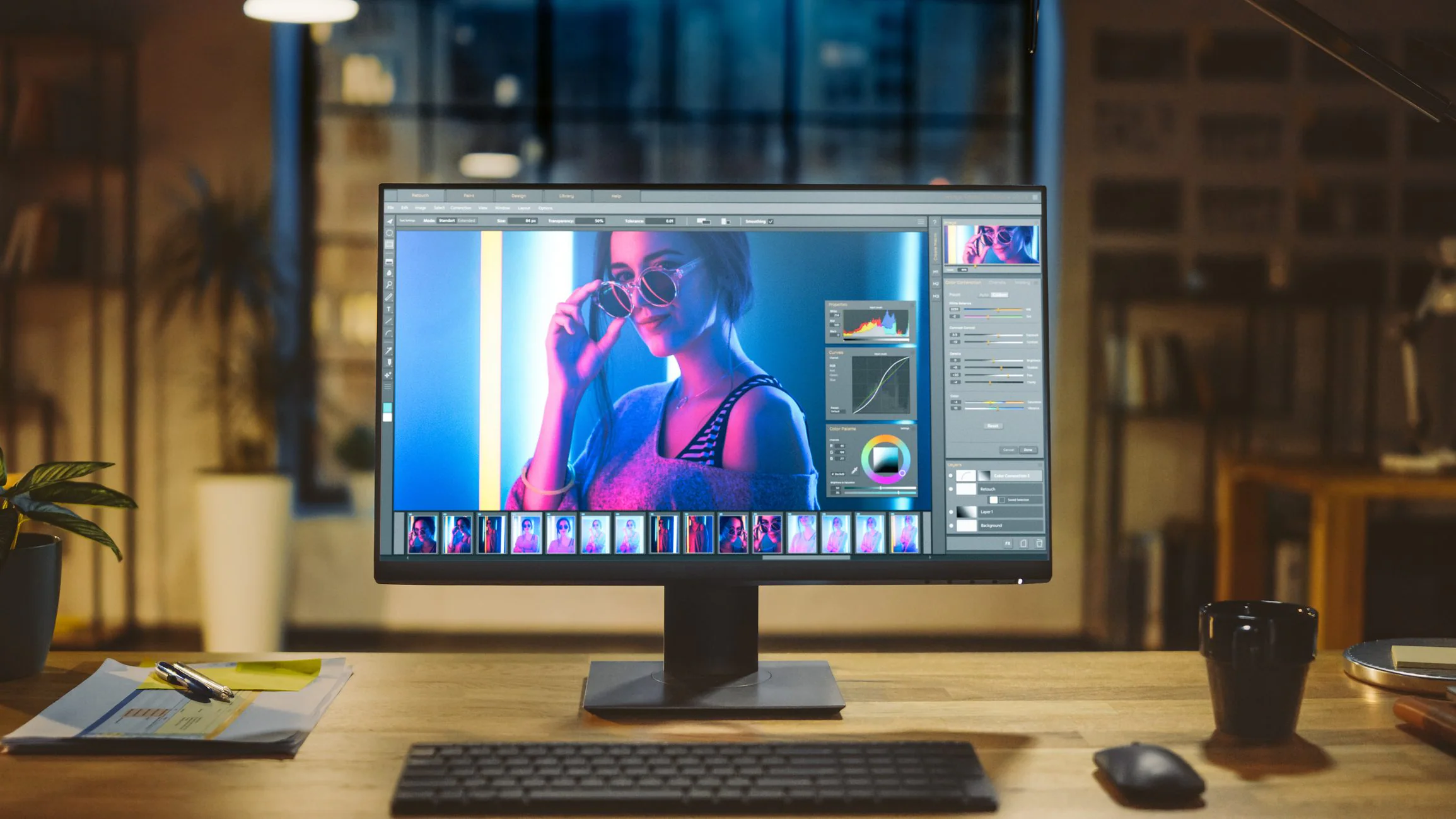
With the advent of digital, new professional tools emerged: systems such as Quantel Paintbox allowed the first complex digital retouching, later supplanted by much more complex software such as Photoshop and GIMP. In photojournalism and communication, this made it easier to do what had already been done for decades with analogue techniques: removing people, changing skies, combining different shots or adapting an image to editorial needs. From “embellished” portraits to political manipulations, the history of photo editing is littered with examples in which photography was shaped for ideological, aesthetic, or practical reasons.
In the 21st century, the most significant innovation is the progressive automation of retouching. Aesthetic filters applicable in real time via smartphone apps use advanced algorithms to change skin, facial proportions, expressions or even age and gender with a single touch. The emergence of so-called deepfakes (images and videos generated by deep learning models) with the unstoppable race of artificial intelligence has further expanded the range of possibilities, from entertainment to less ethical applications.
Yet, not everything that appears manipulated aims to change reality. In astronomy, for example, raw shots from instruments such as the Webb telescope must be “translated” into visible colors, because they contain infrared or ultraviolet data. Scientists and technicians combine filters, increase contrast and combine data from different instruments to create images that are faithful to physical phenomena and at the same time understandable to the public.
From this quick recap of some salient moments in the history of photography, it is clear, therefore, that photo editing is not a recent phenomenon and should not even be considered as a sort of betrayal of photography: it is an essential part of the way in which, for almost two centuries, we have tried to give visual form to the world around us, combining technique, aesthetics and technology.









