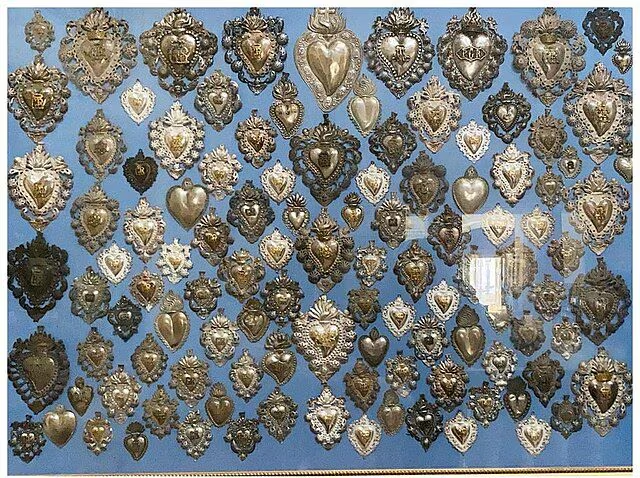
Ex-votos are objects offered to God or a saint to thank him after the realization of an event considered miraculous or to invoke his protection; they are generally donated to a sanctuary, which arranges to display them in special rooms. Ex-votos “for grace received” can be made for the most varied reasons, for example to have escaped a danger, such as an illness or a road accident. In other cases, ex-votos are given to solicit the intervention of the divinity: not for grace received, but to receive it.
Although objects with similar functions already existed in the ancient world, votive offerings in their current form date back only to the 16th century. Among the artists who, in their career, have created ex votos also include world-famous painters, such as Raphael. In addition to paintings, votive offerings include pendants, metal or silver hearts, wax body parts, and other personal symbols.
What they are and what they are for
Ex-votos (from the Latin “following a vow”, literally “for the vow, for the promise”) are objects offered to the divinity to ask for a grace or as an act of thanksgiving for the realization of an event that is believed to be due to divine intervention: they often contain the phrase “for grace received” and therefore represent the fulfillment of a vow, a promise made to the divinity. Paintings, hearts or body parts in wax, pendants and other objects are left in churches, sanctuaries or sacred places as fulfillment of a promise made to God, the Madonna or a Saint, often accompanied by the formula “by grace received”.
All ex-votos are an example of popular devotion, based on the assumption that the divinity intervenes in human affairs. In addition to being signs of gratitude and personal faith, they bear witness to daily and private events, transforming over time into precious sources for cultural, social and artistic history. The custom of donating ex voto is widespread in Italy and in many other Catholic countries: ideally offered to God, Jesus, the Madonna or specific saints, they are generally donated to churches and sanctuaries, some of which set up special rooms to display them to the public.
In many cases, ex-votos for grace received consist of small pictures depicting the miracle received: a sick person in hospital, with or without the presence of divine figures, in the case of ex-votos donated following recovery from an illness; the scene of a car accident if you want to thank God (or some saint) for having survived the collision; etc. Other votive offerings, especially those offered to ask for a grace, instead take the form of symbolic objects, such as pendants or artefacts, displayed in special rooms inside the sanctuaries.
History of ex-votos: objects that tell of miracles
The term ex voto literally means “following a vow”, that is, a promise made to God or a sacred figure in exchange for his intervention. The main function of these objects is to give thanks for a grace received – a healing, a life saved, the overcoming of a danger – but sometimes also to publicly bear witness to the fulfillment of that promise. This practice has its roots in ancient religions, where the offering to the gods was a gesture of gratitude or request, and was then accepted and reworked by Christianity, spreading in many religious cultures up to the present day. Among many peoples, the practice of offering gifts to the gods to thank them after having received a grace or to “urge” them to act if their intervention was needed was widespread. The tradition did not stop after the advent of Christianity, however, in their modern form, votive offerings have existed since approximately the sixteenth century. At first, the custom of donating them was widespread only among wealthy people, but over the years it has spread to all social classes.
Over time, these objects have taken on very different shapes and materials: bronze, terracotta, wax, silver, gold, wood, fabrics, but also small objects of everyday use. In addition to the classic painted pictures, you can find statuettes, jewelry, model ships, wedding crowns, crutches, even representations of healed body parts. Each of them tells a story: fear, illness, the hope of a miracle or gratitude for a life saved.
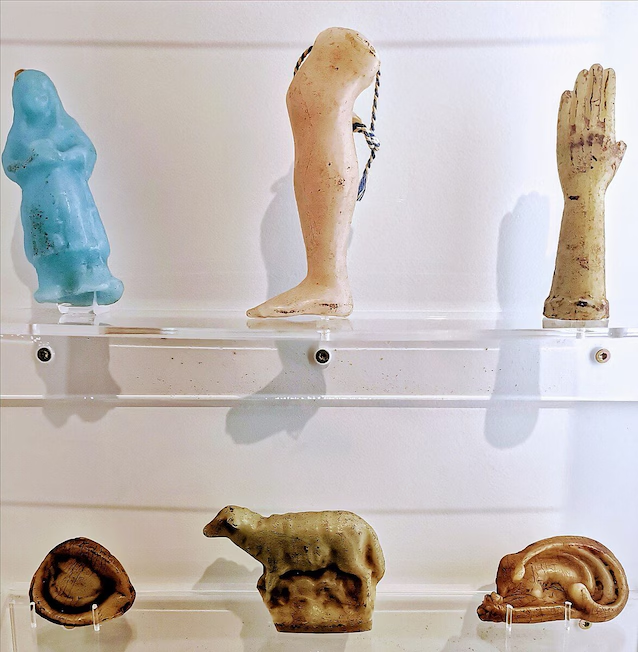
Even great artists have tried their hand at this genre. Raphael, for example, painted some, and over the centuries there have been painters specialized in votive offerings, so much so that they have created hundreds of them. But their value is not only religious: they are real documents of life, precious for understanding how people of every era faced the trials of existence, from illnesses to daily misfortunes.
Each ex-voto is also a “public testimony”, a way of saying to others: “Behold, grace has arrived, faith has worked”. In the paintings we see miracles, accidents, healings, but also scenes of domestic or working life: authentic cross-sections of the popular world. Even today, many Italian sanctuaries preserve collections of votive offerings from every era, true galleries of faith and humanity.
And perhaps the roots of all this are even further back: some scholars believe that the first traces of votive offerings date back to the Paleolithic, in the hands imprinted on the walls of caves. A simple but universal gesture: leaving a mark, a thank you, a memory of oneself in the face of the mystery of life.
Large collections of votive offerings can be admired in some sanctuaries, including the Sanctuary of the Consolata in Turin, the Sanctuary of Nostra Signora del Boschetto in Camogli, the Sanctuary of Montevergine near Avellino. Other ex-votos are part of private collections, among which the one of the National Library of Medicine of the United States (the largest medical library in the world) deserves to be highlighted, which preserves a collection of ex-votos of a “healthcare” nature, donated following “miraculous” healings.