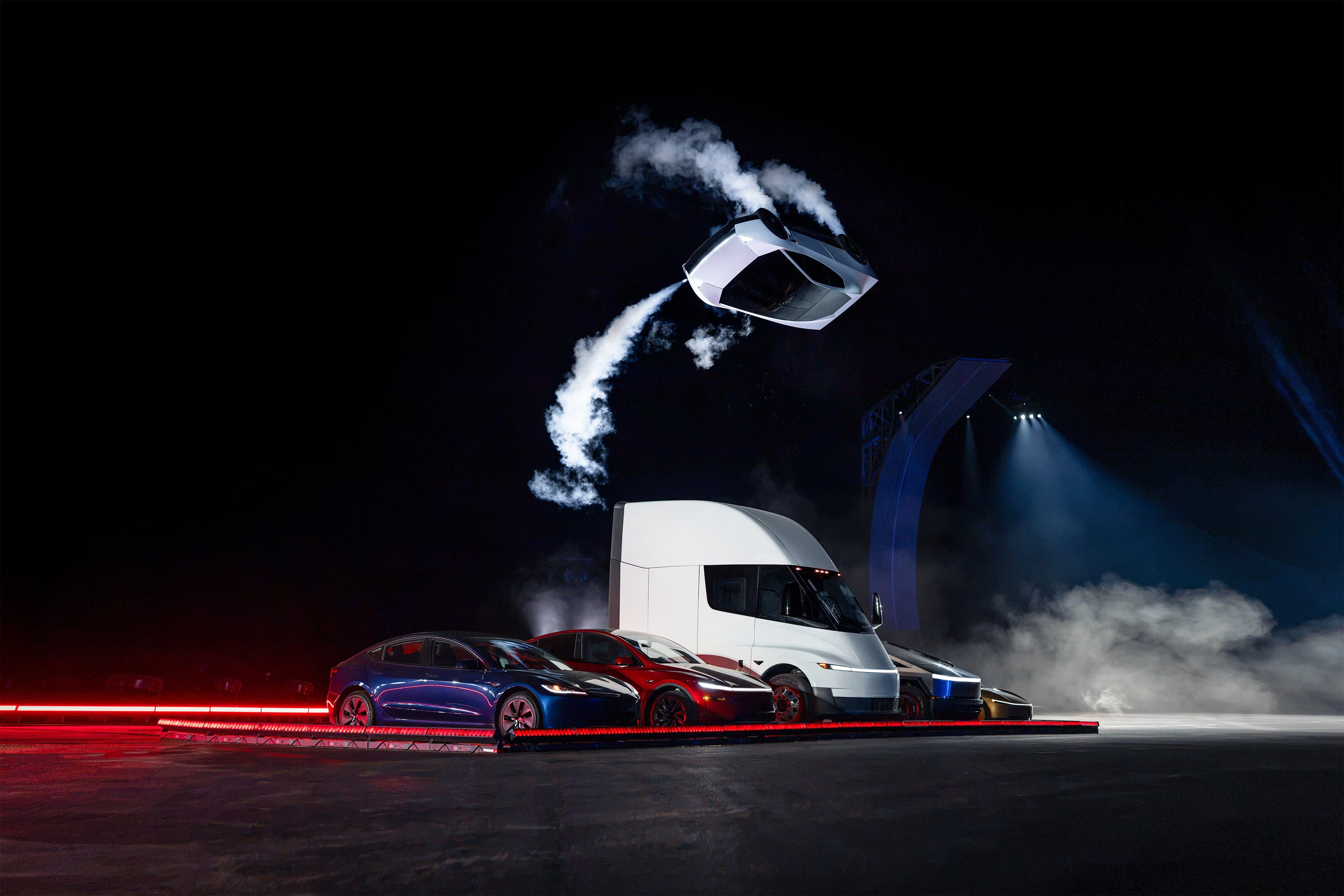
An electric sports car going up a curved ramp, sticking to the asphalt even when upside down, then breaks away, does a somersault in mid-air and lands on all four wheels in a cloud of white smoke. It is called the Tesla Roadster and was presented by Elon Musk on October 15, 2026 in a live stream from SpaceX’s rocket development center in McGregor, Texas. But how does a car weighing almost two tons get off the ground? The answer comes from the aerospace world. The new hypercar, in fact, has no propellers or wings but “flies” thanks to jets of air. The “flight”, which we can define as a “controlled jump”, is made possible by cold gas thrusters similar to those used by rockets to propel themselves into space and by a fan installed under the floor. However, Musk’s attempt is neither the first nor the only attempt in the world to make a car take its wheels off the ground. For years, various companies and startups have been working on prototypes of flying cars or hybrid aircraft.
The flight demonstration and record performance
During the test, the prototype of the new Tesla demonstrated two spectacular maneuvers: an upside-down ride down a steep ramp and a mid-air jump over a truck and other vehicles, with a cushioned landing. This was all done without anyone on board for safety reasons.
What glues the car to the ramp upside down is an active suction system: a fan under the floor sucks the air between the asphalt and the body, generating a strong depression, a dynamic attributable to the ground effect of Formula 1 cars. According to Lars Moravy, head of engineering at Tesla, this mechanism creates up to 2 g of downforce – a downward aerodynamic push that glues the vehicle to the ground, acting in the opposite way to the lift that lifts planes. To give an everyday example, it’s like putting a hand on the back of the hairdryer and feeling a suction effect.
As for performance, the declared numbers seem like science fiction. As reported ReutersMoravy cited acceleration from 0 to 100 km/h in less than a second and a top speed of more than 370 km/h. Musk relaunched by claiming that the car could reach “half the speed of sound”. The company explains that the thruster system (ten very high pressure air nozzles powered by internal tanks) produces a force 4-5 times greater than what the tires can discharge to the ground.
The physics of compressed air thrusters
The idea behind the SpaceX and Tesla project is to exploit a very simple concept: the third principle of dynamics. For every action there is an equal and opposite reaction: if one body exerts a push on another, it receives back a push of equal value in the opposite direction, just like an inflated balloon let go without a knot.
The engines exploit cold gas technology: there is no combustion to guide the process, but compressed air at very high pressure inside carbon fiber tanks. When this is released at high speeds, it undergoes a sudden expansion which causes its temperature to collapse, which is why it is called cold gas.
This principle explains why the car only travels short distances and cannot sustain a real flight. To lift approximately two tons of vehicle, tens of kilograms of air are needed per second, but this “yields” very little for every kilo consumed, so you get an enormous boost but for a very short time.
Appearance, models and prices
On an aesthetic level, the exteriors have minimalist lines flush with retractable headlights, ultra-light wheels and solutions derived from aerospace: “Ano White” technical paint (resistant to corrosion, UV rays and cryogenic temperatures), titanium details and “Gold Glazed” tinted glass inspired by space suit visors. The passenger compartment is designed to minimize the weight of the vehicle, using microsuede (eco-leather) finishes, fixed position seats, manual controls and a structure based on ultra-light and high-strength materials such as carbon fibre, titanium and magnesium.
Tesla has three versions of this model in the pipeline:
- Performance: the high-performance road version (bookable for $50,000)
- Thrust: two-seat configuration with cold gas rear engines
- Rocket: single-seater with ten perimeter nozzles. It is the only variant capable of lifting itself off the ground, but It is not approved for road circulation. The production window is set approximately to 2028
A project that Elon Musk has had in mind for several years, as demonstrated by a post on