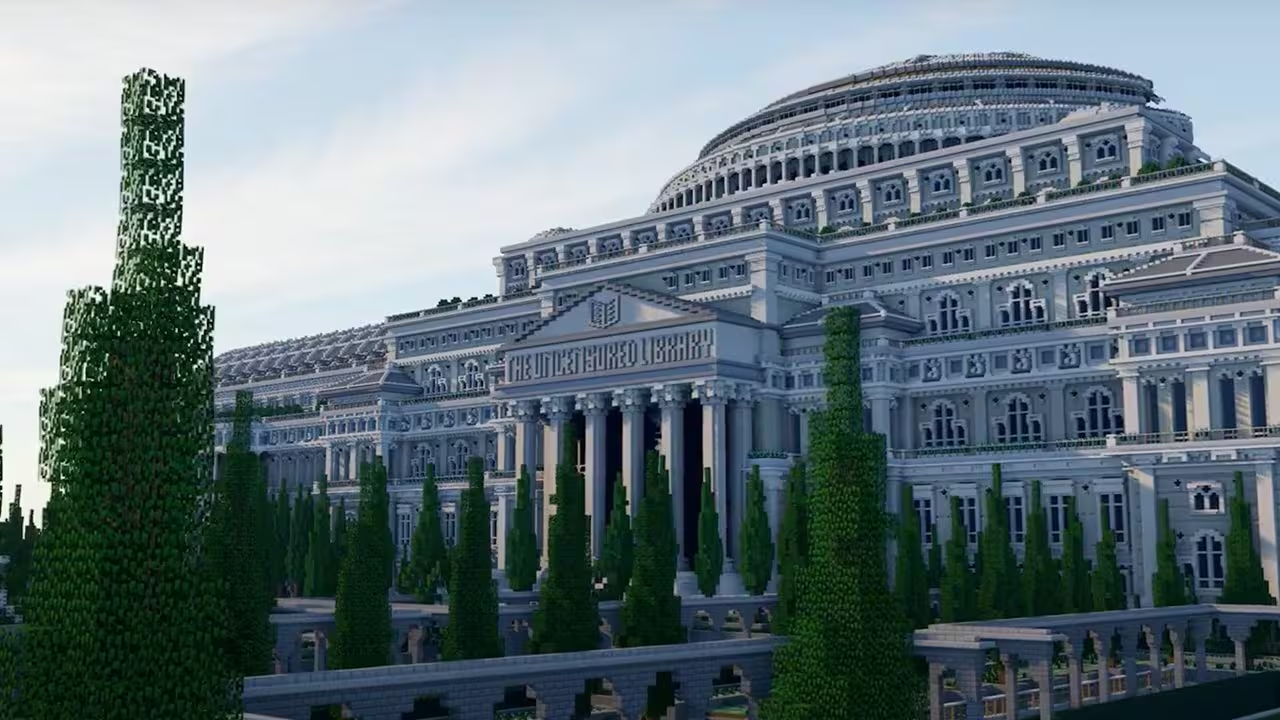
The Minecraft library, whose official name is The Uncensored Libraryis a virtual building built inside the famous video game that collects the articles of journalists censored in their countries of origin, making them available to anyone and impossible to modify.
In this imposing digital neoclassical library, made up of millions of blocks, each book contains an investigation, a report or an opinion that someone has tried to make disappear.
In fact, in many countries, sites, blogs and independent newspapers are blocked, while Minecraft remains accessible. But how does it work, and how does it get around censorship?
Who invented The Uncensored Library and how is it made
The Minecraft library was born from an idea of Reporters Without Borders (RSF), the non-governmental organization that has defended press freedom since 1985 and monitors the conditions in which journalists around the world work.
To create it, RSF relied on BlockWorks, a British studio specialized in architectural projects within Minecraft, with the support of the creative agency DDB Germany and the production house MediaMonks. The project was presented in March 2020, on the occasion of the World Day against Cyber Censorship, and since then it has been accessible to anyone on a public server of the game.
What is striking, even before the contents, is the building: the library, in fact, stands on an island surrounded by gardens, and has the appearance of a large white neoclassical palace, with colonnades, high domes and staircases leading to the shelves. This style is not at all random: it was chosen because it recalls the great cultural and public institutions, those that have safeguarded knowledge for centuries, and conveys the idea of a solemn and lasting place, in contrast with the fragility of information in the countries from which the articles come.
But there is also another striking detail: over 12.5 million blocks were needed to build this library, positioned by 24 builders from 16 different countries in more than 250 hours of work (31.25 working days, so to speak, if we consider a typical 8-hour day).
Inside, each room is dedicated to a country where the press is under pressure and hosts the texts of journalists who have been censored, threatened or, in some cases, even killed. To understand which countries to choose, RSF cross-referenced data: on the one hand its annual press freedom ranking, which measures the conditions in which journalists work in the world; on the other, the diffusion of Minecraft, obtained from traffic data, to understand where the game had the greatest chance of being reached.
Once the list was finished, it was journalists from 180 countries (primarily Mexico, Russia, Saudi Arabia, Vietnam, but also Egypt, Brazil, Belarus, Eritrea and Iran) who made their work available and included them in the game, or independent newspapers (such as the Egyptian Mada Masr).
But not only that: among the articles there are also those of well-known journalists who were killed before 2020. An example is that of the famous Mexican journalist Javier Valdez Cárdenas, murdered in 2017 in Culiacán, a few steps from Ríodoce, the editorial office of the newspaper that he himself had co-founded. The journalist was known for his investigations into drug trafficking and drug cartel violence.
Still speaking of killed journalists, in the bookshop there are articles by another famous author, that of the Saudi journalist Jamal Khashoggi, considered a threat by the Saudi Arabian government for his articles criticizing its work and organized opposition projects abroad.
In any case, the library is not a fixed archive, because it is updated over time. The latest news dates back to 12 March 2026, in fact: on the occasion of the World Day against Cyber Censorship, RSF inaugurated a room dedicated to the United States, where according to the organization the pressure on the press has grown since Donald Trump’s return to the presidency in January 2025.
How to publish an article and how to visit it
In this library, players can create their own book, write in it and then sign it. Of course, you don’t have to transcribe everything by hand: the project team installed a plugin that automatically converts text documents into game books, which are then signed and placed on shelves.
After signing, the book is definitive and public (and anyone can read it, both in English and in the language of the user who wants to consult it), and the content inside can no longer be changed.
To visit it, there are two ways: the first is to connect to the project’s public server, which is open to anyone who owns the game. Thus, you can consult the library like any other online world. The second is to download the map from the official website and open it on your computer, without having to connect to the server.
Below, a video from The Uncensored Library showing what the library is like inside.
How this secret library manages to bypass censorship in various countries
In countries where information is under control, governments tend to concentrate censorship on channels perceived as dangerous: news sites, blogs, social networks, messaging apps.
But why have they so far failed to do anything to take down the Minecraft library or part of it? To understand why the library succeeds where a normal news site would fail, you need to know how online censorship works.
Governments that control information mainly use certain tools: blacklists of web addresses, which prevent citizens from reaching a certain domain; blocking the IP addresses of servers hosting unwelcome content; and filtering systems that analyze traffic for recognizable keywords or sites. An online newspaper, however protected, has an unmistakable name, address and appearance: once identified, just include it in the blacklist.
Here things are a little more complex. First of all because the Minecraft library is not a website: the articles are not in pages that can be consulted by browser, but inside the video game data, which travels through the game’s communication protocol. Furthermore, in the Java version of the game (the one used by the library server), the connection is encrypted, and those who monitor the network cannot read what is written in the books: they only see someone who is playing. It should also be remembered that the library, unlike a website that can be darkened, is a file that can be copied, moved and reopened elsewhere.
Furthermore, security is quite high: in addition to the fact that once a signature has been placed on an article, no changes can be made, the map that can be downloaded from the official website is distributed via a decentralized archiving system based on blockchain technology. The file therefore does not depend on a single server that can be shut down or seized, and anyone who downloads it can in turn host it on their Minecraft server: in this way the library multiplies, and it becomes much more difficult for a government to make it disappear completely.
Finally, even if a government wanted to block Minecraft, it would not be convenient for them to do so due to the cost and the impact of censorship: Minecraft, in fact, is one of the most popular games in the world, and blocking it would mean affecting millions of players who have nothing to do with politics, with the risk of attracting the very attention that censorship is trying to avoid. RSF has exploited exactly this blind spot, transforming a space considered harmless into a channel for circulating independent information.
Are there any limits?
Despite this, there are countries affected by press censorship where reaching the library is very difficult, such as China and Iran.
In China, in fact, the global version of the game is not used, but a local version modified and strictly controlled by the government, on which the library server is not present.
In Iran the situation is even different: due to international sanctions and local restrictions on game servers, in fact, direct multiplayer access to external platforms is often disabled, therefore it is structurally unstable.
Beyond its limitations, Minecraft’s Uncensored Library has demonstrated that video games are not just entertainment, but also spaces where ideas are shared and the memory of those who have been silenced is preserved.