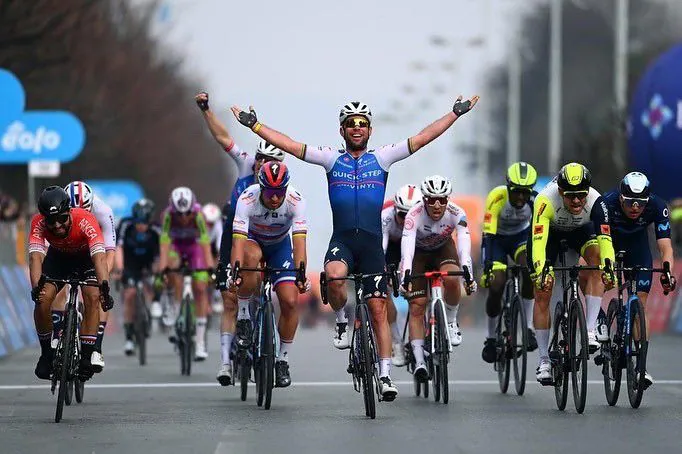
When we see a sprinter win a stage in the Tour de France, a race now in its 113th edition and which this year takes place in 21 stages from 4 to 26 July starting from Barcelona and arriving in Paris, the impression is that everything is played out in the last seconds. In reality, the final sprint is the result of a precise collective mechanism that is activated about 10 km from the finish line: the “train”. It is a sequence of teammates who, pedaling at over 55 km/h, protect the leader from air friction allowing him to save over 40% of his energy depending on the position, and then launch him in the last 200 meters. Let’s discover the physics and strategy behind the battle for position in the world’s most famous cycling race.
What is a sprint train in cycling and how does it work
In the flat stages of the Tour de France, the teams of the best sprinters build the so-called “train“, a formation of team-mate runners lined up in front of their leader, the sprinter, in the last kilometers of a sprint.
Teammates have the task of keeping the pace high to prevent opponents from advancing, keeping their sprinter away from falls and protecting him from the wind, allowing him to save energy. The scientific study “Aerodynamic drag in cycling pelotons: new insights by CFD simulation and wind tunnel testing” proved that in the heart of the group the air resistance is reduced by up to 95%while staying behind a single companion in the “train” saves approximately 40% of the energy. It is extremely expensive work: each rider gives everything for a few minutes and, once their work is finished, they move sideways and allow themselves to be passed by the group, exactly like a multi-stage rocket.
There is no identical pattern for all teams, but around 7-10 km from the finish the trains begin to move steadily in front of the group. In this phase the wingmen work to maintain position and prevent other teams from taking control. As you get closer to the finish line, the speeds progressively rise above 55 km/h and the changes become shorter.
In the last 500 meters approximately, the so-called takes command last manthe most delicate role of the entire sprint. He must launch the sprinter at the right speed and at the right time, without exposing him to the wind too soon.
The leader is then left between 150 and 250 meters from the finish line. From that moment on it is an individual challenge: whoever has the best position and manages to maintain the highest speed until the final line wins.
Why sprinters sit so low on the bike
Observing a sprint you immediately notice a characteristic common to all sprinters: one extremely aerodynamic positionwith head low, elbows bent and torso almost parallel to the ground. At over 65 km/h the number one enemy is air resistance and reducing the surface exposed to the wind by even just a few centimeters can make the difference between winning and finishing second.
For the same reason, sprinters try to stay in the zone for as long as possible trail of companions. Those who are on the wheel have to produce much less power than those who face the air directly. This allows the sprinter to conserve precious energy to use in the final seconds.
Also the wind it can completely change a sprint. If it blows against you, the risk of starting too early and being caught up by someone coming from behind increases considerably.
Finally, when the arrival is particularly difficult, the so-called comes into play kidney strokea movement with which the runner pushes his bike and shoulders forward on the finish line. In a decisive sprint for a few centimeters, this gesture can be enough to precede the opponent and gain victory. This is what happened at Milan-Sanremo 2026, where Tadej Pogacar got the better of Tom Pidcock thanks to the final shot, at the end of a very tight sprint.
The war of the wheels: what sprinters do without a train
Not all teams have a train as strong as those of the big WorldTour teams. In these cases it is fundamental get the right wheel. In fact, sprinters without their own team try to position themselves behind the sprinter considered to be the strongest, to take advantage of the work of his team and arrive launched at the decisive moment.
This is where the chaos typical of the last kilometres. Dozens of runners try to conquer the same positions at the same time. Continuous changes in trajectory result, contacts between shoulders and handlebars that touch each other. At speeds above 60 km/h, losing a single wheel can mean going from a chance of winning to an anonymous finish. It is at these moments that most of the group fallsprecisely because the density of cyclists per square meter reaches its maximum peak for the entire stage.
How fast they go: speeds between 65 and 70 km/h
In the final stages of the flat stages the best sprinters regularly reach speeds between 65 and 70 km/h. In particularly favorable conditions we can go even further: in 2025 Matteo Moschetti touched him 83 km/h at the AlUla Tour, taking advantage of a slightly downhill stretch and a favorable wind.
The power developed in the last seconds of the race is also impressive. The strongest sprinters can in fact touch the 2000 wattsa quantity of energy comparable to that absorbed by a domestic electric oven turned on at maximum power. And all this after having traveled over 150 kilometers and spent hours in the saddle.