Protests continue in Iran and with them the brutal repression of the population, while President Donald Trump considered an attack – later frozen – by the USA. There are currently no official estimates of the number of deaths but Amnesty International and the NGO Iran International speak of thousands of deaths, an unspecified number which, according to some estimates, could exceed 12,000 victims. But if we analyze the history of international relations between the two countries since the Second World War, we can observe a discontinuous and complex relationship made up of temporary alliances, tensions, coups d’état and slight openings.
- 1Iran after the Second World War: the 1953 coup
- 2The alliance between the United States and Iran
- 3The revolution of 1979 and Khomeini’s seizure of power
- 4The 1979 hostage crisis
- 51990s: The United States escalates sanctions against Iran
- 6The opening during Obama’s Presidency
- 7Donald Trump’s first term and the Biden administration
- 8Donald Trump’s second term and foreign policy against Iran
Iran after World War II: the 1953 coup
After World War II, in 1951, Iran was a constitutional monarchy, led by the King of Persia, Shah Mohammad Reza Pahlavi and the nationalist leader Mohammad Mosaddegh, democratically elected Prime Minister of Iran. Mosaddegh began a policy of emancipation of Iran from the Western sphere of influence, especially regarding Iranian mineral resources, primarily oil. In fact, at the time, Great Britain, through the Anglo-Iranian Oil Company (AIOC) controlled the majority of the country’s oil industry. Mosaddegh began a campaign to nationalize the country’s oil companies, in a Cold War context in which the United States strongly feared the closeness between Iran and the Soviet Union. For this reason, in 1953 the CIA, collaborating with the intelligence services of the United Kingdom, engineered a coup that overthrew Prime Minister Mosaddegh – in what was called Operation AJAX – and which effectively gave full powers to the Shah Mohammad Reza Pahlavi. The term shah comes from Persian shahwhich means “king” and indicates the command figure with absolute powers in the political but also spiritual fields.
The alliance between the United States and Iran
The Pahlavi Shah remained in power for about 20 years, during which time the alliance between Iran and the United States greatly strengthened. Iran became one of the largest producers and exporters of oil and, also thanks to US support, began to strengthen its army and its military power, which was necessary for the United States to contain Soviet power. During these years, the development of the Iranian nuclear program also began, with the support of the United States: in 1957, in fact, the two countries signed the Cooperation agreement on the civil use of atomic energyunder President Eisenhower, under which developing countries would receive nuclear training and technology from the United States for nuclear research programs. Their collaboration continued until the start of the Iranian Revolution of 1979.
The 1979 revolution and Khomeini’s seizure of power
1979 represented a watershed both in Iranian history and in international relations between the two countries. Following the outbreak of the Islamic revolution and the protests calling for the end of the repressive regime of the Pahlavi Shah, the latter was forced to flee and Ayatollah Khomeini returned from exile in Paris, which lasted 14 years, imposing himself as the Supreme Leader of the country. Khomeini strongly opposed the Shah’s Westernization of Iran, transforming the country into an anti-Western Islamic theocracy, based on Sharia, the sacred law of the Islamic religion, founded on the Koran. In this context, the United States was identified as one of the main enemies of the Islamic Republic and, also following the 1979 hostage crisis, relations between the two countries had an abrupt breakdown and gave rise to a period of frost in diplomatic relations.
THEhe hostage crisis of 1979
On November 4, 1979, a group of Iranian students attacked the American embassy in Tehran, taking 52 people hostage, including diplomats and embassy staff. The request was to extradite Shah Reza Pahlavi, who had been taken in by the United States for medical treatment, requesting his extradition to be tried and punished. The last hostages were released only in January 1981, after 444 days of detention. This episode strongly influenced relations between Iran and the United States and since the 1979 revolution the two countries have interrupted diplomatic relations: even today the United States does not have diplomatic representation in Tehran and vice versa. There is representation in Washington Interests of the Islamic Republic of Iran in the United Statesthrough the Embassy of Pakistan.
After the hostage crisis, the United States participated in the Iran-Iraq war from 1980 to 1988, in which between 500,000 and 1,000,000 people died, supporting – with economic aid and intelligence services – Saddam Hussein, and reinforcing the tension between the United States and Iran.
At the same time, the Tehran regime, led by Ayatollah Khomeini, began a foreign policy of expanding the Shiite religion into neighboring countries, financing and militarily supporting forces such as the Lebanese Shiite militias of Hezbollah, and being responsible for terrorist attacks against numerous US targets in the region.
1990s: The United States escalates sanctions against Iran
Relations between the United States and Iran have remained tense particularly regarding possible Iranian nuclear armament which over time has led both the United States and the European Union to impose harsh economic sanctions against Iran, particularly under the Presidencies of George W. Bush and Bill Clinton. In 1992, the US Congress passed theIran-Iraq Arms Non-proliferation Actwith sanctions on materials that could have been used to develop advanced weapons. In 1995 the United States then imposed a total embargo on Iranian oil and trade, with particular concern over the Natanz enrichment plant and the Arak heavy water reactor.
The opening during Obama’s presidency
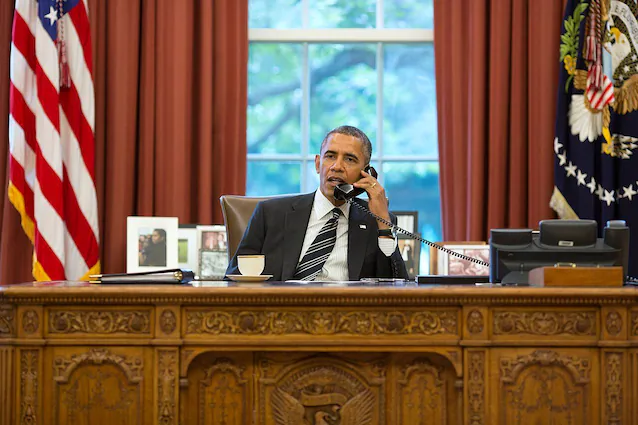
During the presidency of Barack Obama, an opening was attempted in diplomatic relations between the two countries: in 2013, for the first time in more than 20 years, there was a telephone conversation between the US president and Iranian president Hassan Rouhani. After great diplomatic work, two years later, in 2015 the nuclear agreement was signed: the Joint Comprehensive Plan of Action (JCPOA) with the so-called P5+1 group: China, France, Germany, the United Kingdom, Russia and the United States, plus the European Union. According to the agreement, in exchange for the lifting of the harsh economic sanctions imposed on the country, Iran would have limited its nuclear activities for 15 years and would have allowed the entry of international inspectors from the IAEA (International Atomic Energy Agency) for inspection and monitoring activities.
Donald Trump’s first term and the Biden administration
The agreement lasted until 2018, when newly elected President Donald Trump decided to withdraw from the JCPOA, accusing Iran of continuing to carry out enriched uranium storage activities. From that moment on, a period of strong tensions between the two countries began again, with the reinstatement of international sanctions, to limit Iranian oil exports and destabilize the country’s economy. This has led to numerous retaliations and attacks by Iran on US oil assets in the Persian Gulf and other US targets in the region. With the Biden administration, the possibility of resuming talks regarding the Iranian nuclear issue was glimpsed, but in fact no progress was recorded in this direction.
Donald Trump’s second term and foreign policy against Iran
With Trump’s second mandate, relations with Iran have become even more tense, with increasingly harsh economic sanctions and support in military terms to neighboring countries, such as Israel, to support attacks against Iranian targets, including nuclear sites, such as that of June 2025, in which the Natanz sites were hit, where the turbines for enriching uranium and transforming it into nuclear fuel are located, the experimental nuclear reactor of Arak and the city of Isfahan. In this volatile context, President Trump is currently considering a military attack against Iran if the brutal repression of recent days continues.