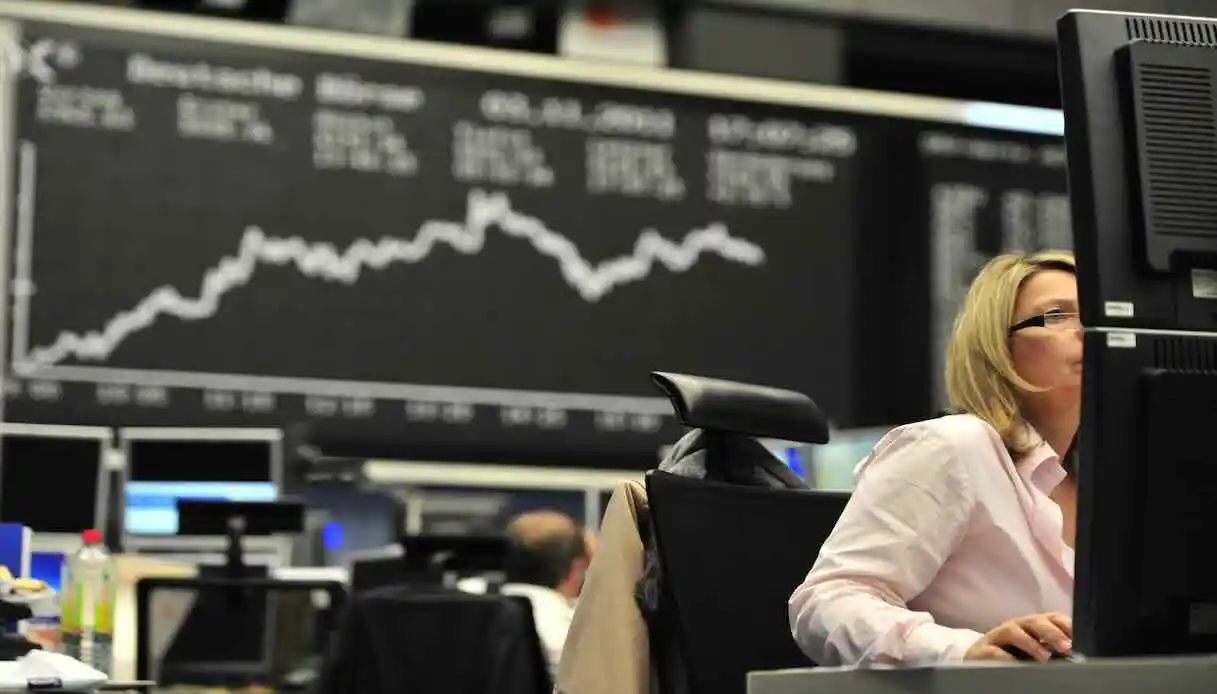
The last session of the week ends with a clear decline for Piazza Affari, which thus moves away from the psychological threshold of 50,000 points after yesterday it almost came close to the historical record of March 2000. The performance of the Milanese square was in line with that of the other European stock exchanges, which were coming from a hyper-bought phase. Market sentiment has returned to pessimism as efforts to end the war in the Middle East remain at a standstill (and fears that the Strait of Hormuz will remain blocked beyond June) and following the summit between US President Donald Trump and Chinese President Xi Jinping (although the meeting was described as positive by both sides, no concrete agreements were reached on open issues, including trade).
Today’s session also saw a decidedly negative outlook for the government bonds of the main advanced economies. The disappointment over the meeting between Trump and Xi, from which the markets probably expected progress towards the reopening of the Strait of Hormuz, translates into expectations of inflation above central banks’ targets for a longer period of time.
On the macroeconomic front, Italian inflation jumped in April due to the acceleration of energy prices linked to the war in Iran. According to the final reading provided by Istat, which revised the preliminary data slightly downwards, consumer prices rise by 1.1% month-on-month and 2.7% year-on-year after the +0.5% cyclical and +1.7% annual figures in March (vs preliminary data of +1.2% and +2.8% respectively). Also in Italy, public debt marked a new historical record in March with a jump of 20 billion compared to the previous month (to 3,159 billion euros from 3,139 billion). New historical high in February also for the value of government bonds held by foreign investors while the retail one has changed little.
The main indices
Among the main European stock exchanges, there were full sales in Frankfurt, which suffered a decrease of 2.07%, a terrible performance for London, which recorded a decline of 1.71%, and a black session for Paris, which left a loss of 1.60% on the table.
In Milan, a sharp decline in the FTSE MIB (-1.87%), which reached 49,116 points; along the same lines, sales fell on the FTSE Italia All-Share, which closed the day at 51,719 points, down sharply by 1.72%. The FTSE Italia Mid Cap showed fractional progress (+0.29%); negative changes for the FTSE Italia Star (-0.74%).
Italian titles
At the top of the ranking of the most important stocks in Milan, we find Avio (+2.09%) and DiaSorin (+1.44%). The strongest declines, however, occurred on Buzzi, which closed the session at -4.25%. STMicroelectronics lost 4.22%. The negative performance of BPER Banca stands out, falling by 3.69%. Stellantis falls by 3.51%.
At the top of the ranking of mid-cap stocks in Milan, Technoprobe (+32.32%), Carel Industries (+6.59%), Reply (+5.11%) and WIIT (+2.89%). The worst performances, however, were recorded on Ferragamo, which closed at -18.60%. Heavy Multiply Group, which marks a decline of -9.87 percentage points. Negative session for Ferretti, which fell by 9.60%. Significant losses for Interpump, down 9.06%.
The Trump-Xi summit
Little concrete information has emerged about the meeting between Trump and Xi: the US president warmly praised his meeting with the Chinese president, but the summit produced few tangible results. The US has said China will buy 200 Boeing planes and larger quantities of American agricultural and oil products, but no other figures were specified. According to Trump, there wasn’t even any talk of tariffs. China did not disclose the concrete agreements, but its intentions were nevertheless clear. Xi highlighted the importance of Taiwan as a determining factor in US-China relations and warned Trump of the “Thucydides trap”. This is a veiled threat that refers to the historical tendency of rival great powers to slide towards conflict.
Macroeconomic data
The most important data of the week just ended was that of inflation in the United States, which exceeded expectations in April, both at a general level (+3.8%; compared to +3.3% previously) and at a core level (+2.8%; compared to +2.6% previously). Producer price growth in the United States in April also significantly exceeded expectations (+6%; compared to the previous +4%). In addition to gasoline prices, the data was driven by wholesaler margins and the information technology sector, such as semiconductors and other components. So far, US consumer spending has resisted price increases, with retail sales growing at 4.9% year-over-year (up from +4.2% previously).
Next week
The most important data next week will be the May PMI indices for the Eurozone and the United States, which will be published on Thursday. While the spring data was distorted by both supply chain tensions and the frontloading of orders over fears of shortages, the indices will still provide important insights into the economy’s response to a rapidly changing environment. April data on retail sales, industrial production and investment growth in China will be released on Monday morning. On the central banking front, analysts expect China’s central bank to keep its two main lending interest rates unchanged, namely the one-year prime rate (LPR) at 3.0% and the five-year prime rate at 3.5%.