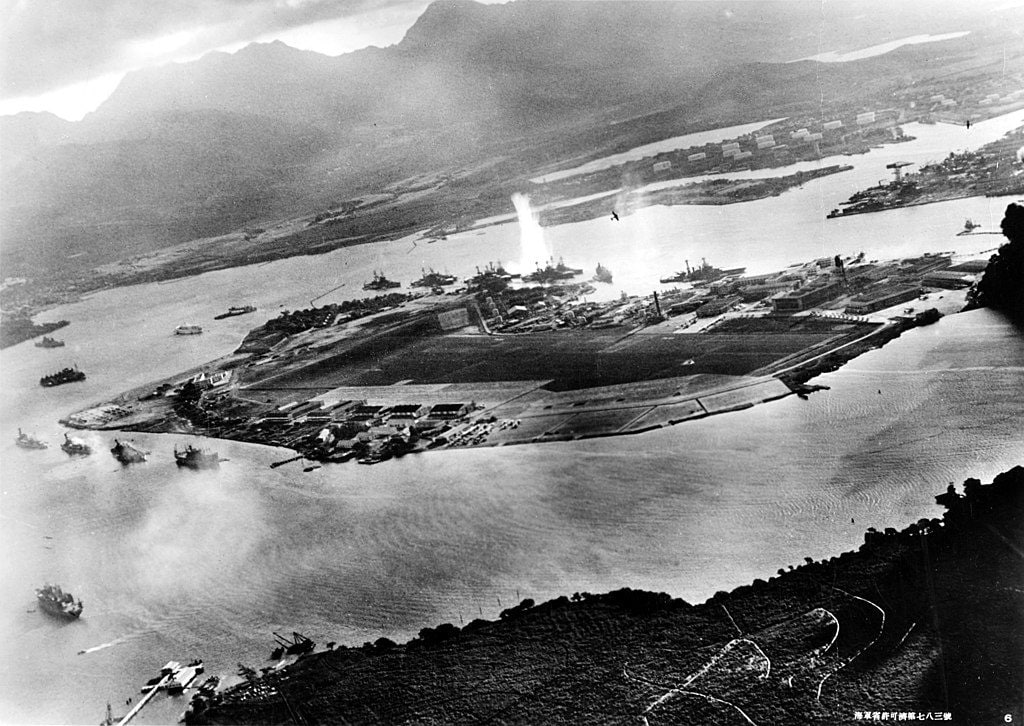
The Japanese attack on Pearl Harbor on the island of Oahu in Hawaii – home of the US Pacific fleet – was launched during World War II on December 7, 1941, at dawn on Sunday morning. It was a sudden attack by the Japanese air force, which occurred in two waves and caused the death of 2,403 US soldiers and the destruction of 8 battleships of warships.
The causes can be traced back to Japan’s expansionist policy, which intended to build a “new world order” in Asia and the Pacific, in a similar way to what Nazi Germany and fascist Italy tried to do in Europe. The Tokyo government’s plans, however, were hindered by the United States, which had imposed a trade embargo on Japan to curb its expansionism. That episode marked the entry of the United States into the Second World War: on 8 December 1941, US President Roosevelt declared war on Japan, defining the attack as a “day of infamy”.
That moment marked the history of the United States: it is still commemorated today during the National Pearl Harbor Remembrance Day and inspired the film “Pearl Harbor” of the same name.
- 1The causes of the attack by the Japanese air force
- 2The surprise attack on Pearl Harbor
- 3The results of the attack and the end of the operations
- 4The consequences of the attack on Pearl Harbor
The causes of the attack by Japanese aviation
In the 1930s, a nationalist and militarist regime established itself in the Japanese Empire, in some respects similar to European totalitarianisms. In 1931 the Japanese army invaded a peripheral region of China, Manchuria, and in 1937 brought the war to the heart of Chinese territory. The goal was to become the dominant power in the Asia-Pacific region.
The United States also had interests in the Pacific: it controlled the Philippines, which became its colony at the end of the 19th century, and had commercial interests in the area.
In 1939, as we know, the Second World War began in Europe. The United States and Japan were not directly involved, but the conflict still exacerbated tensions because the Americans supported the United Kingdom, while the Japanese were close to Nazi Germany and fascist Italy. After the start of the war in Europe, the government in Tokyo intended to continue its expansion, but had to decide in which direction to direct it. There were two options: towards continental Asia, attacking the Soviet Union, or towards Southeast Asia, facing the United States. On 25 June 1941, in a “liaison” meeting of the government with the military leaders, it was decided to attack in the South-East and in July the army occupied the French colony of Indochina.
In the United States, Japanese expansionism was greatly feared, also because it appeared similar to that of Hitler in Europe, but a large part of public opinion did not want the country to be involved in conflicts in other areas of the world. The government, led by President Franklin D. Roosevelt, reacted to expansionism with economic measures: in 1940 it imposed the first sanctions on Japan and, after the invasion of Indochina, it completely stopped exports of oil and other strategic goods, followed by the United Kingdom and the Netherlands. For Japan, the American decision was a serious obstacle, since without oil it would not have been able to continue its expansion. On 6 September an imperial conference (i.e. a government meeting with the presence of the emperor) decided that, if the negotiations for the interruption of sanctions failed, there was no alternative to war. In October, General Hideki Tojo became head of government and established the deadline for closing the negotiations: November 30. If no agreement was reached by then, war would begin.
The surprise attack on Pearl Harbor
The Japanese military leaders were aware of the military and industrial potential of the United States and believed that the only possibility of victory lay in dealing them a mortal blow from the start of hostilities. The navy, led by Admiral Isoroku Yamamoto, developed an ambitious plan: to bring aircraft carriers near Hawaii and destroy the American Pacific Fleet, which was anchored in Pearl Harbor, a port on the island of Oahu, by air strikes.

The Japanese fleet, which included six aircraft carriers and numerous escort units, put to sea on November 26 under the orders of Admiral Chuichi Nagumo. The Tokyo government decided to send the declaration of war to its counterpart half an hour before the attack began, so that the American army would not have time to prepare countermeasures. However, the ambassador in Washington took time to decipher the text and delivered the statement after the attack had begun.
Shortly before 8:00 on December 7, the first wave of the attack was recorded: 183 Japanese planes, including torpedo bombers (i.e. planes that dropped torpedoes), bombers and fighters, arrived in the skies of Pearl Harbor, taking the enemy completely by surprise. The American intelligence services, which had deciphered the secret code used by the Japanese authorities, had intercepted many communications in the previous months, but they did not know where and when the enemy would attack and had not prepared any countermeasures. Japanese planes were therefore able to bomb Pearl Harbor practically undisturbed.
At approximately 09:00, shortly after the aircraft of the first wave had withdrawn, the second attack wave, consisting of 171 aircraft, arrived at Pearl Harbor. This time the American anti-aircraft reacted and some fighters managed to take off to face the enemies, but the Japanese still carried out the attack successfully.
The balance of US losses: ships destroyed and soldiers killed
The immediate consequences of the attack were disastrous: all eight American battleships (including USS Arizona and USS Oklahoma) were hit and four sank or suffered non-repairable damage; many other military ships suffered serious damage; as many as 188 planes were destroyed on the ground; 2,403 soldiers lost their lives. The Japanese, however, lost only five submarines and 29 aircraft.

The Japanese air force, however, did not hit any of the three aircraft carriers that were part of the Pacific fleet, because on the day of the attack they were on a mission far from Pearl Harbor. Furthermore, Admiral Nagumo made a serious mistake: after the second wave he ordered his fleet to head towards Japan, not wanting to risk the ships being hit by American planes or submarines. If he had launched the third wave, as his subordinates insisted he do, he could have destroyed the shipyards and fuel depots, forcing what remained of the American fleet to abandon Hawaii.
The aftermath of the attack on Pearl Harbor
The attack on Pearl Harbor had very different consequences than those hoped for by Japanese leaders. In the United States the event caused a very strong emotional reaction and December 7 was considered “the day of infamy”, because the country had been attacked without a formal declaration of war. At the same time, the episode favored the spread of anti-Japanese sentiment throughout the country.
Furthermore, the enormous American industrial apparatus allowed the navy to replace losses and equip itself relatively quickly with a fleet based on aircraft carriers. After suffering some defeats in the first months of the war, the American military was able to counterattack and defeat Japan.
Pearl Harbor also profoundly influenced the progress of the conflict in Europe, because on 11 December 1941 Italy and Germany, allies of the Japanese, declared war on the United States and involved them in hostilities.










