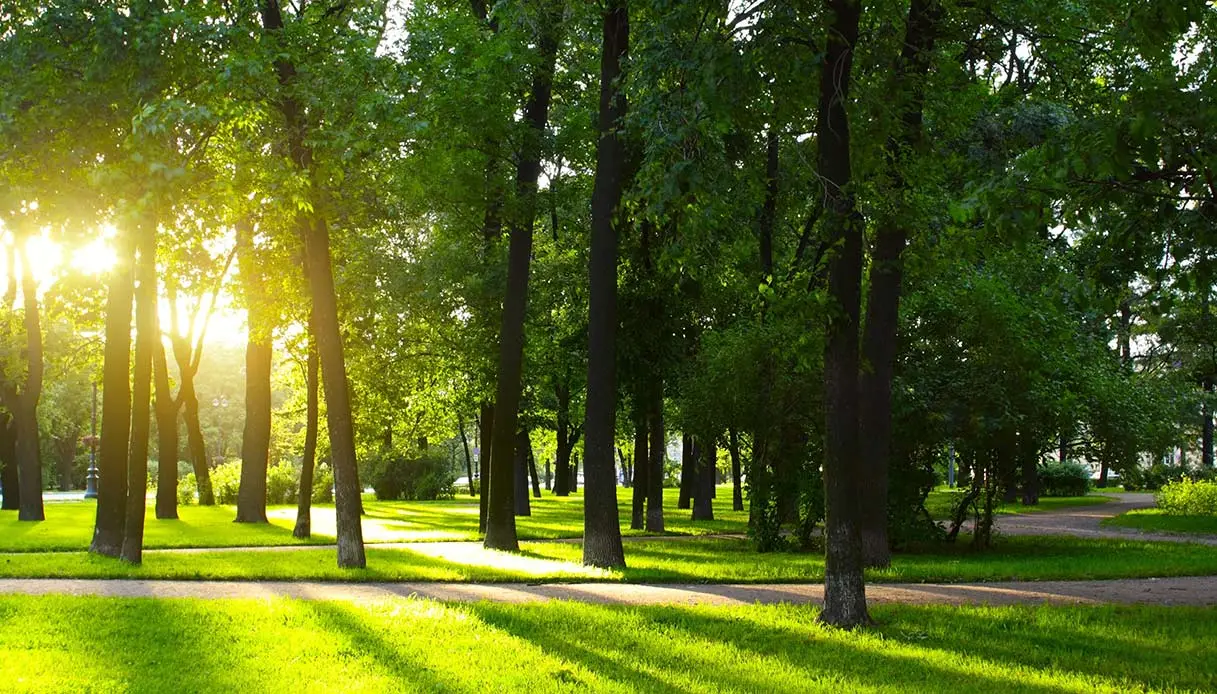
Urban flora tailored for anti-pollution action. Because it would not be enough just to introduce greenery into the area, but to better control smog and the potential effects on human health it would be necessary to select tree species capable of carrying out this function.
To say that not all green is the same, at least in this sense, is a research published on Science Advancesconducted by experts from Jinan University, China, who measured the situation in Beijing, with a tracking and subsequent analysis of the situation and trends. Moral: planting urban greenery would not in itself be a sufficient strategy against smog, it also depends on what you put in the ground. According to the study, in fact, there are tree species capable of releasing substances which, by reacting with the pollutants already present, can accentuate the formation of ozone at ground level.
What happens thanks to green
Let’s be clear: greenery in the city is a real blessing, also because trees absorb carbon dioxide and other harmful compounds, return oxygen and contribute to urban climate comfort. But if we talk about creating new natural areas, we must not forget when scholars observed analyzing the BVOCs (Biogenic Volatile Organic Compounds) emitted by trees. Similar substances are also produced by human activities and we speak of AVOC (Anthropogenic Volatile Organic Compounds) linked for example to solvents, paints and detergents.
Warning: these compounds, by interacting with sunlight and nitrogen oxides, favor the formation of tropospheric ozone. Low-altitude ozone is a toxic gas, associated with respiratory and cardiovascular disorders as well as effects on the nervous system. So what could happen with the compounds produced by greenery, given that on the human activity front the situation has much improved. And it is precisely in this sense that Chinese experts conducted the study, tracing in real time the chemical profile of what happened in Beijing between May and July 2021. The analysis, which lasted five years, led to significant results: despite representing approximately 10% of the total VOCs, compounds of biogenic origin were found to be much more reactive than anthropogenic ones. In particular, isoprene has emerged as the main promoter of ozone formation.
The role of isoprene
Mapping the urban flora therefore revealed that many species widely used in Beijing, such as willows and poplars, are large emitters of isoprene. A comparison with several European cities – where the dominant species in urban areas generally do not release isoprene in significant quantities – confirms the picture: ozone levels are lower than those observed in Beijing.
In short: today we must not give up trees which must indeed find more and more space, nor should we proceed to remove existing specimens of species with a high release of isoprene. But on the planning front, this data can be of great help. So here are three tips that come from the research:
- choose low-emission varieties when designing new parks or replacing dead trees
- evaluate the local chemical-atmospheric context
- balance the benefits of greenery with the potential contribution to ozone formation.
And go ahead for walks
On the other hand, having green areas available for running and walking means creating a real connection with nature that improves our well-being. This is recalled by research coordinated by Amy McDonnell and David Strayer of the University of Utah, which appeared on Scientific Reports. The study reveals how walking in nature leads to demonstrable benefits for the nervous system, not related to physical activity but precisely to the environment, given that the same situations do not seem to reveal themselves when walking or perhaps running along urban streets.
American experts even used electroencephalography (EEG), which records electrical activity in the brain with small disks attached to the scalp, to measure participants’ attention span. And they have come to see that, as the study concludes and as a note from the university reports, “a walk in nature strengthens some executive control processes of the brain far beyond the benefits associated with physical exercise”.
To reach this conclusion, the experts proposed that two groups of people, about ninety in total, take a walk of about forty minutes: half of the walk took place in a forest of trees, for the others on the asphalt of the road. At the beginning and at the end of the check, an electroencephalographic survey was carried out, following the administration of repeated tests such as to exhaust the attention reserves of the participants before carrying out a scientifically standardized tailor-made check of the parameter. Result: those who had walked in nature showed an improvement in executive attention, while walkers in an urban environment did not.
So let’s enjoy the greenery, with an eye on health. Always.