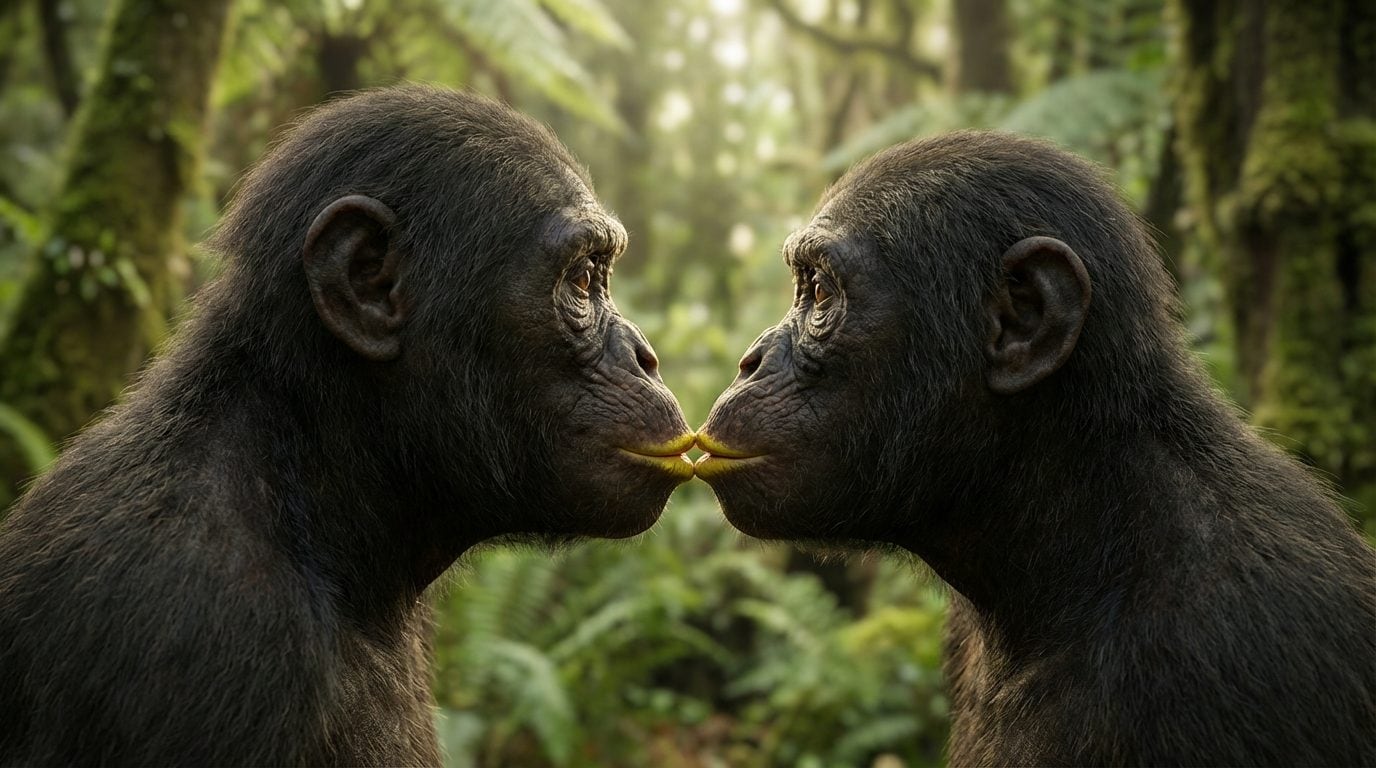
The activity of kissing is much older than we think – 21 million years ago – and could even date back to the common ancestor of humans and great apes. This is what emerged from a recent study, conducted by Matilda Brindle and Stuart West, of the University of Oxford, together with Catherine Talbot of the School of Psychology of the Florida Institute of Technology.
Although we tend to think that kissing is a purely human activity, this is absolutely not the case. In fact, it is a very common activity among different species of hominids (chimpanzees, bonobos, orangutans, gorillas, the primates most closely related to our species), but also macaques and baboons and many other species, even very distant from us evolutionarily. Taking this into consideration, it is very likely that kissing is a phylogenetic trait of our species, almost certainly also present in the other extinct species of the genus Homo, including the one closest to us, Homo neanderthalensis. It is therefore an activity that can trace its origins back to the common ancestor between Homo and other hominids, who lived around 10-20 million years ago. Notably, the team that conducted the study says that the findings suggest that kissing evolved between 21.5 and 16.9 million years ago in the ancestors of great apes.
From this point of view, the relationship between our species, Homo sapiensAnd Homo neanderthalensisit becomes even narrower, and passes right through the mouth. In fact, a particular microbiota bacterium is found in the oral cavity of both species, Methanobrevibacter oralis. Sapiens and Neanderthals, in the evolutionary history of man, separated from their common ancestor (probably Homo heidelbergensis) between 750,000 and 450,000 years ago, but the genetic heritage of the microbiota Methanobrevibacter oralis it diverged between the two species “just” between 143,000 and 112,000 years ago. This data could tell us how Sapiens and Neanderthals “exchanged saliva” for about half a million years, probably in the Middle East, where the two species coexisted in that very long period of time.
Kissing, by its very nature (contact between sensitive parts of the body) is a risky activity: it can in fact favor the contagion and transmission of diseases. From an evolutionary point of view, therefore, it must be a behavior that has been preserved because it allows greater benefits compared to potential risks. Kissing most likely evolved starting from pre-chewing, that is, that activity common to many animal species which sees adult individuals chew food and then pass it with their mouths to their young. It cannot be excluded that this activity was also practiced by ancient Sapiens and Neanderthals.
Considering kissing as an ancient sublimation of pre-chewing (therefore an activity that triggers positive sensations), the theories proposed by researchers to explain the conservation of this trait are different. There is a theory of sexual selection, which sees kissing as an opportunity to “test out” a potential partner or to increase sexual arousal to improve the chances of reproducing, but also a social theory, which sees this activity as an opportunity to create bonds between individuals and promote relaxation and the resolution of social conflicts.