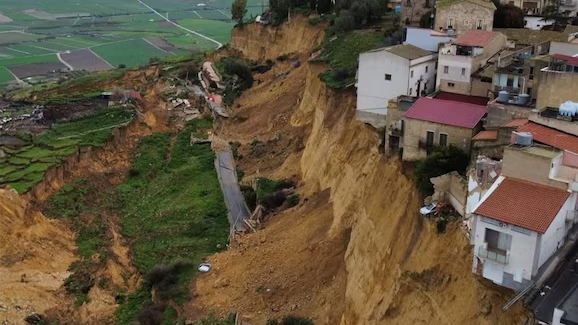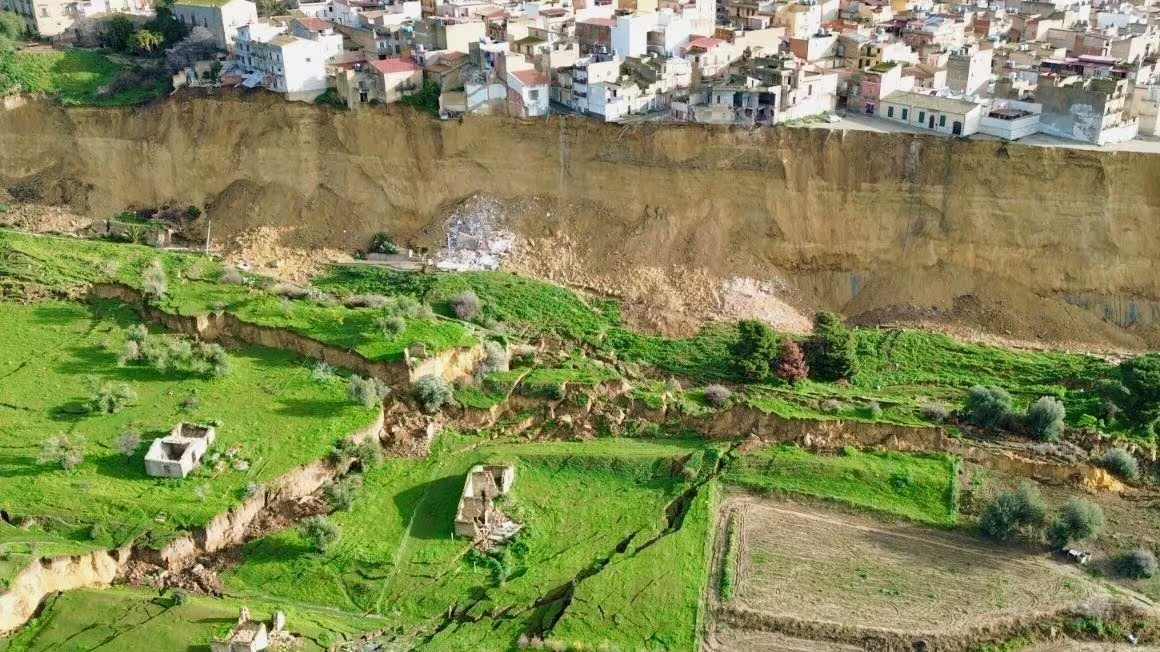
The landslide that occurred yesterday in Niscemi, in the province of Caltanissetta in Sicily, is still ongoing. According to Salvo Cocina, director of the Sicilian Civil Protection, this is an “unprecedented” landslide for Sicily. The situation worsened starting from late yesterday afternoon, with other failures which caused a widening of the landslide front and an increase in the vertical shear which reached up to 50-55 metres, as confirmed by the mayor Massimiliano Conti. The safety zone was widened to 150 meters from the front, bringing the number of evacuees to 1500 (over 300 families). Two of the four access roads to the town, the provincial SP10 and SP12, were closed, leaving the town almost isolated.
The alert remains maximum: as stated by the president of the Italian Geological Society Rodolfo Carosi, the retreat of the landslide crown is gradually continuing, therefore the buildings on the edge of the slope are at high risk. According to Cocina, the houses within a distance of 50-70 meters from the front would be destined to collapse due to the progressive subsidence of the sandy soils exposed following the landslide.
The geological reason why the landslide does not stop lies in the stratigraphy of the area affected by the landslide. A geological report presented to the Sicily Region in 2019 confirms that under the soil there is in fact a first layer of alluvial deposits due to the waterways present there, made of pebbles immersed in a poorly cemented matrix. Below we find a layer of sand and a layer of silt before arriving at a substratum of marly clay. Higher states are porous, while clays are much less permeable.
With the heavy rainfall that recently fell with Storm Harry, the porous materials allowed rainwater to infiltrate down to the clay substrate. At this point the clays became soaked in water, and this caused them to lose resistance, causing them to slide downstream. The overlying layers, poorly cemented and weighed down by the absorbed water, then collapsed also due to the formation of an interstitial surface of water that accumulated on the upper edge of the clay layer, which reduced the friction between the two masses. As a result, the landslide crown began to retreat, because the sandy and silty layers do not have enough consistency to sustain themselves over time without support. This process, once started, does not stop with the end of rainfall.
However, we must not “blame” the tempered Harry. While it may have played a role in triggering this landslide event, the process was already underway. In fact, let us remember that this is one of the areas with the highest landslide risk in Italy, already classified by ISPRA as P4 (very high danger) and the risk for buildings near the crown was indicated as R3-R4 (high-very high). The same area had been hit by a large landslide in 1997, which was partially reactivated by yesterday’s event, as well as by a landslide just about ten days ago. In short, it was not a sudden and unexpected event: the area was fragile, already partially compromised by previous subsidence and was considered high risk.