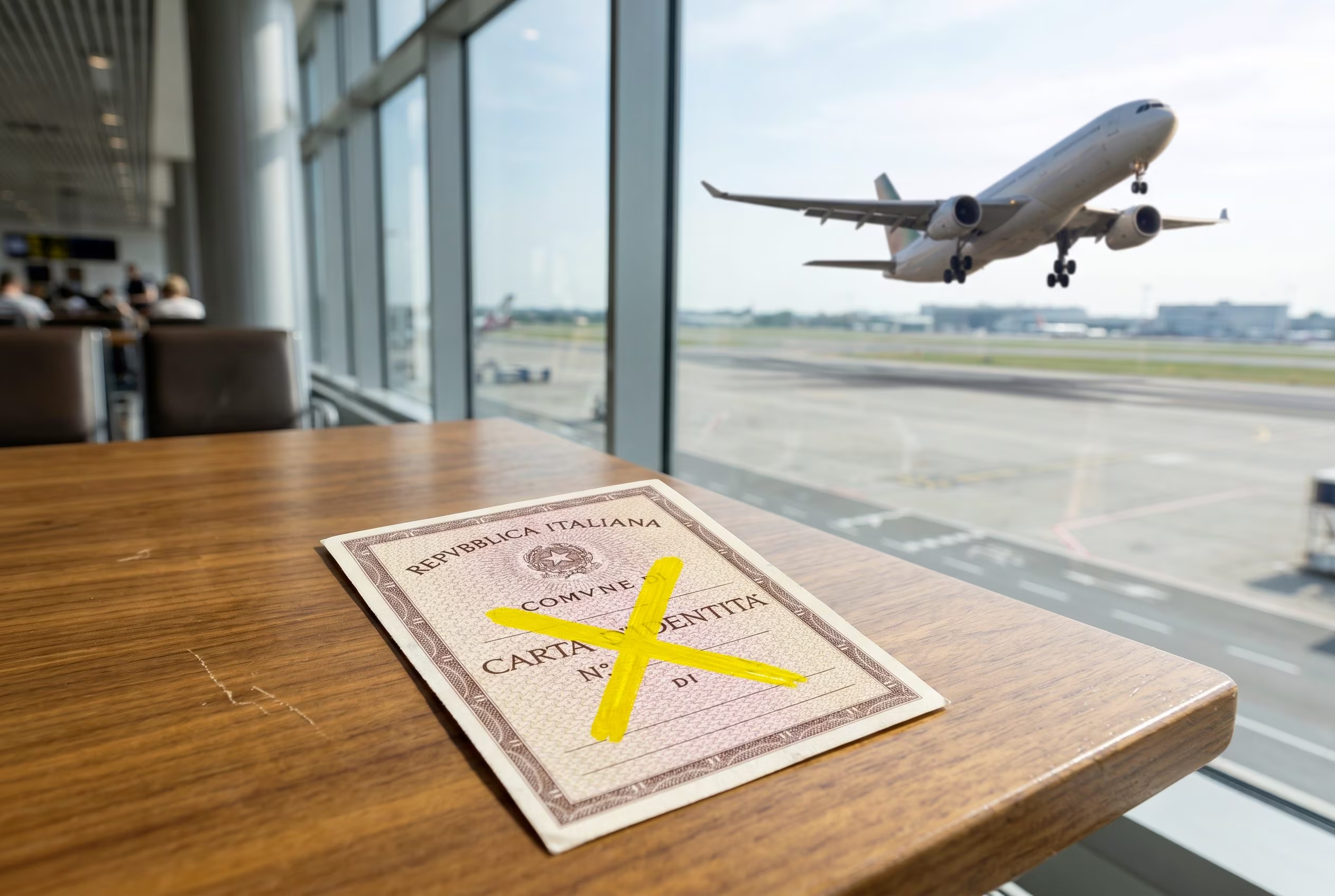
The paper identity card will remain valid within national borders until 31 January 2027, but only for purposes such as the exercise of fundamental rights and access to health, social security and insurance benefits. To travel abroad, however, from 3 August 2026 you will necessarily need the CIE or passport: this is what is provided for by Legislative Decree no. 108 of 26 June 2026, with which the Government finally clarified the conditions under which the paper identity card can still be used.
But let’s take a step back. As we know, the deadline of 3 August was set in application of European Regulation 2019/1157, which requires all member states to gradually eliminate identity documents that do not comply with European security standards (not guaranteed, in fact, by paper identity documents).
The problem, however, is that the Municipalities and Consulates have not been able to keep up with the requests: the queues at the counters have become enormously long and many citizens have found themselves physically unable to obtain the CIE by the deadline, with the risk of being left without a valid identity document in the midst of the summer holidays.
For this reason, the Government had announced a partial about-face, anticipating that the paper identity card would remain usable “for certain purposes and in relations with the public administration and with entities that provide public services”. Now, with the publication of Decree 108/2026 in the Official Journal, the picture is finally clear.
The cases in which the paper identity card can be used (but only until 31 January 2027)
Decree 108/2026 establishes two distinct tracks for the validity of the identity card in paper format: the first concerns contractual relationships, both public and private. If you have used your paper identity card to identify yourself in any contract entered into by 3 August 2026, then that document remains valid until its natural expiry date – that is, the one indicated on the back of the document at the time of issue. For example, if you have opened a bank account by presenting your paper ID card, that bank will continue to recognize it as a valid document until its original expiration, but only for the purposes of that relationship.
The second track is instead linked to the use of the document in daily life. Pending the release of the CIE, the unexpired paper document may continue to be used as an identity and recognition document until 31 January 2027, but only within national borders and for a series of very specific purposes:
- The exercise of fundamental rights (such as exercising the right to vote);
- Access to health, social security and insurance services;
- Relationships with the public administration and with entities that provide public services;
- The delivery of mail and judicial documents;
- The withdrawal or deposit of money at banks and credit institutions that provide financial or postal services.
From 3 August 2026 the paper identity card will no longer be valid for travel abroad
There is a fundamental element, however, that does not change: from 3 August 2026 the paper identity card will no longer be valid for traveling abroad. Anyone wishing to travel abroad must therefore have the CIE or, alternatively, a temporary identity document issued by the mayor in cases of urgency.
The Decree, in fact, establishes that until 31 December 2027, in cases of urgency, the mayor will be able to issue a temporary identity document with a maximum validity of six months (non-renewable) which will also be considered valid for expatriation. The Government, however, clarified that some foreign states may not recognize this provisional document.
Outside of the specific purposes listed above, therefore, the paper identity card will lose its effectiveness as an identification document. The decree, in fact, does not provide for a general extension of the validity of the old document: it limits itself to authorizing its use for specific purposes, essentially linked to the continuity of essential services on the national territory, and for a limited period of time. The path of progressive replacement of paper with electronic paper, therefore, remains confirmed: the times for the complete transition have simply been extended. According to data reported by the State Printing and Mint Institute and the National Registry of the Resident Population (updated to 1 July 2026), 2 million paper identity cards are still in circulation.
In short, the advice always remains the same: if you still have your paper identity card, book an appointment at your municipality to issue the CIE as soon as possible.