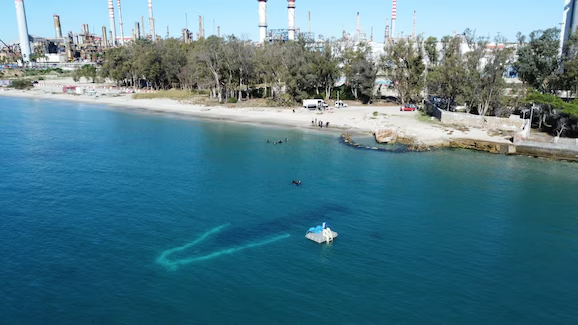
For over twenty years the Gulf of Khambhat, on the western coast of India, has been at the center of one of the most controversial debates in contemporary archaeology. In 2001 the National Institute of Ocean Technology, engaged in geophysical surveys of the seabed, identified some anomalies with sonar, interpreted as possible artificial structures. The subsequent recovery of wood, lithic fragments and other materials led some researchers and representatives of the Indian government to hypothesize the existence of a large submerged settlement dating back to around 9,000 years ago, well before the Indus Valley civilisation.
The announcement immediately aroused enormous media interest, but also strong criticism from the scientific community. The main problem concerns the method of recovering the finds. The objects were not found during a stratigraphic archaeological excavation, but rather dredged from the seabed using mechanical buckets. Consequently, it is not possible to demonstrate with certainty that the materials come from the structures identified by the sonar or that they all belong to the same archaeological context, which should be between 20 and 40 meters deep.
Even the famous dating of around 9,000 years ago has often been misunderstood. Radiocarbon was performed on a fragment of wood recovered from the area, but this only demonstrates the age of that single find, not of the hypothetical city. The wood could have been transported by currents or come from older sediments, of more likely natural formation, without any direct link with any anthropic structures. Even sonar images, often presented as evidence of buildings, streets and squares, are not considered conclusive. The Gulf of Khambhat is one of the most dynamic coastal environments in India, characterized by very strong tides, currents, high turbidity and continuous erosion and sedimentation processes, factors that make both direct intervention with an archaeological excavation on the seabed and the interpretation of seabed anomalies particularly complex.
Without its stratigraphic context, a piece of data is of little relevance. Any object recovered from the seabed in this way could have been lost in other conditions, or belong to a wreck that sank in the area at very different times. Proposing radiocarbon dating of an element to date an entire archaeological context is scientifically incorrect. What makes everything even more doubtful is the fact that the sonar images detected are difficult to access.
For these reasons, more than twenty years after the discovery there is no scientific consensus on the existence of a submerged city in the Gulf of Khambhat. Furthermore, none of the bodies that carried out the research have ever published rigorous archaeological documentation. Most archaeologists believe that new surveys and above all controlled underwater excavations are essential, capable of documenting the finds in their original context. Until then, the site represents an interesting case study in how geophysical data, scientific analyzes and archaeological interpretations must be rigorously integrated before rewriting the history of early civilizations.