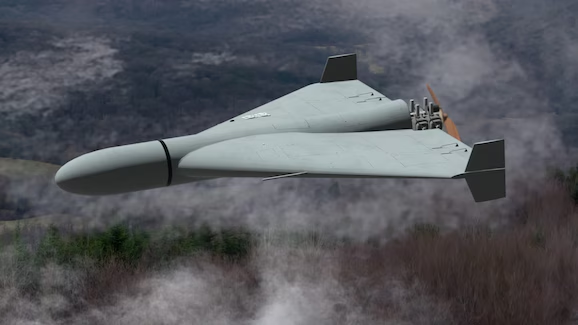
Hybrid war is a conflict in which the belligerents, to damage the enemy, use both “traditional” military weapons and unconventional tools, such as cyber attacks, economic pressure, disinformation, even migratory flows.
The distinction between hybrid war and conventional war is not always simple, considering the fact that, already in the past, most conflicts have been fought not only with military means, but also through other types of instruments. From a historical perspective, therefore, hybrid warfare is certainly not a new phenomenon: in recent times, however, the concept of hybrid warfare has gained great popularity and is frequently used by the media in relation to the war between Russia and Ukraine and the geopolitical tensions between NATO and Moscow.
What is hybrid warfare
Hybrid warfare generally refers to a conflict in which the warring parties (whether states or non-state actors) use both conventional military tools and non-military tools to weaken or sabotage an adversary. The adjective hybrid, in fact, indicates something that arises from the union or crossing of two or more different elements.
In the case of hybrid warfare, the warring parties use different means in addition to weapons. The most common include cyber tools, used to conduct hacker attacks; communication tools, to carry out propaganda and spread fake news with the aim of influencing public opinion; economic tools, to strike the enemy’s infrastructure and production centers.
Hybrid warfare, therefore, is not only fought on the battlefield, but also in the economic, IT, political and communication fields. Not only are the armed forces affected, but also the infrastructure, the economy and the morale of citizens.
Sometimes, unconventional activities are not conducted directly by states, but by irregular armed groups, mercenaries or individuals acting on behalf of state authorities, making it difficult to identify those responsible.
In any case, for a war to be defined as hybrid it is essential that, alongside non-conventional instruments, there also be armed combat. In fact, however, journalistic language sometimes refers to “hybrid war” even in the absence of military operations, for example, if one state launches cyber attacks against another, but does not accompany them with “traditional” armed attacks.
How to distinguish it from conventional wars
The definition of “hybrid warfare” is difficult to apply. In fact, it is not easy to distinguish it from conventional wars, because in almost all armed conflicts non-military instruments are also used to subdue the enemy. For example, propaganda already existed in the ancient world and has gained increasing importance over the centuries. In the two world wars, in particular, it played a decisive role and all the belligerent countries invested enormous resources in developing it.
Likewise, economic pressures have always accompanied armed conflicts. Just think, for example, of the Peloponnesian War, fought in the 5th century BC. C. between Athens and Sparta: both sides tried to control the trade routes and damage the enemy’s economy; in more recent times, think of the naval blockade imposed by Napoleon on the United Kingdom.
As time has passed, of course, unconventional means have changed. Today one of the most widespread tools is information technology: cyber warfare, conducted through hacker attacks, is an essential part of conflicts. Furthermore, sometimes even migratory flows are used as an instrument of war: states threaten to facilitate the passage of unmanageable flows of migrants to destabilize other countries.
Another difficulty arises from the confusion between hybrid warfare and unconventional warfare. Sometimes the two concepts overlap and are used synonymously in journalistic languages. However, these are two different things: unconventional warfare, in fact, is a war conducted with guerrilla actions, sabotage and similar operations, rather than with regular armies. It is therefore different from hybrid warfare.
An example of hybrid warfare: the conflict between Russia and Ukraine
An example of hybrid warfare is the conflict between Russia and Ukraine, because actual military operations are combined with cyber activities, disinformation campaigns and economic pressure. Both warring parties have in fact organized disinformation campaigns, tried to attack the enemy’s economy, used cyber attacks and promoted sabotage against infrastructure.
However, the geopolitical tension that has developed between Russia and NATO countries should not fall within the concept of hybrid war: although economic attacks (the sanctions imposed on Russia) and cyber attacks (the alleged hacker attacks organized by the Russians) are underway, there is no actual fighting. Therefore, although the definition of hybrid warfare is sometimes used, at the moment, geopolitical tensions exist, rather than an actual war.