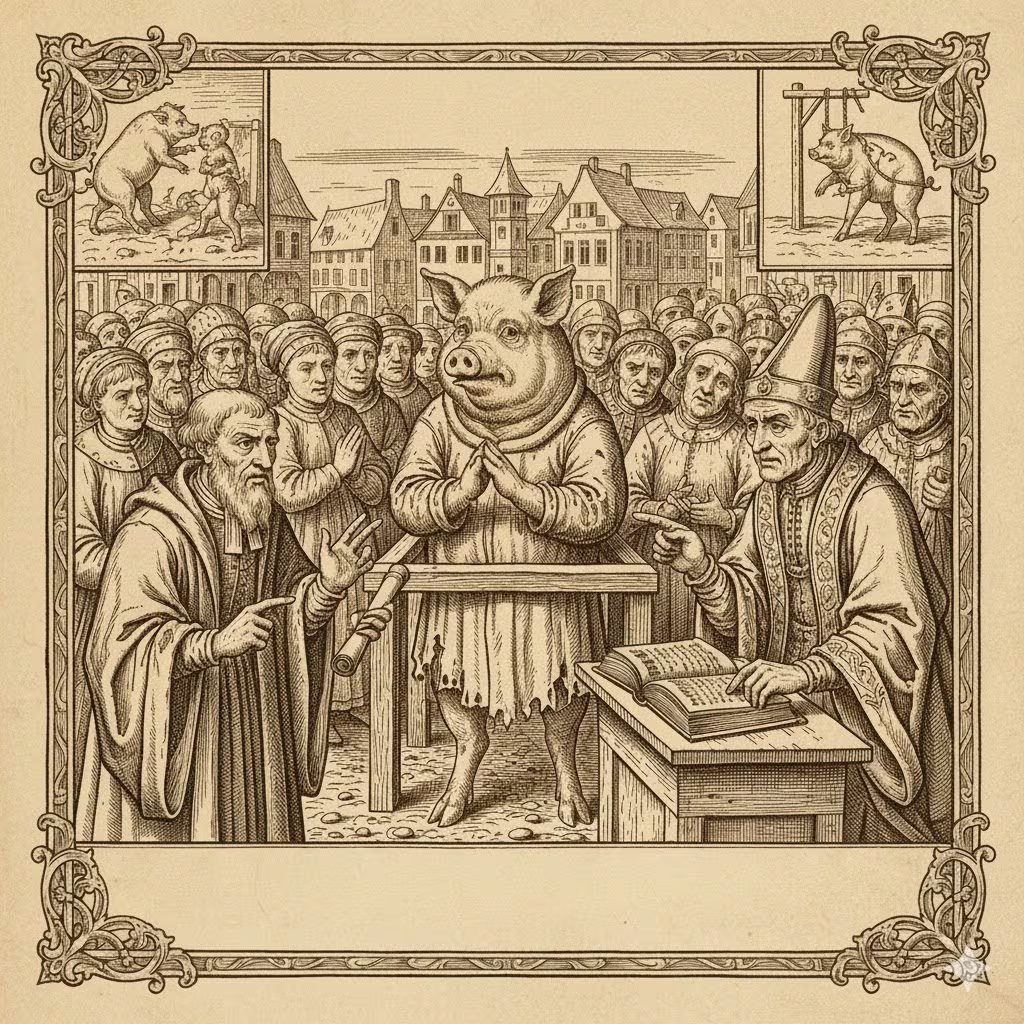
For centuries, in Europe, pigs, horses, donkeys and even insects were tried like people: arrested, defended by lawyers, judged and condemned “in the name of the law”. It is not macabre folklore nor a medieval oddity: those trials tell of a precise moment in our history, in which the law tried to bring order not only to nature, but also to human reproduction, to the family and to the boundaries between species. Understanding why a pig ended up on the gallows means understanding how Europe learned to govern life.
Animal trials
Now let’s try to imagine the scene: in a fifteenth-century square a child dies, killed by a pig. The animal is arrested, locked up, taken to court. He has a lawyer. There is a judge. Finally the sentence arrives: public hanging. It is not a black legend: from the case of Fontenay-aux-Roses in 1266 to the dozens of documented trials in France, domestic animals that injured or killed human beings were judged in the same courts as men with notarial deeds, solemn formulas and even legal debates on the degree of guilt. The idea, shocking today, was simple: some animals could “crime”. And if they broke the order of the community, they were punished.
Why did animals end up in court?
A recent study proposes to read these trials on animals as “crimes against reproduction”. Not because the animals were obsessed with sex, but because we didn’t really judge the animal, but rather the humans involved and the “right” way to have a family. In fact, the cases can be concentrated and grouped into three main areas:
- Bestiality: men and women accused of sexual relations with animals were tried together with the “beast accomplice”. Almost always both sentenced to death. Here the problem is not only moral: it is the violation of the boundary between human and animal, and of a sexuality considered legitimate only if marital and reproductive.
- Infanticide: in cases of infanticide the animal often appears as presumed responsible for the death of a newborn, or enters into trials against mothers accused of killing children born out of wedlock. But the center of the matter is not the animal itself. It’s motherhood that gets out of control. In an era in which an “illegitimate” pregnancy weighs as a crime, the court does not just judge a death, but the very right of that woman to be a mother. Attributing responsibility to an animal, or taking it to trial together with the woman, serves to reiterate a fundamental rule: children are acceptable only if they are born within a precise family and social order. The animal, in this scenario, becomes part of a larger mechanism. It is not just an alternative culprit, but a tool through which the law polices the female body, sexuality and reproduction.
- Witches’ familiars: cats, toads, dogs accused of helping witches: sucking blood, damaging male fertility, making children sick. Even when there is no real court, these animals end up with the same obsession: controlling reproduction and the family.
In all cases, the “culprit” animal is seen as a threat to the domestic order: stable family, regulated sexuality, clear boundaries between species.
A right that tries to tame life
This becomes even clearer if we look at the laws of the time. Between the sixteenth and seventeenth centuries the State forcefully entered private life. In France, royal power regulates marriage and parentage, rewards fathers with many legitimate children and transforms clandestine pregnancy and infanticide into capital crimes, especially for poor and single women. In England, in 1623, a law made infanticide the only crime in which the accused had to prove her innocence. A reversal that says a lot about the social fear of what goes outside the “ordered” family model.
It is the same climate in which animals are tried and witches are hunted. According to many historians, these courts function like a laboratory: there they decide who can reproduce, how, and what a “normal” home means. The witch, the “denatural” mother and the murderous pig are three faces of the same anxiety.
From legal person to thing
The paradox, however, is that in medieval courts, the animal is treated almost like a subject: it can be accused, defended, judged. In some cases he is even acquitted, if the blame falls on the owner who did not supervise him. But it is precisely this passage that prepares the future.
With modernity the animal leaves the court not because it is freer, but because it definitively becomes a thing: property, workforce, biological capital. There is no longer any need for a public trial. It is eliminated, locked up, exploited. Today animals are no longer judged. They are protected only as objects of human feeling, not as true subjects of law. A complete reversal.