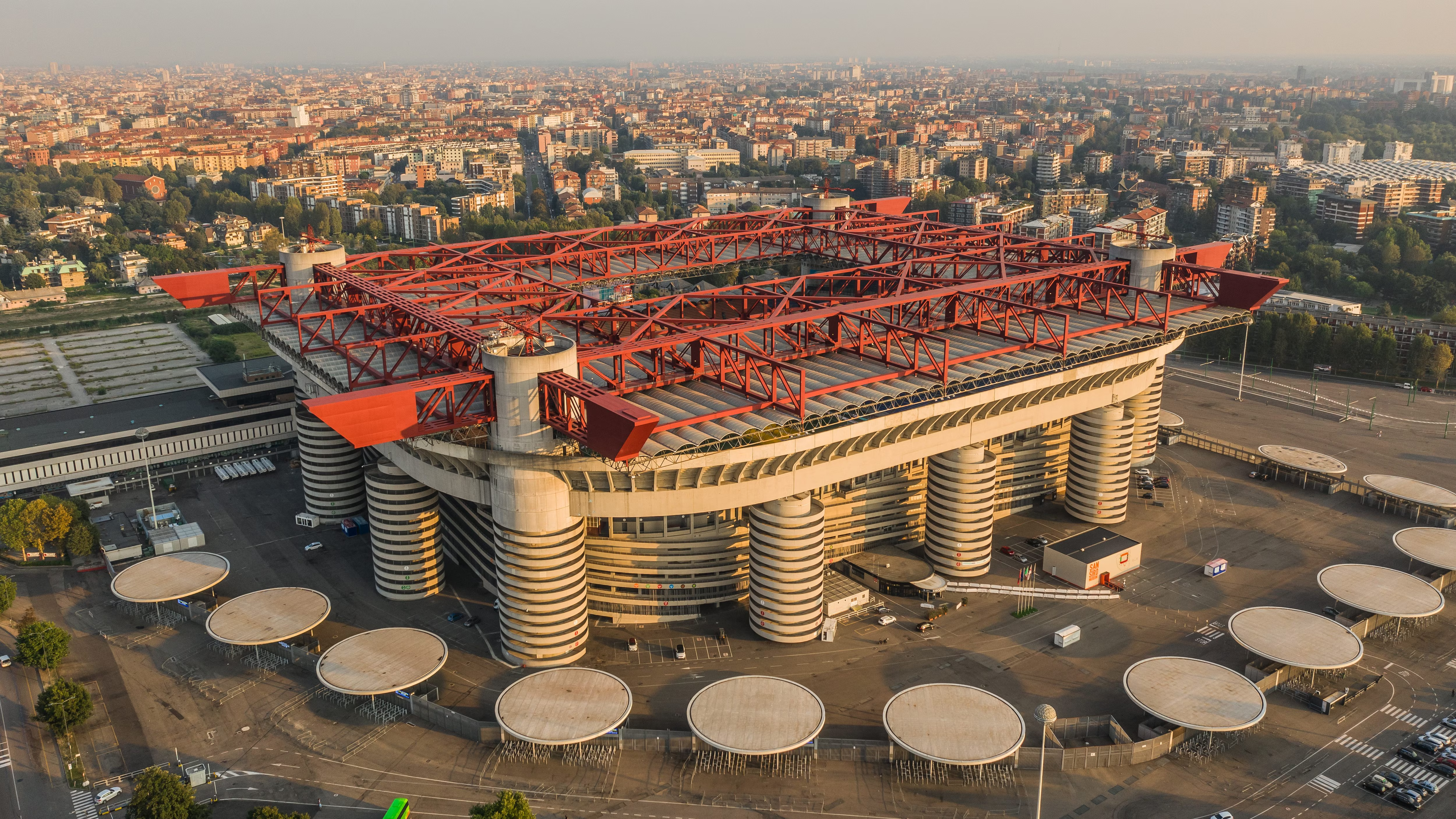
One hundred years ago, in 1925, the then president of Milan Piero Pirelli urged the construction of an English-inspired football stadium. Although its official name is Giuseppe Meazza Stadium – in honor of the two-time world champion who wore the shirts of both Milanese teams – for the whole world it is simply San Sirofrom the name of the neighborhood that hosts it. Also known as the ‘Football ladder‘ for its majesty and the prestige it evokes, equal to that of the famous city theatre. Its construction took 13 months and an investment of 5 million lire. The first match to inaugurate the facility was the Milan derby on 19 September 1926, won by Inter with a result of 6-3. Between the Champions League, World Cup, Europa League and Serie A, San Siro has hosted some of the most exciting matches in the history of football, but also other great events such as concerts by Bob Marley, Bruce Springsteen or Michael Jackson.
The history of the Giuseppe Meazza Stadium
At the inauguration in 1926, the total seats in the four straight stands were 35,000 and the first goal scored inside the stadium known by the name of the neighborhood that hosts it, was that of AC Milan player Giuseppe Santagostino. In this first period San Siro was strictly dependent on the activities of the Ippodormo which, in fact, had in some sense limited its capacity and had reserved, in the rooms below, some spaces used as stables, barns or fodder warehouses. Almost ten years later, in 1935, the Municipality of Milan purchased the plant and decided to implement a first expansion plan. This specifically involved the construction of four curves to connect the existing stands and, at the same time, a modification of the central one, with an increase in capacity up to 55,000 spectators. Exclusive home of Milan until the 1947/48 season, San Siro was again the subject of restoration in 1955. In this session of work, a new load-bearing structure was built with the idea of introducing a second ring of stands above those already present. At this point there could have been 80,000 paying passengers in total, of which around 60,000 were seated, and to facilitate access to the second ring, helical ramps were inserted. Two years later the night lighting works were completed and in 1965 the electronic scoreboard was installed.
Another important date to keep in mind when talking about the history of this stadium is 1980, the year in which it was named after Giuseppe Meazza, who died a few months earlier, in honor of his indissoluble bond with the city of Milan and the legacy, not just football, that he left there. After all, his contribution to Italian football was certainly incredible: twice world champion with the national team and striker for both Milanese teams, recognized by all for his profound talent and his strong personality.
With the advent of Italy’s organization of the 1990 World Cup, San Siro reached its final form, the one we all know today and which, surely, will be impossible to forget. That same year, many Italian cities began ambitious renovation works on their facilities to raise the general level and make them as suitable as possible to host the upcoming great event. Thanks to the contribution of the architects Giancarlo Ragazzi and Enrico Hoffer and the engineer Leo Finzi, a third ring was created that covers (partially) the stadium, with 11 towers that support it and act as stairways to access it. The final result is 85,700 seats, colored seats based on the sector they belong to and polycarbonate sheets that guarantee natural lighting on the playing field. Furthermore, a new turf heating system is installed in order to regulate the temperature of the ground and avoid any formation of ice.
Why it is also called “Football Ladder”
The lawn of San Siro (or Giuseppe Meazza in Milan, whatever you want to call it) has seen glorious years and hosted some of the most incredible world events, not only from a football point of view. Due to its incredible notoriety and its powerful appearance, it has earned the title of “Scala del calcio” with explicit reference to the historic Milanese theater which, in the same way, is considered by all to be one of the most prestigious theaters in the world as well as a temple of entertainment and art, home to artists of the caliber of Verdi, Puccini or Nureyev.
The future of the San Siro stadium
In recent times there has been a lot of talk about the future of this system, which many do not consider cutting-edge enough. Probably the failure to be awarded the 2027 Champions League final and UEFA’s no to the candidacy for Euro 2032 were seen as strong signals regarding the fate of San Siro.
A few weeks ago, in fact, there was a significant turning point represented by the transfer of the facility and surrounding areas from the Municipality of Milan to the AC Milan and Inter companies. The purchase, for a total sum of around 197 million euros, was completed after months of internal debates on what to do. The objective of the two Milanese clubs is to use the area for the construction of a brand new facility which, from the report presented, should have a capacity of approximately 71,500 seats, museum, store, hotel, restaurants, offices and green areas. The overall investment to date is around 1.29 billion euros with the works expected to start in 2027 and be completed, according to estimates, in 2031. The final product will be, following the declarations of the top management, a cutting-edge and sustainable structure, which adapts perfectly to the needs of society and the territory and which can host events of various kinds.
Despite the almost total demolition of the “Scala del calcio”, there would still be a desire to conserve a small part of it, renovate it and use it for commercial, recreational or museum purposes.










