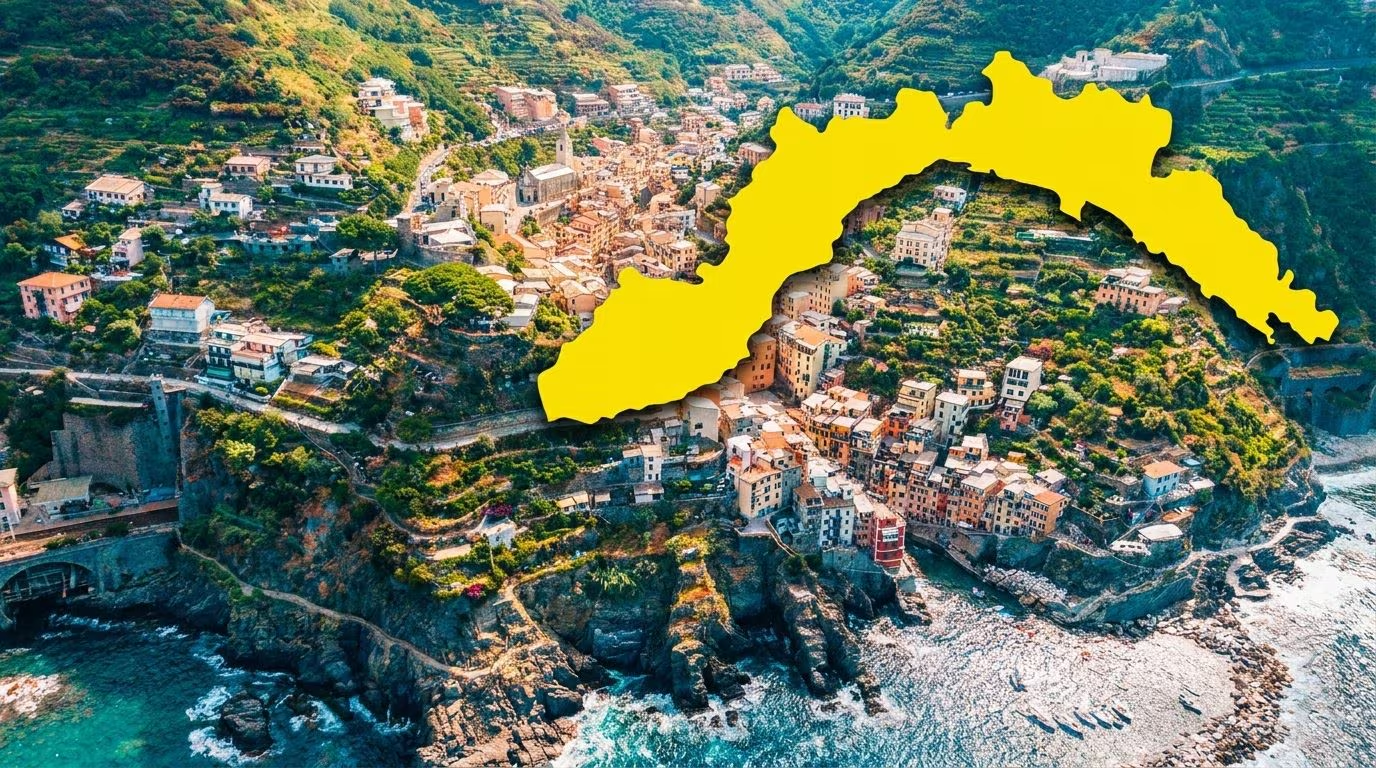
Among the few regions of northern Italy to have a strong maritime vocation, Liguria extends with its slender arch shape into the north-western portion of our country.
Sandwiched between the Maritime Alps and the Ligurian Apennines, to the north and north-east, and the Ligurian Sea, to the south, this region populated by over 1.51 million inhabitants is characterized as a very important hub for commercial and tourist flows in and out of Italy, thanks to its ports, among which, certainly, the historic port of Genoa, the capital, stands out.
Although it is a region of modest size, many of its products, such as Ligurian focaccia and Genoese pesto, and landscapes, such as the picturesque Cinque Terre to the east and the Riviera di Ponente, have a profound resonance not only on a national level, but also on an international level. In this article we discover 10 curiosities about the territory, history and culture of the Liguria Region and its 4 provinces.
1. The origin of the name of the region
The current name Region Liguria derives from the ancient people of the Ligurians: lígyes in Greek; Ligures in Latin. The exact dynamics that led this population to settle in northern Italy are lost in the mists of time and the first historical sources, dating back to the 8th century BC, are extremely fragmented and uncertain. According to recent studies, the Ligurians arrived in present-day Italy with the great migrations of populations Indo-Europeanbetween the 4th and 2nd millennium BC, but other hypotheses would trace their origin back to even more ancient times.
What is quite certain, however, is that around 2000 BC the Ligurians occupied a much larger portion of territory than today’s Liguria, which extended across much of north-western Italy, up to the northernmost portions of Tuscany, and part of the French region of Provence-Alpes-Côte d’Azur.
2. The coat of arms of Liguria
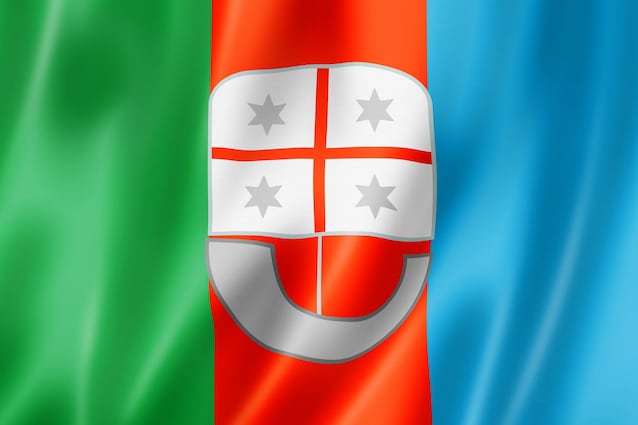
The coat of arms of the Liguria Region consists of a stylized caravel with a black border and a white sail with four silver stars.
The symbol is a clear reference to the maritime tradition of the region and its famous navigators, among which we certainly find the Genoese Christopher Columbus, but also Andrea Doria and Antonio da Noli, and therefore a tribute to the historical bond that this territory has with the sea, which for centuries has contributed to forging the historical identity of the region.
It is worth remembering that the characteristic Argentine neighborhood of “La Boca”, in Buenos Aires, was founded and colored by the numerous Genoese immigrants who arrived in South America, who painted their houses with leftover paint from ships.
3. The numbers and the green record
Liguria, with Genoa as its capital, is one of the smallest Italian regions. With its 5,417.62 square kilometers of extension, in fact, it ranks third to last in terms of surface area among the 20 regions that make up our territory. Despite this, the population of 1,511,988 inhabitants is quite numerous, especially if one takes into account its limited size: this determines a rather high population density: 279 inhabitants per square kilometre, the fourth highest in our country after Lombardy, Campania and Lazio.
Although traditionally associated with the sea and high cliffs, Liguria holds an almost unsuspected record: it is the most wooded region in Italy! 74.2% of the regional surface is in fact covered by woods and forests: chestnut trees, beeches, maritime pines, larches and holm oaks cover most of the slopes and tops of the mountains, transforming the territory into a true treasure chest of scenic and environmental wonders, crossed by 976 itineraries that hikers and outdoor activity enthusiasts can follow for a total length of 5456 kilometres. Furthermore, in the Cinque Terre National Park, you can admire a vertical forest: these are the heroic vineyards, created with a system of dry stone walls that extend for thousands of kilometres.
4. The Christ of the Abyss in San Fruttuoso
On the seabed of the bay of San Fruttuoso, on the promontory between Camogli and Portofino, within the protected marine natural area of Portofino, there is a bronze statue. At 17 meters deep, the Christ of the Abyss stands out with open arms, pointing towards the sky, placed in 1954 to commemorate Dario Gonzatti, who died during a dive. The idea was Duilio Marcante, who was also present with a commemorative plaque placed on the base of Christ.
The statue, approximately 2.50 m high and obtained with the fusion of medals, bells and naval elements, was brought to the bottom thanks to a team of divers. Some reproductions have been made: one is located in Florida, in Key Largo, another in Lake Palù in Valmalenco, in the province of Sondrio, and one on the quay of the port of St. George’s, in the Caribbean, on the island of Grenada. The Ligurian statue can now be reached with a simple dive: given the protected natural marine area, however, the presence of companions registered with the Liguria Region is necessary.
5. The origin of blue jeans
In the 16th century, the Maritime Republic of Genoa exported blue fustian to the rest of Europe, a fabric that was rather cheap and highly appreciated for its robustness. The Genoese navy used this fabric to make the sails of boats and create packaging for goods, but it was the local sailors who used it for the first time as a fabric for practical and resistant work clothes: the name blue jeans it derives, in fact, from French bleu de Gênesthat is, Genoa blue.
Jeans as we understand them today, however, we owe to the American tailor Jacob Davis, who made sturdy work trousers for miners. To his trousers, Jacob added small copper nails to secure the seams, and which we can still see today in almost all blue jeans on the planet.
6. The tallest lighthouse in the Mediterranean
The Lantern of Genoa is certainly one of the icons of the Ligurian capital. Located in the eastern portion of the Sampierdarena district, the Lanterna seems to have been built, at least in its first version, in 1128, and then rebuilt in its current form in 1543.
The building is 77 meters high and, if we consider the rock on which it was built, it reaches an altitude of 117 meters above sea level: which makes this lighthouse, still active, the highest in Italy and the entire Mediterranean basin, as well as the second in height in Europe after the Île Vierge lighthouse in France, which was however built only four centuries later.
7. The Cinque Terre
It is impossible to talk about Liguria without mentioning the wonderful Cinque Terre and their five villages that dot the jagged walls of this stretch of coast: Monterosso al Mare, Vernazza, Corniglia, Manarola and Riomaggiore.
The Cinque Terre are located in the territory of the Province of La Spezia, in what is called the Ligurian Riviera di Levante. The landscape is quite characteristic: steep terraced slopes planted with vines and olive trees, rocky cliffs overlooking the sea and colorful houses give life to truly unique views which, among other things, inspired the animated film produced by Walt Disney Pictures and Pixar Animation Studios and directed by Enrico Casarosa, Luca.
In 1997, the Cinque Terre were included in the list of UNESCO World Heritage Sites for their landscape and historical value and in 1999 the Cinque Terre National Park was established to preserve the environmental balance of the territory.
8. The birth of the Sanremo Festival
In the years preceding the birth of the Sanremo Festival, the Casino of the famous Ligurian city was already a place dedicated to musical shows and events. Among these, the Neapolitan festival of songs and traditions and customs celebrated the Neapolitan musical heritage by attracting various artists, but also audiences and media interest.
The success of these initiatives gave rise to the idea of a broader event, capable of representing the entire panorama of Italian song. Thus, in 1951, the Lombard entrepreneur Pier Busseti, the director of the Casino Angelo Amato and other organizers transformed that intuition into reality with the aim of creating something that could relaunch the prestige of the Casino and the city itself: the Sanremo Festival was born. The first edition took place in a very different atmosphere from today’s, less sophisticated than that of the time, and only three guests participated. Over time, however, the event has grown to become one of the most important musical events of pop music in our country.
9. The Genoa aquarium: the largest in Italy
The Aquarium of Genoa, located in the Old Port of the city of the same name, is the largest in Italy and one of the largest aquariums in Europe. It was inaugurated in 1992 on the occasion of the celebrations for the 500th anniversary of Christopher Columbus’ voyage to America.
The structure is home to over 600 different species of animals and plants from marine environments around the world, for a total of approximately 12,000 specimens. In addition to the exhibition aspect, the aquarium carries out an important educational function, as well as scientific research, promoting knowledge of marine environments and their protection.
10. Genoese pesto
We cannot conclude this selection of ideas on Liguria without mentioning the undisputed king of the regional gastronomic tradition: Genoese pesto.
Genoese pesto was born in the Ligurian capital during the nineteenth century, although its origins probably date back to even older preparations, already in use in the Middle Ages as sauces based on aromatic herbs and other ingredients pounded in a mortar. The modern recipe combines raw ingredients that are simple and rich in flavour: fresh basil, pine nuts, garlic, extra virgin olive oil, parmesan, pecorino and salt.
The name recalls the method of preparation with the marble mortar and wooden pestle, even if today it is largely produced industrially. Genoese pesto is considered one of the excellences of Italian cuisine in the world. Every year, the final of the Mortar Pesto World Championship takes place in Genoa, which welcomes competitors from all over the world!