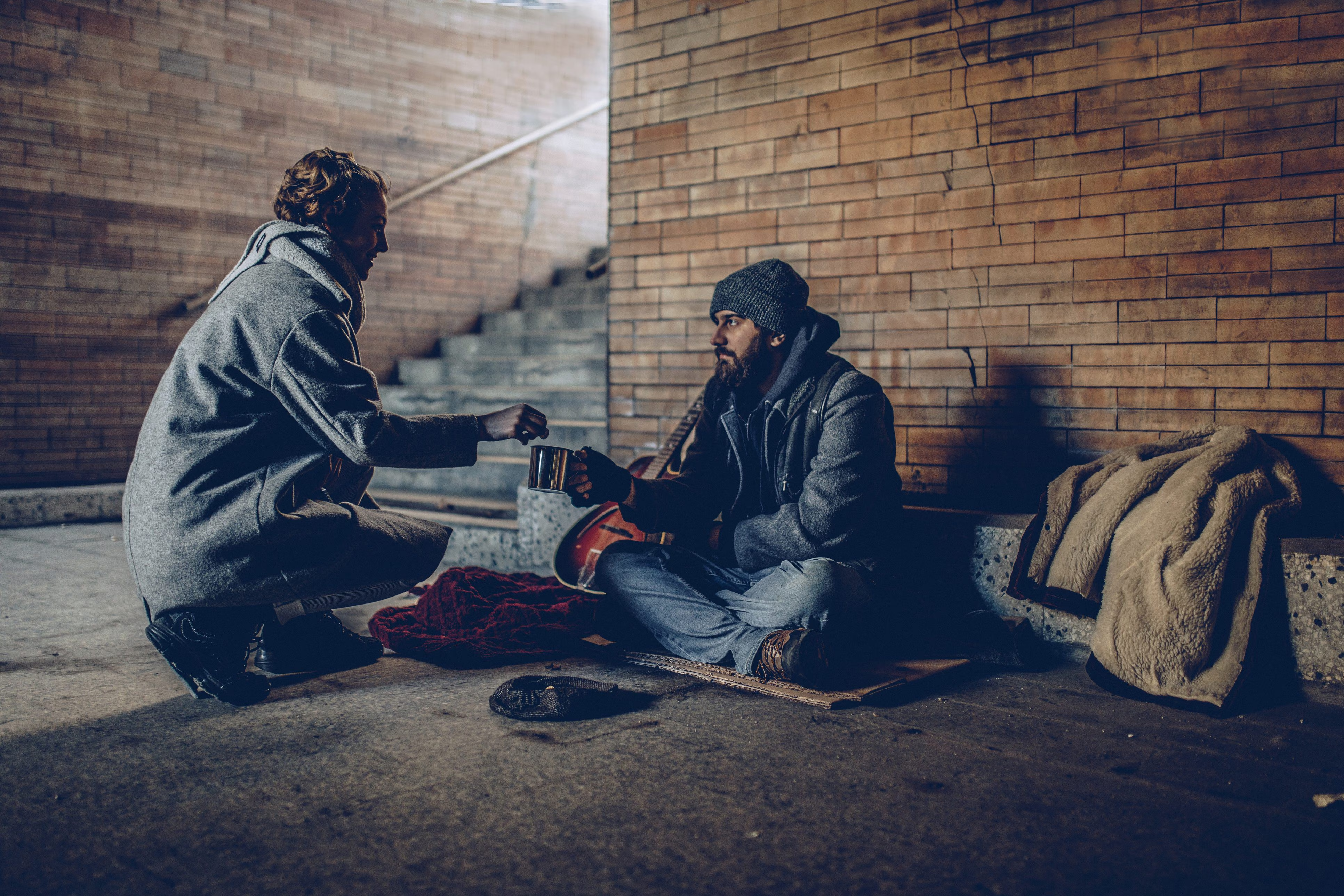
Via Modesta Valenti is the fictitious residence address established by the Municipality of Rome to allow the registration of homeless people or people in conditions of serious housing insecurity. This is a street that does not physically exist, but this paradox is only apparent: this address also allows those who do not live in a house to obtain residency and therefore equally access fundamental rights such as healthcare, identity documents and social services.
In Italy, the residence address is the key to access numerous rights such as:
- Register with the National Health Service (SSN) to have a general practitioner
Without residence, only first aid services are guaranteed, but not continuous assistance (family doctor, CSM, SERT, consultants). - Obtain or renew your identity card, which is also essential for opening a current account and protecting any savings.
- Access social assistance, and be able to take advantage of state bonuses and subsidies.
- Get pension and some other social security benefits
- Exercise your right to vote.
In other words, residency is not just a bureaucratic detail, but a tool for social inclusion. In fact, it doesn’t just mean receiving mail, but being able to exercise constitutional rights. On the contrary, without registration, a person risks finding himself trapped in a real administrative limbo.
The National Institute of Statistics, with Circular no. 29 of 1992, established that each Registry Office must also register homeless people in the resident population register. If there is no stable domicile, the Municipality must therefore establish a fictitious route, valid only for registry purposes, which allows access to the rights linked to residence.
For example, since 2022 in Rome there has been via Modesta Valenti, a virtual address in memory of Modesta Valenti, an elderly homeless woman who died in 1983 near the Rome Termini station after an ambulance refused to help her due to her precarious hygienic conditions. Naming the registered address of the homeless after her was a symbolic and civil gesture: transforming a story of exclusion into an instrument of protection.
On a practical level, on the documents of the Romans to whom this address is assigned, Via Modesta Valenti will appear as the street of residence, while the house number corresponds to the Municipality that issues the registration and the mail can be collected at the dedicated post detention service.
But who can register in Via Modesta Valenti?
In the Municipality of Rome, registration is foreseen for people in severe socio-housing conditions:
- Homeless people “in the strict sense”: those who, by choice or work, do not reside permanently in a place, such as itinerant artists, circus performers, itinerant artisans and wanderers.
- People in housing insecurity, such as:
- Homeless: people living on the streets, in makeshift accommodation or using dormitories and night shelters.
- Homeless: guests of reception centers for homeless people, women victims of violence, migrants, etc.
- Unsafe accommodation: people living in homes where they are at risk of domestic violence, when the situation is certified by judicial authorities.
However, Rome is not an isolated case. In many Italian cities, virtual ways have been established to allow registered residence for the homeless.
In March 2019, the Municipality of Alghero also adopted a fictitious street named after Modesta Valenti, while in other cities, the naming recalls other people linked to local stories. For example:
- In Bologna there is via Mariano Tuccella, dedicated to a homeless man who was savagely beaten by three boys while he slept on the street in the initial capital and died in 2007 after a few months in a coma.
- In Salerno and Torre del Greco we find Via Gli Amici di Jarek, in memory of a kindly mannered Polish homeless man who in 2013 suffered a sudden heart attack after leaving a night shelter.
- In Pistoia, via Remo Cerini was established, a poet who lived for a long time under the city’s loggias.
- In Reggio Calabria the virtual residence is via Filemon, named after the first child born in Casa Anawim (an apartment confiscated from the mafia which housed victims of violence)
Other Municipalities have instead chosen symbolic or institutional names such as “via del Comune”, “via dell’Anagrafe”, or evocative names such as “via della Speranza”, “via della Solidarietà”, “via dell’Accoglienza” but also “via delle Stelle”, “Strada della Fantasia”, “via della Fortuna”, “via Sogni di Gianni Rodari n.1000”.
Regardless of the name chosen, all these streets that do not exist on the map demonstrate how public administration can become a concrete tool of inclusion. Because without an address you risk losing much more than a house and a street, even if only symbolic, can make the difference between invisibility and citizenship.









